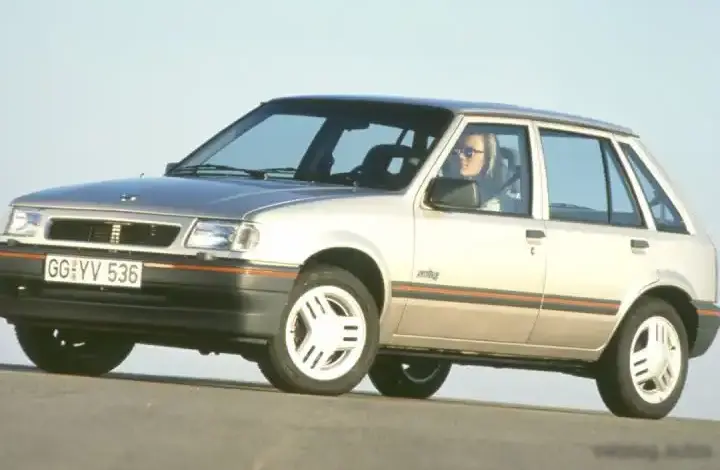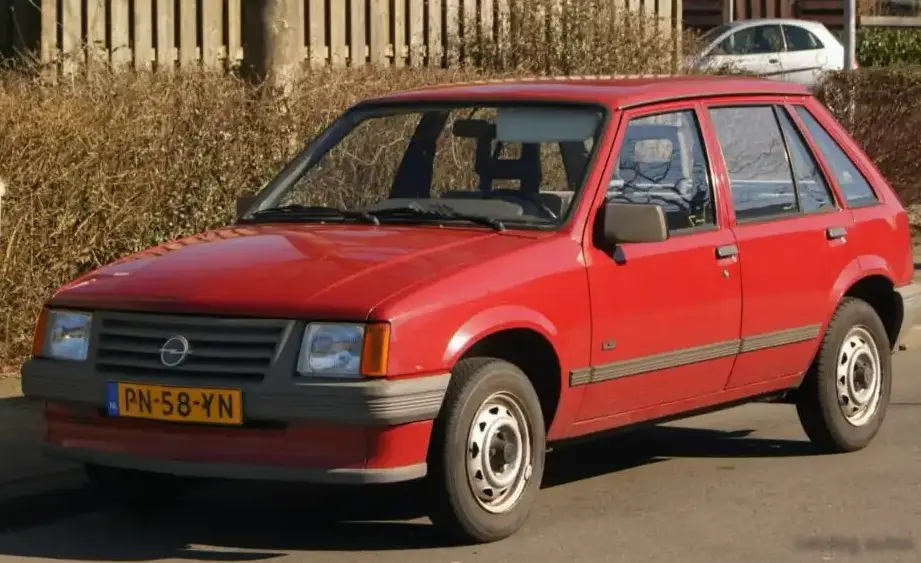
Technical Specifications
| Brand | Opel |
| Model | Corsa |
| Generation | Corsa A |
| Type (Engine) | 1.2 S (55 Hp) |
| Start of production | 1982 |
| End of production | 1983 |
| Powertrain Architecture | Internal Combustion engine |
| Body type | Hatchback |
| Seats | 5 |
| Doors | 3 |
| Fuel consumption (combined) | 6.9 l/100 km (34.1 US mpg, 40.9 UK mpg, 14.5 km/l) |
| Fuel Type | Petrol (Gasoline) |
| Acceleration 0 – 100 km/h | 16 sec |
| Acceleration 0 – 62 mph | 16 sec |
| Acceleration 0 – 60 mph | 15.2 sec |
| Maximum speed | 152 km/h (94.45 mph) |
| Weight-to-power ratio | 13.5 kg/Hp (74.3 Hp/tonne) |
| Weight-to-torque ratio | 8.2 kg/Nm (121.6 Nm/tonne) |
| Power | 55 Hp @ 5600 rpm |
| Power per litre | 46 Hp/l |
| Torque | 90 Nm @ 2200 rpm (66.38 lb.-ft. @ 2200 rpm) |
| Engine layout | Front, Transverse |
| Engine Model/Code | 12ST |
| Engine displacement | 1196 cm3 (72.98 cu. in.) |
| Number of cylinders | 4 |
| Engine configuration | Inline |
| Cylinder Bore | 77.8 mm (3.06 in.) |
| Piston Stroke | 62.9 mm (2.48 in.) |
| Compression ratio | 9.2:1 |
| Number of valves per cylinder | 2 |
| Fuel injection system | Carburettor |
| Engine aspiration | Naturally aspirated engine |
| Valvetrain | SOHC |
| Engine oil capacity | 3 l (3.17 US qt | 2.64 UK qt) |
| Coolant | 6.1 l (6.45 US qt | 5.37 UK qt) |
| Kerb Weight | 740 kg (1631.42 lbs.) |
| Max. weight | 1215 kg (2678.62 lbs.) |
| Max load | 475 kg (1047.2 lbs.) |
| Trunk (boot) space – minimum | 270 l (9.53 cu. ft.) |
| Trunk (boot) space – maximum | 1060 l (37.43 cu. ft.) |
| Fuel tank capacity | 42 l (11.1 US gal | 9.24 UK gal) |
| Length | 3622 mm (142.6 in.) |
| Width | 1532 mm (60.31 in.) |
| Height | 1365 mm (53.74 in.) |
| Wheelbase | 2343 mm (92.24 in.) |
| Front track | 1320 mm (51.97 in.) |
| Rear (Back) track | 1300 mm (51.18 in.) |
| Ride height (ground clearance) | 140 mm (5.51 in.) |
| Drag coefficient (Cd) | 0.36 |
| Minimum turning circle | 10 m (32.81 ft.) |
| Drivetrain Architecture | The Internal combustion engine (ICE) drives the front wheels of the vehicle. |
| Drive wheel | Front wheel drive |
| Number of gears and type of gearbox | 4 gears, manual transmission |
| Front brakes | Disc |
| Rear brakes | Drum |
| Tires size | 145/70 R13 |
| Wheel rims size | 13 |
The Opel Corsa A 1.2 S, launched in 1982, was a pivotal model for Opel, marking the transition to a modern, front-wheel-drive platform. It was designed to address the growing demand for smaller, more efficient vehicles in Europe, competing directly with rivals like the Fiat Uno, Renault 5, and Volkswagen Polo. The “S” designation indicated a slightly sportier trim level, though performance remained modest. The Corsa A represented a significant investment for Opel, replacing the aging Kadett C-based small cars and establishing a new identity for the brand in the supermini segment. Production continued until 1983, with subsequent updates and variations following throughout the Corsa A’s lifespan.
Powertrain & Engine Architecture
The heart of the Corsa A 1.2 S was the 12ST engine, a 1.2-liter (1196 cc) inline-four cylinder petrol engine. This engine utilized a single overhead camshaft (SOHC) valvetrain with two valves per cylinder. Crucially, the 1.2 S employed a carburetor for fuel delivery, a cost-saving measure typical of entry-level models of the era. This carburetor system, while simple and reliable, offered less precise fuel control compared to fuel injection systems. The engine produced 55 horsepower at 5600 rpm and 90 Nm (66.38 lb-ft) of torque at 2200 rpm. The engine was transversely mounted, driving the front wheels. The transmission was a four-speed manual gearbox, chosen for its simplicity and affordability. This configuration was typical for the base model Corsa A, prioritizing economy over performance.
Driving Characteristics
The Corsa A 1.2 S offered modest performance, reflecting its low horsepower output. Acceleration from 0 to 60 mph took approximately 15.2 seconds, and the top speed was around 94.45 mph. The four-speed manual transmission provided adequate gear spacing for city driving, but felt somewhat limited on the open road. The carburetor contributed to a slightly sluggish throttle response compared to fuel-injected counterparts. The suspension, tuned for comfort, provided a relatively smooth ride, but body roll was noticeable during cornering. Compared to higher-spec Corsa A models with larger engines (like the 1.3L or later 1.4L variants), the 1.2 S felt significantly underpowered. The manual gearbox allowed for greater driver control than the optional automatic transmission available on some Corsa A models, but the overall driving experience was geared towards practicality and fuel efficiency rather than sporty handling.
Equipment & Trim Levels
The Corsa A 1.2 S was positioned as a basic, affordable model, and its equipment level reflected this. Standard features typically included cloth upholstery, a basic instrument cluster, and manually operated windows and door locks. The interior was functional but spartan, with a focus on durability rather than luxury. Optional extras included a radio, upgraded seat fabrics, and a sunroof. The “S” trim level did offer a slightly more appealing aesthetic than the base model, often featuring color-coded bumpers and hubcaps. However, it lacked many of the convenience features found on higher-trim Corsa A variants.
Chassis & Braking
The Corsa A featured a MacPherson strut front suspension and a twist-beam rear suspension. The front brakes were disc brakes, providing adequate stopping power for the vehicle’s weight and performance. However, the rear brakes were drum brakes, a cost-saving measure that reduced braking effectiveness compared to disc brakes on all four wheels. The 1.2 S models typically had smaller tires (145/70 R13) mounted on 13-inch steel wheels. The suspension was tuned for comfort, prioritizing ride quality over sporty handling. A stabilizer bar was often omitted on the base models to further reduce costs.
Market Reception & Comparison
The Corsa A 1.2 S was generally well-received as an affordable and economical city car. Critics praised its fuel efficiency and ease of driving, but noted its lack of power and refinement. Compared to other superminis of the time, the Corsa A 1.2 S offered a competitive price point, but its performance lagged behind some rivals. The 1.3L and later 1.4L Corsa A models offered significantly more power and a more enjoyable driving experience, but at a higher cost. The 1.2 S appealed to buyers who prioritized economy and practicality over performance and features.
Legacy
The Opel Corsa A 1.2 S, while not a performance icon, played a crucial role in establishing the Corsa as a successful model line for Opel. The 12ST engine, while simple, proved to be relatively reliable, and many examples remain on the road today. The Corsa A’s front-wheel-drive layout and modern design paved the way for future generations of the Corsa. In the used car market, the 1.2 S is often sought after by enthusiasts looking for a classic, affordable, and easy-to-maintain city car. Its simplicity and low running costs make it an attractive option for those seeking a nostalgic driving experience.