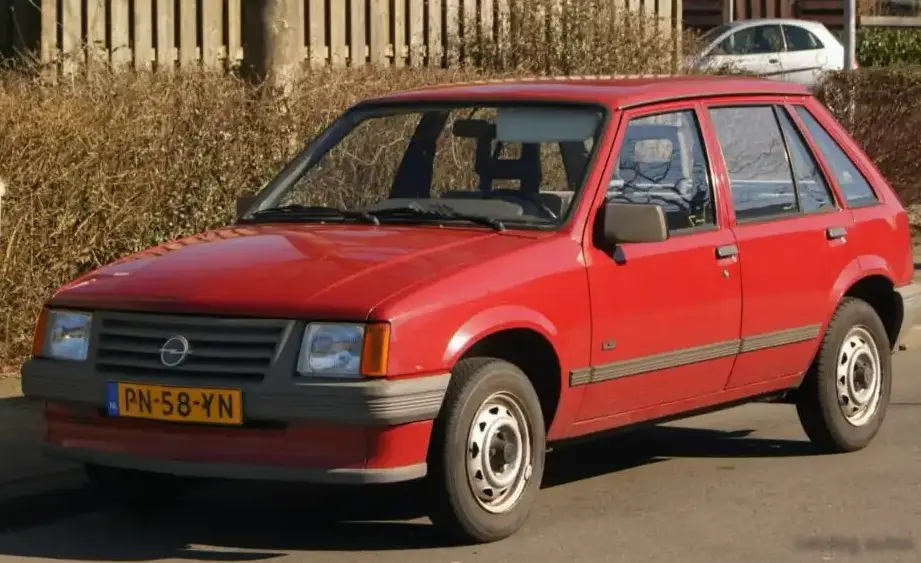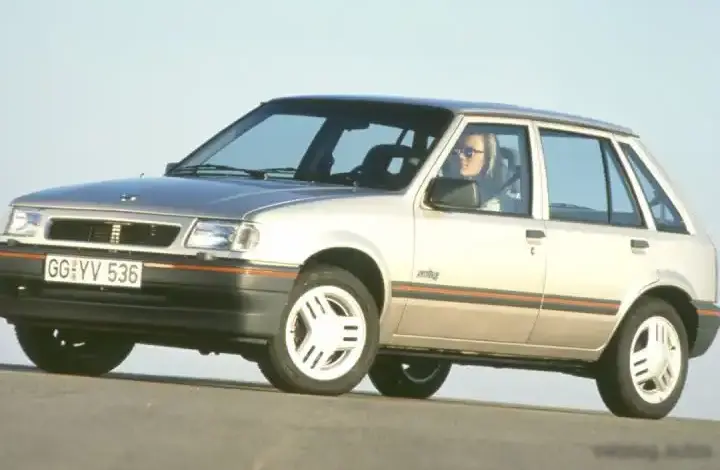
The Opel Corsa A 1.6 GSi, produced from 1988 to 1990, represented a performance-oriented variant within the first generation Corsa (A) lineup. Following the 1987 facelift, the GSi model aimed to provide a sportier driving experience compared to the base Corsa trims. Positioned as the top-of-the-line offering, it featured a more powerful engine, upgraded suspension, and distinctive styling cues. The Corsa A, launched in 1982, was Opel’s entry into the supermini segment, intended to replace the aging Kadett C. The 1.6 GSi specifically targeted drivers seeking a fun-to-drive, economical hatchback with a touch of sporting flair, primarily in European markets.
Technical Specifications
| Brand | Opel |
| Model | Corsa |
| Generation | Corsa A (facelift 1987) |
| Type (Engine) | 1.6 GSi (100 Hp) |
| Start of production | 1988 |
| End of production | 1990 |
| Powertrain Architecture | Internal Combustion engine |
| Body type | Hatchback |
| Seats | 5 |
| Doors | 3 |
| Fuel consumption (combined) | 7.5 l/100 km |
| Fuel consumption (US mpg) | 31.4 US mpg |
| Fuel consumption (UK mpg) | 37.7 UK mpg |
| Fuel consumption (km/l) | 13.3 km/l |
| Fuel Type | Petrol (Gasoline) |
| Acceleration 0 – 100 km/h | 9.5 sec |
| Acceleration 0 – 62 mph | 9.5 sec |
| Acceleration 0 – 60 mph | 9 sec |
| Maximum speed | 188 km/h (116.82 mph) |
| Weight-to-power ratio | 8.2 kg/Hp |
| Weight-to-torque ratio | 6.1 kg/Nm |
| Power | 100 Hp @ 5600 rpm |
| Power per litre | 62.6 Hp/l |
| Torque | 135 Nm @ 3400 rpm (99.57 lb.-ft. @ 3400 rpm) |
| Engine layout | Front, Transverse |
| Engine Model/Code | E16SE |
| Engine displacement | 1598 cm3 (97.52 cu. in.) |
| Number of cylinders | 4 |
| Engine configuration | Inline |
| Cylinder Bore | 80 mm (3.15 in.) |
| Piston Stroke | 79.5 mm (3.13 in.) |
| Compression ratio | 10:1 |
| Number of valves per cylinder | 2 |
| Fuel injection system | Multi-port manifold injection |
| Engine aspiration | Naturally aspirated engine |
| Valvetrain | SOHC |
| Engine oil capacity | 3.5 l (3.7 US qt | 3.08 UK qt) |
| Coolant capacity | 6.4 l (6.76 US qt | 5.63 UK qt) |
| Kerb Weight | 820 kg (1807.79 lbs.) |
| Max. weight | 1260 kg (2777.82 lbs.) |
| Max load | 440 kg (970.03 lbs.) |
| Trunk (boot) space – minimum | 270 l (9.53 cu. ft.) |
| Trunk (boot) space – maximum | 1060 l (37.43 cu. ft.) |
| Fuel tank capacity | 42 l (11.1 US gal | 9.24 UK gal) |
| Permitted trailer load with brakes (12%) | 800 kg (1763.7 lbs.) |
| Permitted trailer load without brakes | 400 kg (881.85 lbs.) |
| Length | 3622 mm (142.6 in.) |
| Width | 1532 mm (60.31 in.) |
| Height | 1365 mm (53.74 in.) |
| Wheelbase | 2343 mm (92.24 in.) |
| Front track | 1320 mm (51.97 in.) |
| Rear (Back) track | 1307 mm (51.46 in.) |
| Ride height (ground clearance) | 140 mm (5.51 in.) |
| Drag coefficient (Cd) | 0.35 |
| Minimum turning circle (turning diameter) | 10 m (32.81 ft.) |
| Drivetrain Architecture | The Internal combustion engine (ICE) drives the front wheels of the vehicle. |
| Drive wheel | Front wheel drive |
| Number of gears and type of gearbox | 5 gears, manual transmission |
| Front brakes | Ventilated discs |
| Rear brakes | Drum |
| Tires size | 175/65 R14 |
| Wheel rims size | 14 |
Introduction
The Opel Corsa A 1.6 GSi, produced between 1988 and 1990, was a key variant in the facelifted first generation of the Corsa. Building upon the foundation laid by the initial Corsa A launch in 1982, the GSi offered a more engaging driving experience and a sportier aesthetic. It occupied the premium position within the Corsa A range, appealing to buyers who desired a small, practical hatchback with a bit more performance. The Corsa A, and subsequently the 1.6 GSi, was primarily marketed in Europe, where it competed with rivals like the Peugeot 205, Renault Clio, and Volkswagen Polo.
Powertrain & Engine Architecture
The heart of the Corsa 1.6 GSi was the E16SE engine, a 1.6-liter inline-four cylinder gasoline engine. This engine produced 100 horsepower at 5600 rpm and 135 Nm (99.57 lb-ft) of torque at 3400 rpm. The E16SE featured a single overhead camshaft (SOHC) valvetrain with two valves per cylinder. Fuel delivery was managed by a multi-port fuel injection system, contributing to improved efficiency and responsiveness compared to earlier carbureted Opel engines. The engine’s transverse mounting and front-wheel-drive configuration were typical for vehicles in this class. The GSi was exclusively offered with a five-speed manual transmission, designed to maximize the engine’s potential and provide a more connected driving experience. This transmission featured gear ratios optimized for both acceleration and fuel economy.
Driving Characteristics
The Corsa 1.6 GSi offered a noticeable step up in performance compared to the lower-spec Corsa models. The 100 hp engine, while not exceptionally powerful by modern standards, provided brisk acceleration for a vehicle of its size and weight. Acceleration from 0 to 60 mph was achieved in approximately 9.5 seconds, and it could reach a top speed of 116.82 mph. The five-speed manual transmission allowed drivers to keep the engine in its optimal power band, enhancing responsiveness. The GSi’s suspension was also tuned for a sportier feel, offering improved handling and reduced body roll compared to the standard Corsa. While not a dedicated sports car, the 1.6 GSi provided a fun and engaging driving experience, particularly on winding roads.
Equipment & Trim Levels
The Corsa 1.6 GSi came equipped with a range of features designed to enhance both comfort and style. Standard equipment typically included upgraded cloth upholstery, a sporty three-spoke steering wheel, and a more comprehensive instrument cluster. Exterior features included distinctive GSi badging, a rear spoiler, and often, alloy wheels. Optional extras could include power windows, central locking, and a sunroof. The interior design, while functional, was relatively basic by today’s standards, but it offered a comfortable and practical environment for both driver and passengers.
Chassis & Braking
The Corsa A 1.6 GSi utilized a MacPherson strut front suspension and a twist-beam rear suspension. This setup provided a good balance between ride comfort and handling. The front brakes were ventilated discs, offering superior stopping power compared to the drum brakes found on the rear. The GSi also featured a slightly thicker stabilizer bar compared to the base Corsa models, further reducing body roll during cornering. The steering was a rack-and-pinion system, providing precise and responsive control.
Market Reception & Comparison
The Corsa 1.6 GSi was generally well-received by automotive critics, who praised its lively performance and engaging handling. It was often seen as a more appealing alternative to some of its rivals, offering a good balance of practicality, affordability, and driving enjoyment. Compared to the base Corsa models, the 1.6 GSi offered a significant performance upgrade, but it came at a higher price. Compared to other sporty small hatchbacks of the era, such as the Peugeot 205 GTI, the Corsa GSi offered a more accessible and affordable option, albeit with slightly less outright performance. Fuel economy was reasonable for the time, averaging around 31.4 US mpg.
Legacy
The Opel Corsa A 1.6 GSi has become a popular classic car among enthusiasts. The E16SE engine is known for its reliability and relatively simple maintenance requirements. While age and mileage can affect the condition of these vehicles, many examples remain on the road today. The Corsa GSi is often appreciated for its affordability, its nostalgic appeal, and its enjoyable driving characteristics. In the used car market, well-maintained examples of the 1.6 GSi can command a premium, particularly those with low mileage and original features. It represents a significant chapter in Opel’s history and a reminder of a time when small hatchbacks were all about fun and practicality.