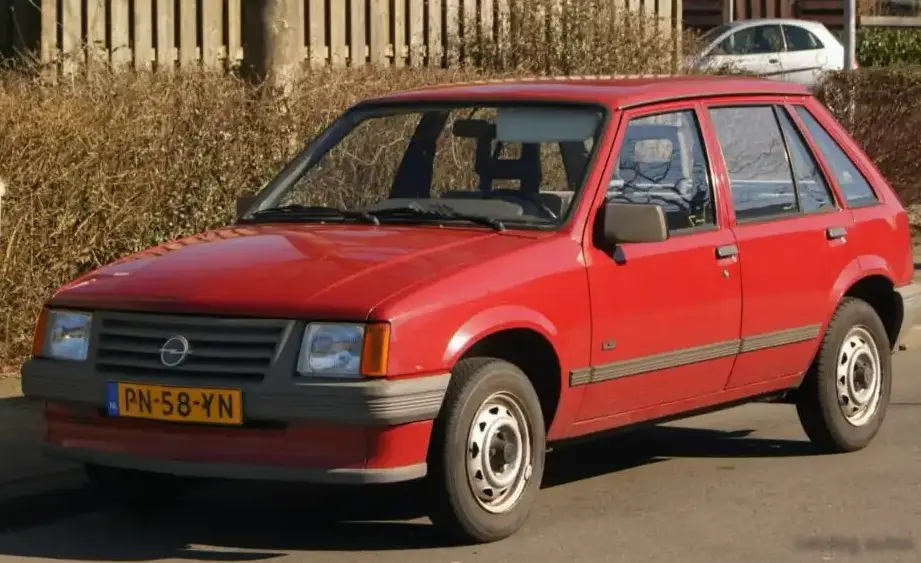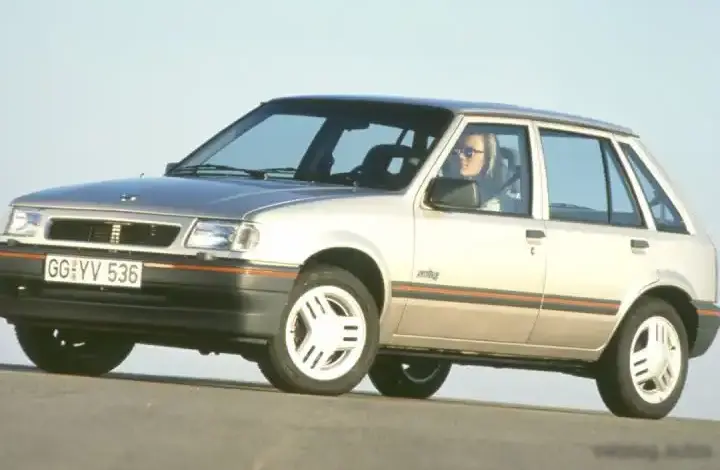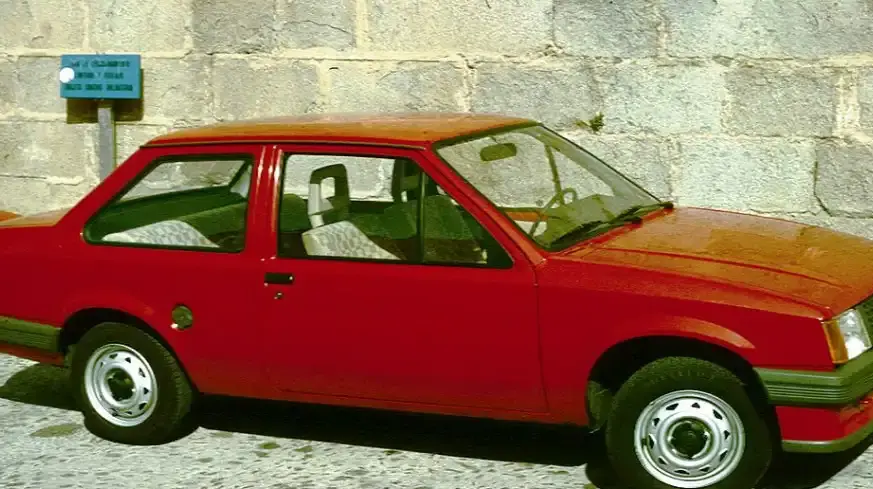
The Opel Corsa A Sedan 1.0, producing 45 horsepower, was a foundational model within the first generation of the Corsa A, manufactured between 1982 and 1987. Positioned as the entry-level variant of the Corsa A Sedan range, it served as an affordable and economical option for buyers, particularly in European markets. This model represented Opel’s attempt to compete in the burgeoning small car segment, offering a practical and compact vehicle for urban commuting and family use. The Corsa A, overall, was a significant departure for Opel, moving away from rear-wheel drive designs to a more modern front-wheel drive layout.
Technical Specifications
| Brand | Opel |
| Model | Corsa |
| Generation | Corsa A Sedan |
| Type (Engine) | 1.0 (45 Hp) |
| Start of production | 1982 |
| End of production | 1987 |
| Powertrain Architecture | Internal Combustion engine |
| Body type | Sedan |
| Seats | 5 |
| Doors | 2 |
| Fuel consumption (combined) | 6.7 l/100 km (35.1 US mpg, 42.2 UK mpg, 14.9 km/l) |
| Fuel Type | Petrol (Gasoline) |
| Acceleration 0 – 100 km/h | 19.5 sec |
| Acceleration 0 – 62 mph | 19.5 sec |
| Acceleration 0 – 60 mph | 18.5 sec |
| Maximum speed | 140 km/h (86.99 mph) |
| Weight-to-power ratio | 16.4 kg/Hp (60.8 Hp/tonne) |
| Weight-to-torque ratio | 10.9 kg/Nm (91.9 Nm/tonne) |
| Power | 45 Hp @ 5400 rpm |
| Power per litre | 45.3 Hp/l |
| Torque | 68 Nm @ 2600-3800 rpm (50.15 lb.-ft. @ 2600-3800 rpm) |
| Engine layout | Front, Transverse |
| Engine Model/Code | 10S |
| Engine displacement | 993 cm3 (60.6 cu. in.) |
| Number of cylinders | 4 |
| Engine configuration | Inline |
| Cylinder Bore | 72 mm (2.83 in.) |
| Piston Stroke | 61 mm (2.4 in.) |
| Compression ratio | 9.2:1 |
| Number of valves per cylinder | 2 |
| Fuel injection system | Carburettor |
| Engine aspiration | Naturally aspirated engine |
| Valvetrain | OHV |
| Engine oil capacity | 2.75 l (2.91 US qt | 2.42 UK qt) |
| Coolant | 5.5 l (5.81 US qt | 4.84 UK qt) |
| Kerb Weight | 740 kg (1631.42 lbs.) |
| Max. weight | 1215 kg (2678.62 lbs.) |
| Max load | 475 kg (1047.2 lbs.) |
| Trunk (boot) space – minimum | 430 l (15.19 cu. ft.) |
| Fuel tank capacity | 42 l (11.1 US gal | 9.24 UK gal) |
| Length | 3955 mm (155.71 in.) |
| Width | 1540 mm (60.63 in.) |
| Height | 1360 mm (53.54 in.) |
| Wheelbase | 2343 mm (92.24 in.) |
| Front track | 1320 mm (51.97 in.) |
| Rear (Back) track | 1300 mm (51.18 in.) |
| Ride height (ground clearance) | 140 mm (5.51 in.) |
| Drag coefficient (Cd) | 0.38 |
| Minimum turning circle | 10 m (32.81 ft.) |
| Drivetrain Architecture | The Internal combustion engine (ICE) drives the front wheels of the vehicle. |
| Drive wheel | Front wheel drive |
| Number of gears and type of gearbox | 4 gears, manual transmission |
| Front suspension | Coil spring |
| Rear suspension | Coil spring |
| Front brakes | Disc |
| Rear brakes | Drum |
| Assisting systems | ABS (Anti-lock braking system) |
| Steering type | Steering rack and pinion |
| Tires size | 165/65 R14 |
| Wheel rims size | 5J x 14 |
Powertrain & Engine Architecture
The Corsa A Sedan 1.0 was powered by the 10S engine, a 993cc inline-four cylinder engine. This engine utilized a single overhead valve (OHV) valvetrain and a carburetor for fuel delivery. The 10S engine was known for its simplicity and durability, but it was not a powerhouse. Its 45 horsepower output at 5400 rpm and 68 Nm (50.15 lb-ft) of torque at 2600-3800 rpm were modest, even for the early 1980s. The engine’s design prioritized fuel economy over performance. The four-speed manual transmission was the standard offering, designed to maximize the limited power available. The transverse engine layout, a relatively new feature for Opel at the time, contributed to the Corsa’s compact dimensions and improved interior space.
Driving Characteristics
The driving experience in the Corsa A Sedan 1.0 was characterized by its light steering and nimble handling, typical of small, front-wheel-drive cars. However, the 45 horsepower engine meant acceleration was slow. 0-60 mph took approximately 18.5 seconds, and top speed was limited to around 87 mph. The four-speed gearbox had relatively long gear ratios, further emphasizing fuel economy over spirited driving. Compared to later Corsa A variants, such as those equipped with the 1.2 or 1.4-liter engines, the 1.0-liter model felt significantly underpowered, especially when carrying passengers or cargo. The manual transmission, while basic, provided a direct connection to the engine, allowing drivers to make the most of the available power.
Equipment & Trim Levels
The Corsa A Sedan 1.0 was typically offered with a basic level of equipment, reflecting its position as the entry-level model. Standard features generally included cloth upholstery, a basic instrument cluster, and manual windows and door locks. Optional extras, such as a radio, upgraded interior trim, and a sunroof, were available, but these added to the vehicle’s cost. The interior design was functional and utilitarian, prioritizing practicality over luxury. The trim levels were relatively simple, with limited customization options available.
Chassis & Braking
The Corsa A Sedan featured a simple chassis design with coil spring suspension at both the front and rear. The front brakes were disc brakes, providing adequate stopping power for the vehicle’s weight and performance. However, the rear brakes were drum brakes, which were less effective than disc brakes. The steering was a rack and pinion system, offering precise and responsive handling. The relatively lightweight construction of the Corsa A Sedan (740 kg or 1631 lbs) helped to offset the engine’s limited power, contributing to its nimble handling characteristics.
Market Reception & Comparison
The Opel Corsa A Sedan 1.0 was generally well-received as an affordable and economical small car. Critics praised its fuel efficiency and nimble handling, but noted its lack of power. Compared to other small cars of the era, such as the Fiat Uno and the Renault 5, the Corsa A Sedan 1.0 offered a competitive package in terms of price and practicality. However, its performance was generally inferior to that of its rivals. The 1.2 and 1.4-liter Corsa A variants offered significantly improved performance, but at a higher price point.
Legacy
The Opel Corsa A Sedan 1.0, while not a performance icon, played a crucial role in establishing the Corsa as a popular and reliable small car. The 10S engine, despite its modest output, proved to be durable and relatively trouble-free. Today, the Corsa A Sedan 1.0 is a relatively rare sight on the roads, but it remains a popular choice among classic car enthusiasts and collectors. Its simplicity, affordability, and fuel efficiency continue to appeal to those seeking a classic small car experience. Parts availability can be a challenge, but the Corsa A’s robust design and widespread production numbers mean that many components are still obtainable.