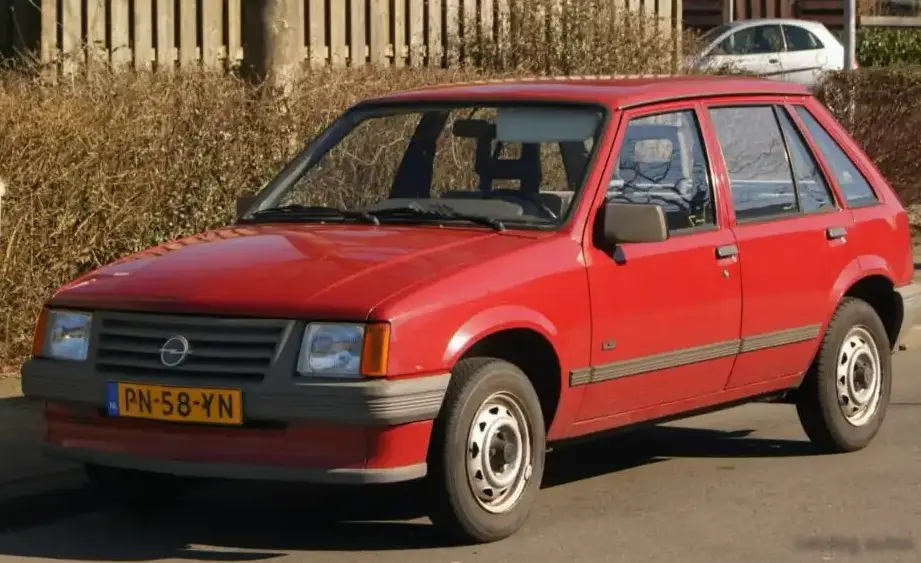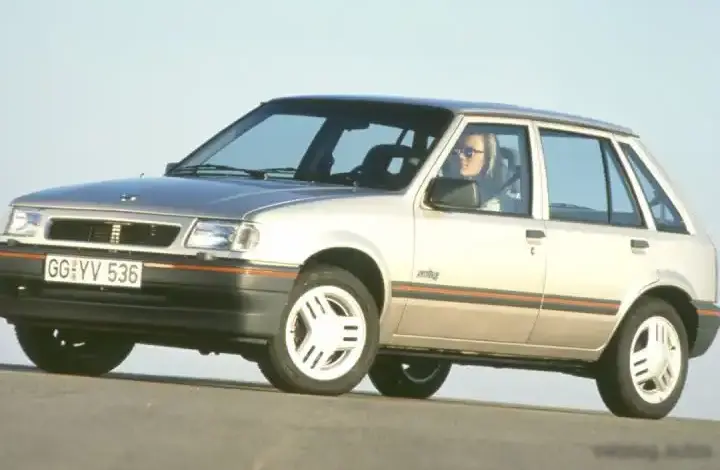
The Opel Corsa A Sedan (facelifted in 1987) powered by the 1.3i engine producing 60 horsepower represents an entry-level offering within the broader Corsa A range, produced from 1987 to 1990. This variant was primarily aimed at budget-conscious buyers seeking economical transportation in the European market. The Corsa A, as a whole, was Opel’s attempt to compete in the burgeoning supermini segment, replacing the aging Kadett. The sedan body style, while less common than the hatchback, offered a more traditional appearance and a slightly larger trunk capacity, appealing to a different segment of the market. This specific 1.3i configuration served as the base model, offering a balance between affordability and practicality.
Technical Specifications
| Brand | Opel |
| Model | Corsa |
| Generation | Corsa A Sedan (facelift 1987) |
| Type (Engine) | 1.3i (60 Hp) |
| Start of production | 1987 |
| End of production | 1990 |
| Powertrain Architecture | Internal Combustion engine |
| Body type | Sedan |
| Seats | 5 |
| Doors | 4 |
| Fuel consumption (combined) | 7.1 l/100 km (33.1 US mpg, 39.8 UK mpg, 14.1 km/l) |
| Fuel Type | Petrol (Gasoline) |
| Acceleration 0 – 100 km/h | 15 sec |
| Acceleration 0 – 62 mph | 15 sec |
| Acceleration 0 – 60 mph | 14.3 sec |
| Maximum speed | 155 km/h (96.31 mph) |
| Weight-to-power ratio | 12.9 kg/Hp, 77.4 Hp/tonne |
| Weight-to-torque ratio | 8.1 kg/Nm, 123.9 Nm/tonne |
| Power | 60 Hp @ 5600 rpm |
| Power per litre | 46.3 Hp/l |
| Torque | 96 Nm @ 3400 rpm (70.81 lb.-ft. @ 3400 rpm) |
| Engine layout | Front, Transverse |
| Engine Model/Code | C13N |
| Engine displacement | 1297 cm3 (79.15 cu. in.) |
| Number of cylinders | 4 |
| Engine configuration | Inline |
| Cylinder Bore | 75 mm (2.95 in.) |
| Piston Stroke | 73.4 mm (2.89 in.) |
| Compression ratio | 9:1 |
| Number of valves per cylinder | 2 |
| Fuel injection system | Multi-port manifold injection |
| Engine aspiration | Naturally aspirated engine |
| Valvetrain | SOHC |
| Engine oil capacity | 3 l (3.17 US qt | 2.64 UK qt) |
| Coolant | 6.1 l (6.45 US qt | 5.37 UK qt) |
| Kerb Weight | 775 kg (1708.58 lbs.) |
| Max. weight | 1255 kg (2766.8 lbs.) |
| Max load | 480 kg (1058.22 lbs.) |
| Trunk (boot) space – minimum | 430 l (15.19 cu. ft.) |
| Fuel tank capacity | 42 l (11.1 US gal | 9.24 UK gal) |
| Permitted trailer load with brakes (12%) | 750 kg (1653.47 lbs.) |
| Permitted trailer load without brakes | 400 kg (881.85 lbs.) |
| Length | 3955 mm (155.71 in.) |
| Width | 1540 mm (60.63 in.) |
| Height | 1360 mm (53.54 in.) |
| Wheelbase | 2343 mm (92.24 in.) |
| Front track | 1320 mm (51.97 in.) |
| Rear (Back) track | 1300 mm (51.18 in.) |
| Ride height (ground clearance) | 140 mm (5.51 in.) |
| Drag coefficient (Cd) | 0.38 |
| Minimum turning circle (turning diameter) | 10 m (32.81 ft.) |
| Drivetrain Architecture | The Internal combustion engine (ICE) drives the front wheels of the vehicle. |
| Drive wheel | Front wheel drive |
| Number of gears and type of gearbox | 5 gears, manual transmission |
| Front brakes | Disc |
| Rear brakes | Drum |
| Tires size | 145/70 R13 |
| Wheel rims size | 13 |
Powertrain & Engine Architecture
The heart of this Corsa A variant is the Opel C13N engine, a 1.3-liter inline-four cylinder gasoline engine. This engine, a mainstay of Opel’s small car offerings for many years, featured a single overhead camshaft (SOHC) valvetrain with two valves per cylinder. The C13N utilized multi-port fuel injection, a relatively modern feature for its time, contributing to improved fuel efficiency and smoother operation compared to carbureted engines. The engine’s 9:1 compression ratio was a compromise between performance and the ability to run on the available fuel grades in Europe. The engine was transversely mounted, driving the front wheels. The transmission was a standard five-speed manual gearbox, chosen for its affordability and efficiency. While an automatic transmission was offered on some Corsa A models, it was not typically paired with the base 1.3i engine.
Driving Characteristics
The 1.3i Corsa A Sedan, with its 60 horsepower, was not designed for outright speed. Acceleration was modest, taking around 15 seconds to reach 62 mph (100 km/h). However, it provided adequate performance for urban driving and shorter journeys. The five-speed manual transmission allowed drivers to keep the engine in its optimal power band, maximizing efficiency and responsiveness. Compared to the more powerful 1.4 and 1.6-liter versions, the 1.3i felt noticeably slower, particularly when fully loaded or climbing hills. The gear ratios were tuned for economy rather than performance, resulting in a relatively relaxed driving experience. Steering was light and easy, making it maneuverable in city traffic. The suspension, while basic, provided a reasonably comfortable ride, absorbing most road imperfections without excessive body roll.
Equipment & Trim Levels
The 1.3i Corsa A Sedan was typically offered with a fairly basic level of equipment. Standard features generally included cloth upholstery, a simple dashboard layout with analog gauges, and manual windows and door locks. Power steering was not usually standard on this base model. Optional extras included a radio, upgraded interior trim, and occasionally, a sunroof. The interior was functional and durable, prioritizing practicality over luxury. The sedan body style offered a slightly larger trunk than the hatchback, providing more space for luggage or groceries. Trim levels were relatively limited, with most variations stemming from the addition of optional equipment packages.
Chassis & Braking
The Corsa A Sedan utilized a relatively simple chassis design. The front suspension consisted of MacPherson struts, while the rear suspension employed a twist-beam axle. This setup provided a good balance between ride comfort and handling. Brakes were disc brakes on the front wheels and drum brakes on the rear. This configuration was common for cars in this price range during the late 1980s. The braking system was adequate for normal driving conditions, but lacked the stopping power of more sophisticated setups found on higher-end vehicles. Stabilizer bars were often omitted on the base 1.3i model to further reduce costs.
Market Reception & Comparison
The 1.3i Corsa A Sedan was generally well-received as an affordable and reliable small car. Critics praised its fuel efficiency and practicality, but noted its lack of performance. Compared to rivals like the Ford Fiesta and Volkswagen Polo, the Corsa A offered a competitive price point and a relatively spacious interior. The 1.4 and 1.6-liter Corsa variants offered significantly more performance, but at a higher cost. The 1.5 diesel version provided even better fuel economy, but with considerably less power. The 1.3i model appealed to buyers who prioritized economy and practicality over driving excitement.
Legacy
The Opel Corsa A, including the 1.3i variant, established the Corsa nameplate as a significant player in the European supermini market. The C13N engine proved to be a durable and reliable unit, and many examples are still on the road today. While not particularly sought after by collectors, the 1.3i Corsa A Sedan represents a practical and affordable classic car, offering a glimpse into the automotive landscape of the late 1980s. Its simplicity and relatively low maintenance costs make it an appealing option for enthusiasts and budget-conscious drivers alike. The Corsa A laid the foundation for subsequent generations of Corsas, which have continued to be popular choices in Europe and beyond.