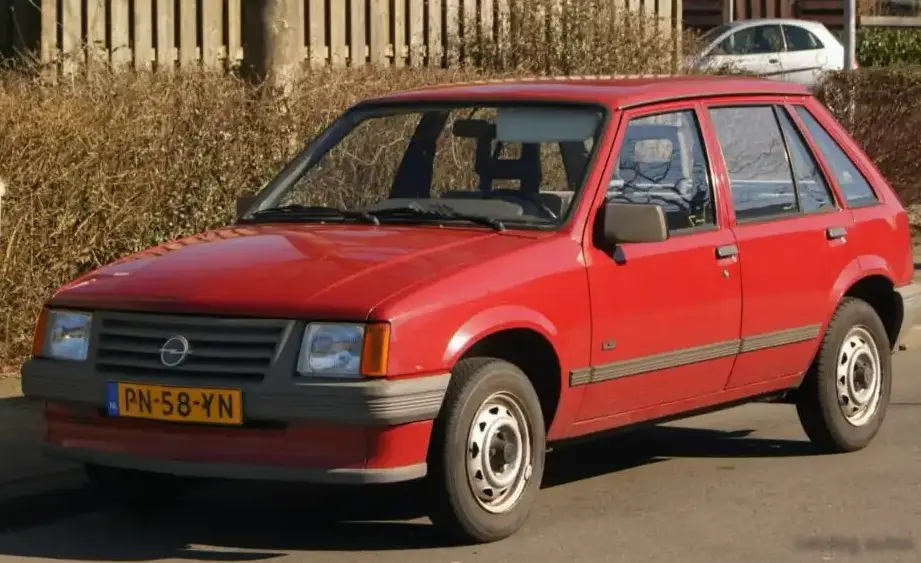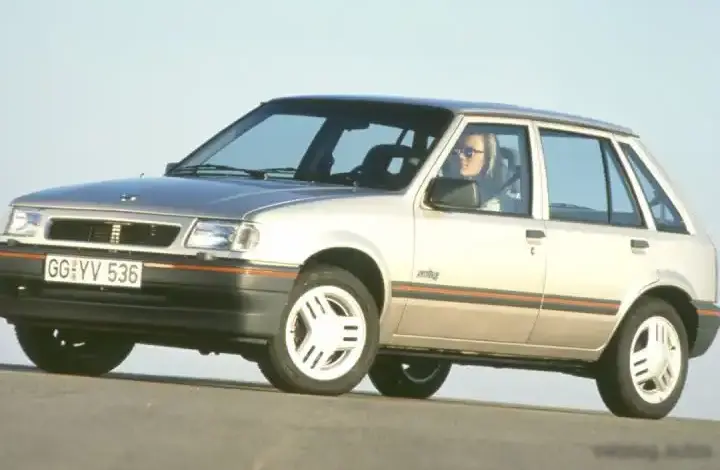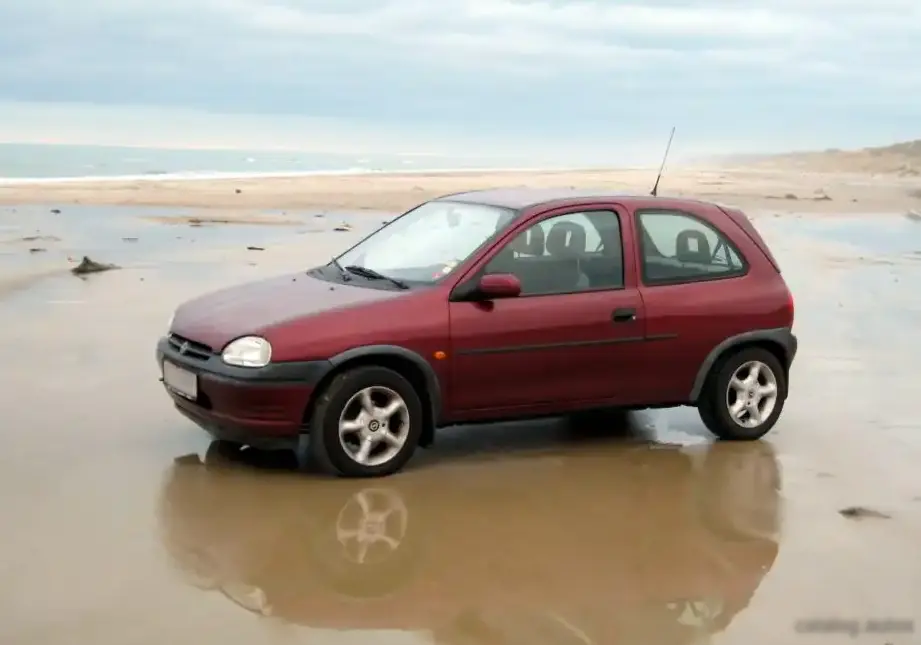
The Opel Corsa B 1.2i, producing 45 horsepower, was an entry-level variant of the Corsa B generation, manufactured between March 1993 and February 1997. Positioned as the most affordable option in the lineup, it served as a practical and economical choice for first-time car buyers and city commuters, particularly in European markets. The Corsa B, internally designated as the 1HX0/A3 platform, represented a significant step forward for Opel in the supermini segment, offering improved styling, safety, and refinement compared to its predecessor. This specific 1.2-liter engine and five-speed manual transmission combination was a mainstay of the range, prioritizing fuel efficiency over outright performance.
Technical Specifications
| Brand | Opel |
| Model | Corsa |
| Generation | Corsa B |
| Type (Engine) | 1.2i (45 Hp) |
| Start of production | March, 1993 |
| End of production | February, 1997 |
| Powertrain Architecture | Internal Combustion engine |
| Body type | Hatchback |
| Seats | 5 |
| Doors | 3-5 |
| Fuel consumption (urban) | 7.2 l/100 km (32.7 US mpg, 39.2 UK mpg, 13.9 km/l) |
| Fuel consumption (extra urban) | 4.4 l/100 km (53.5 US mpg, 64.2 UK mpg, 22.7 km/l) |
| Fuel consumption (combined) | 6.2 l/100 km (37.9 US mpg, 45.6 UK mpg, 16.1 km/l) |
| CO2 emissions | 140 g/km |
| Fuel Type | Petrol (Gasoline) |
| Acceleration 0 – 100 km/h | 20 sec |
| Acceleration 0 – 62 mph | 20 sec |
| Acceleration 0 – 60 mph | 19 sec |
| Maximum speed | 145 km/h (90.1 mph) |
| Weight-to-power ratio | 18.8 kg/Hp, 53.3 Hp/tonne |
| Weight-to-torque ratio | 9.6 kg/Nm, 104.1 Nm/tonne |
| Power | 45 Hp @ 4600-5000 rpm |
| Power per litre | 37.6 Hp/l |
| Torque | 88 Nm @ 2800 rpm (64.91 lb.-ft. @ 2800 rpm) |
| Engine layout | Front, Transverse |
| Engine Model/Code | C12NZ, X12SZ |
| Engine displacement | 1196 cm3 (72.98 cu. in.) |
| Number of cylinders | 4 |
| Engine configuration | Inline |
| Cylinder Bore | 72 mm (2.83 in.) |
| Piston Stroke | 73.4 mm (2.89 in.) |
| Compression ratio | 10:1 |
| Number of valves per cylinder | 2 |
| Fuel injection system | Single-point injection |
| Engine aspiration | Naturally aspirated engine |
| Engine oil capacity | 3.5 l (3.7 US qt | 3.08 UK qt) |
| Coolant | 5.9 l (6.23 US qt | 5.19 UK qt) |
| Kerb Weight | 845 kg (1862.91 lbs.) |
| Max. weight | 1340 kg (2954.19 lbs.) |
| Max load | 495 kg (1091.29 lbs.) |
| Trunk (boot) space – minimum | 260 l (9.18 cu. ft.) |
| Trunk (boot) space – maximum | 1050 l (37.08 cu. ft.) |
| Fuel tank capacity | 46 l (12.15 US gal | 10.12 UK gal) |
| Length | 3740 mm (147.24 in.) |
| Width | 1610 mm (63.39 in.) |
| Height | 1420 mm (55.91 in.) |
| Wheelbase | 2445 mm (96.26 in.) |
| Front track | 1385 mm (54.53 in.) |
| Rear (Back) track | 1390 mm (54.72 in.) |
| Ride height (ground clearance) | 140 mm (5.51 in.) |
| Drag coefficient (Cd) | 0.35 |
| Drivetrain Architecture | The Internal combustion engine (ICE) drives the front wheels of the vehicle. |
| Drive wheel | Front wheel drive |
| Number of gears and type of gearbox | 5 gears, manual transmission |
| Front suspension | Coil spring |
| Rear suspension | Coil spring |
| Front brakes | Disc |
| Rear brakes | Drum |
| Steering type | Steering rack and pinion |
| Tires size | 165/70 R13 |
| Wheel rims size | 5J x 13 |
Powertrain & Engine Architecture
The Corsa B 1.2i was powered by the Opel C12NZ or X12SZ engine, a 1.2-liter (1196 cc) inline-four cylinder petrol engine. This engine featured a single overhead camshaft (SOHC) and two valves per cylinder. The C12NZ was the earlier version, while the X12SZ incorporated minor revisions. Both engines utilized a single-point fuel injection system, which, while cost-effective, was less efficient and offered less precise fuel delivery compared to multi-point injection systems found in higher-spec Corsa B models. The engine’s relatively low compression ratio of 10:1 contributed to its ability to run on lower octane fuel, common in many European markets. The five-speed manual transmission was the standard offering, providing a relatively long-legged gearing setup designed for fuel economy rather than rapid acceleration.
Driving Characteristics
The 45 horsepower output and 88 Nm (65 lb-ft) of torque meant the Corsa B 1.2i was not a performance-oriented vehicle. Acceleration from 0 to 100 km/h (0-62 mph) took approximately 20 seconds, and top speed was around 145 km/h (90 mph). The engine felt strained at higher speeds, and overtaking required careful planning. However, within urban environments, the Corsa B 1.2i proved to be nimble and easy to maneuver. The long gearing of the five-speed manual transmission helped to keep engine speeds low at cruising speeds, contributing to fuel efficiency. Compared to the more powerful 1.4 and 1.6-liter versions, or the diesel options, the 1.2i felt significantly underpowered, but it offered a smoother and more forgiving driving experience for novice drivers.
Equipment & Trim Levels
The 1.2i typically represented the base trim level. Standard equipment generally included basic steel wheels with hubcaps, black plastic bumpers, and a simple interior with cloth upholstery. Power steering was often an optional extra, as were central locking and electric windows. The dashboard layout was functional but lacked the more sophisticated features found in higher-spec models. Air conditioning was rarely fitted to this base variant. The focus was on providing a basic, reliable, and affordable mode of transportation.
Chassis & Braking
The Corsa B 1.2i utilized a relatively simple chassis setup. Front suspension consisted of coil springs and MacPherson struts, while the rear employed a torsion beam axle. Braking was typically comprised of disc brakes on the front wheels and drum brakes on the rear. The braking system was adequate for the car’s performance, but lacked the stopping power of larger-engined models. Stabilizer bars were often omitted from the base trim, contributing to a slightly more pronounced body roll in corners.
Market Reception & Comparison
The Corsa B 1.2i was well-received as an affordable and economical city car. Critics praised its fuel efficiency and ease of driving, but noted its lack of performance. Compared to rivals like the Peugeot 205 and Renault Clio, the Corsa B offered a more modern design and a slightly more refined interior. However, the 1.4-liter and 1.6-liter Corsa B models offered significantly better performance and were often preferred by drivers who frequently traveled on motorways or carried passengers. The 1.7 diesel offered superior fuel economy, but at the cost of refinement and noise.
Legacy
The Opel Corsa B 1.2i has proven to be a relatively reliable vehicle, with the C12NZ and X12SZ engines generally considered durable. However, age and mileage can lead to issues with corrosion, particularly in areas exposed to road salt. The single-point fuel injection system can require more frequent maintenance than modern multi-point systems. Today, the Corsa B 1.2i is a popular choice for classic car enthusiasts and those seeking a cheap and cheerful runaround. Its simplicity and affordability make it an attractive option for those looking for a basic, reliable, and easy-to-maintain vehicle.