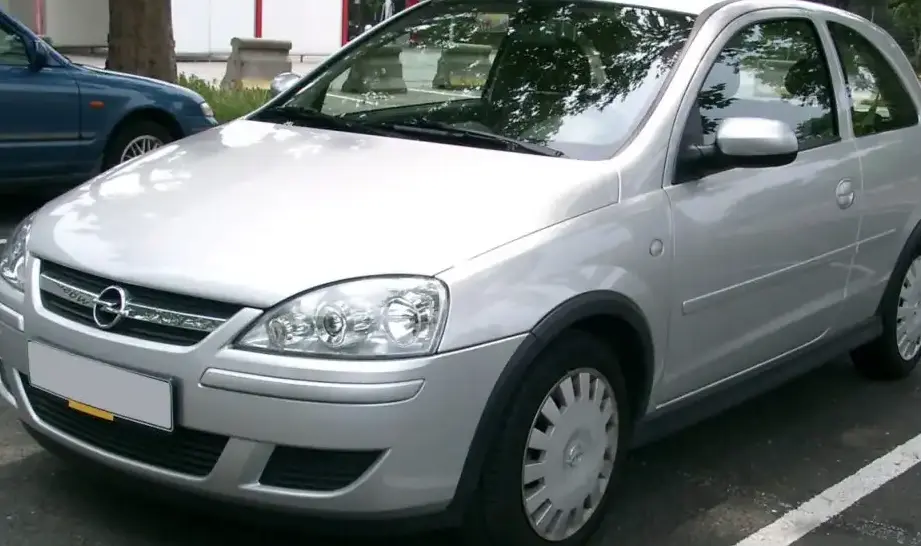
The Opel Corsa C (facelift, introduced in 2003) 1.3 CDTi 70 hp Automatic represents a specific configuration within the broader Corsa C range, produced from July 2003 to June 2006. This variant aimed to provide an economical and accessible entry point into the subcompact hatchback market, particularly in Europe. It utilized a diesel engine paired with an automatic transmission, a relatively uncommon combination at the time, catering to drivers prioritizing ease of use over outright performance. The Corsa C itself was a significant model for Opel, building upon the success of its predecessors and establishing a strong presence in the competitive small car segment.
Technical Specifications
| Brand | Opel |
| Model | Corsa |
| Generation | Corsa C (facelift 2003) |
| Type (Engine) | 1.3 CDTi (70 Hp) Automatic |
| Start of production | July, 2003 |
| End of production | June, 2006 |
| Powertrain Architecture | Internal Combustion engine |
| Body type | Hatchback |
| Seats | 5 |
| Doors | 3-5 |
| Fuel consumption (urban) | 5.5 l/100 km (42.8 US mpg, 51.4 UK mpg, 18.2 km/l) |
| Fuel consumption (extra urban) | 3.7 l/100 km (63.6 US mpg, 76.3 UK mpg, 27 km/l) |
| Fuel consumption (combined) | 4.4 l/100 km (53.5 US mpg, 64.2 UK mpg, 22.7 km/l) |
| Fuel Type | Diesel |
| Acceleration 0 – 100 km/h | 16 sec |
| Acceleration 0 – 62 mph | 16 sec |
| Acceleration 0 – 60 mph | 15.2 sec |
| Maximum speed | 165 km/h (102.53 mph) |
| Weight-to-power ratio | 14.8 kg/Hp, 67.6 Hp/tonne |
| Weight-to-torque ratio | 6.1 kg/Nm, 164.3 Nm/tonne |
| Power | 70 Hp @ 4000 rpm |
| Power per litre | 56.1 Hp/l |
| Torque | 170 Nm @ 1750 rpm (125.39 lb.-ft. @ 1750 rpm) |
| Engine layout | Front, Transverse |
| Engine Model/Code | Z13DT |
| Engine displacement | 1248 cm3 (76.16 cu. in.) |
| Number of cylinders | 4 |
| Engine configuration | Inline |
| Cylinder Bore | 69.6 mm (2.74 in.) |
| Piston Stroke | 82 mm (3.23 in.) |
| Compression ratio | 18:1 |
| Number of valves per cylinder | 4 |
| Fuel injection system | Diesel Commonrail |
| Engine aspiration | Turbocharger, Intercooler |
| Valvetrain | DOHC |
| Engine oil capacity | 3.2 l (3.38 US qt | 2.82 UK qt) |
| Coolant | 6.3 l (6.66 US qt | 5.54 UK qt) |
| Kerb Weight | 1035 kg (2281.78 lbs.) |
| Max. weight | 1520 kg (3351.03 lbs.) |
| Max load | 485 kg (1069.24 lbs.) |
| Trunk (boot) space – minimum | 260 l (9.18 cu. ft.) |
| Trunk (boot) space – maximum | 1060 l (37.43 cu. ft.) |
| Fuel tank capacity | 44 l (11.62 US gal | 9.68 UK gal) |
| Length | 3839 mm (151.14 in.) |
| Width | 1646 mm (64.8 in.) |
| Height | 1440 mm (56.69 in.) |
| Wheelbase | 2491 mm (98.07 in.) |
| Front track | 1429 mm (56.26 in.) |
| Rear (Back) track | 1420 mm (55.91 in.) |
| Ride height (ground clearance) | 140 mm (5.51 in.) |
| Drag coefficient (Cd) | 0.32 |
| Drivetrain Architecture | The Internal combustion engine (ICE) drives the front wheels of the vehicle. |
| Drive wheel | Front wheel drive |
| Number of gears and type of gearbox | 5 gears, automatic transmission |
| Front suspension | Coil spring |
| Rear suspension | Coil spring |
| Front brakes | Disc |
| Rear brakes | Drum |
| Assisting systems | ABS (Anti-lock braking system) |
| Steering type | Steering rack and pinion |
| Power steering | Electric Steering |
| Tires size | 175/65 R14 |
| Wheel rims size | 5.5J X 14 |
Powertrain & Engine Architecture
The heart of this Corsa variant is the Z13DT, a 1.3-liter inline-four cylinder diesel engine. This engine belongs to Opel/Fiat’s family of small-displacement diesel engines, known for their fuel efficiency. The Z13DT utilizes a common rail direct injection system, delivering fuel directly into the combustion chamber at extremely high pressure. This technology, coupled with a turbocharger and intercooler, allows the engine to produce 70 horsepower at 4000 rpm and 170 Nm (125 lb-ft) of torque at a low 1750 rpm. The engine features a double overhead camshaft (DOHC) valvetrain with four valves per cylinder, optimizing gas flow for improved performance. The automatic transmission is a conventional five-speed unit, designed to provide smooth shifts and ease of driving. It’s important to note that this transmission wasn’t known for its sportiness, prioritizing comfort and fuel economy over rapid acceleration.
Driving Characteristics
The 1.3 CDTi Automatic Corsa C offers a decidedly relaxed driving experience. Acceleration is modest, taking around 16 seconds to reach 62 mph (100 km/h). The automatic transmission contributes to this, with gear ratios optimized for fuel efficiency rather than spirited driving. While the 170 Nm of torque provides adequate pulling power for everyday driving and overtaking, it doesn’t offer the punch of higher-output versions like the 1.7 DTi or the petrol-powered 1.4 or 1.6-liter engines. The automatic transmission can feel somewhat sluggish, particularly when downshifting. Compared to the manual transmission versions of the same engine, the automatic sacrifices some responsiveness and fuel economy. However, it provides a significant convenience factor for drivers in urban environments.
Equipment & Trim Levels
The 1.3 CDTi Automatic trim typically fell into the mid-range of the Corsa C lineup. Standard equipment generally included central locking, power steering, an adjustable steering column, and basic audio system. Safety features like ABS were also standard. Interior upholstery was typically cloth, with a functional but basic dashboard layout. Optional extras could include air conditioning, alloy wheels, electric windows, and upgraded audio systems. The specific trim level (e.g., Enjoy, Club) determined the level of standard equipment, with higher trims offering more features.
Chassis & Braking
The Corsa C utilizes a relatively simple chassis design. Front suspension consists of coil springs and MacPherson struts, while the rear suspension employs a torsion beam setup. This configuration provides a comfortable ride, although it doesn’t offer the same level of handling precision as more sophisticated suspension systems. The braking system features disc brakes on the front wheels and drum brakes on the rear. ABS (Anti-lock Braking System) was standard, enhancing safety during emergency braking. The relatively light weight of the vehicle (around 1035 kg or 2282 lbs) helps to compensate for the modest braking performance.
Market Reception & Comparison
The Corsa C 1.3 CDTi Automatic was generally well-received as an economical and practical city car. Critics praised its fuel efficiency and ease of driving, particularly for those unfamiliar with manual transmissions. However, the performance was often criticized as being underwhelming, and the automatic transmission was sometimes described as sluggish. Compared to the 1.7 DTi version, the 1.3 CDTi offered lower running costs but significantly less power. The petrol-powered versions provided more spirited performance but at the expense of fuel economy. The 1.3 CDTi Automatic appealed to a specific segment of buyers – those prioritizing fuel efficiency and convenience over outright performance.
Legacy
The Z13DT engine, while not known for being a powerhouse, proved to be relatively reliable. With proper maintenance, these engines can accumulate high mileage. The automatic transmission, however, is sometimes cited as a potential weak point, with some units experiencing issues over time. In the used car market today, the Corsa C 1.3 CDTi Automatic represents an affordable and economical option for those seeking a small, practical hatchback. Its fuel efficiency and low running costs continue to be its main selling points, making it a popular choice for first-time drivers or those on a budget. However, potential buyers should be aware of the potential for transmission issues and ensure a thorough inspection before purchase.