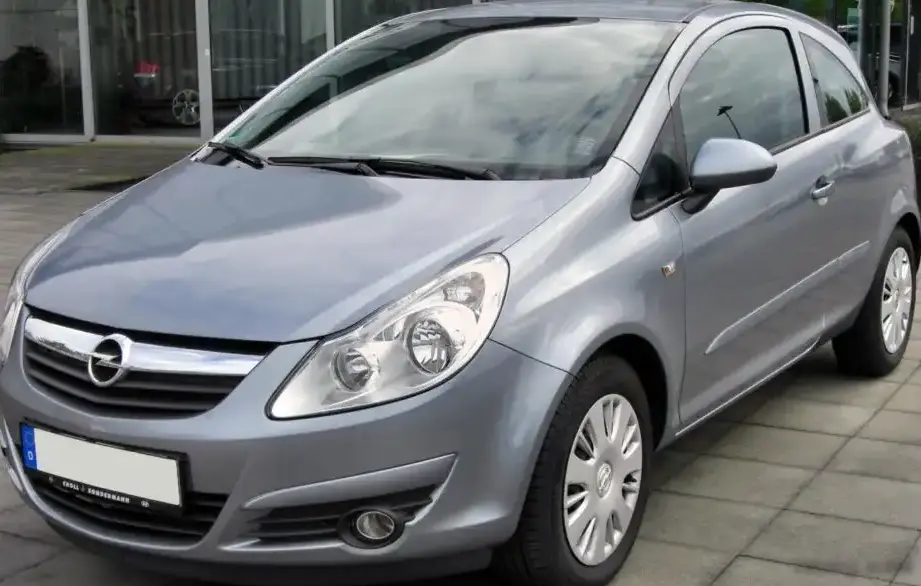
The Opel Corsa D 3-door 1.6i 16V OPC, produced from July 2007 to October 2009, represents the performance-oriented variant of the fourth-generation Corsa (D). Positioned as the flagship model within the Corsa D 3-door range, the OPC (Opel Performance Center) aimed to deliver a more engaging driving experience than the standard trims. It was primarily marketed in Europe, offering a sporty alternative in the subcompact hatchback segment. The Corsa D itself was based on the General Motors Gamma platform, shared with other vehicles like the Fiat Grande Punto and the Opel/Vauxhall Meriva.
Technical Specifications
| Brand | Opel |
| Model | Corsa |
| Generation | Corsa D 3-door |
| Type (Engine) | 1.6i 16V OPC (150 Hp) |
| Start of production | July, 2007 |
| End of production | October, 2009 |
| Powertrain Architecture | Internal Combustion engine |
| Body type | Hatchback |
| Seats | 5 |
| Doors | 3 |
| Fuel consumption (urban) | 10.5 l/100 km (22.4 US mpg, 26.9 UK mpg, 9.5 km/l) |
| Fuel consumption (extra urban) | 6.4 l/100 km (36.8 US mpg, 44.1 UK mpg, 15.6 km/l) |
| Fuel consumption (combined) | 7.9 l/100 km (29.8 US mpg, 35.8 UK mpg, 12.7 km/l) |
| Fuel Type | Petrol (Gasoline) |
| Acceleration 0 – 100 km/h | 8.1 sec |
| Acceleration 0 – 62 mph | 8.1 sec |
| Acceleration 0 – 60 mph | 7.7 sec |
| Maximum speed | 210 km/h (130.49 mph) |
| Emission standard | Euro 4 |
| Weight-to-power ratio | 8 kg/Hp, 124.7 Hp/tonne |
| Weight-to-torque ratio | 5.7 kg/Nm, 174.6 Nm/tonne |
| Power | 150 Hp @ 5000 rpm |
| Power per litre | 93.9 Hp/l |
| Torque | 210 Nm @ 1850 rpm (154.89 lb.-ft. @ 1850 rpm) |
| Engine layout | Front, Transverse |
| Engine Model/Code | Z16LEL |
| Engine displacement | 1598 cm3 (97.52 cu. in.) |
| Number of cylinders | 4 |
| Engine configuration | Inline |
| Number of valves per cylinder | 4 |
| Fuel injection system | Multi-port manifold injection |
| Engine aspiration | Turbocharger, Intercooler |
| Valvetrain | DOHC |
| Engine oil capacity | 4.5 l (4.76 US qt | 3.96 UK qt) |
| Coolant capacity | 5.8 l (6.13 US qt | 5.1 UK qt) |
| Kerb Weight | 1203 kg (2652.16 lbs) |
| Max. weight | 1703 kg (3754.47 lbs) |
| Max load | 500 kg (1102.31 lbs) |
| Trunk (boot) space – minimum | 285 l (10.06 cu. ft.) |
| Trunk (boot) space – maximum | 1050 l (37.08 cu. ft.) |
| Fuel tank capacity | 44 l (11.62 US gal | 9.68 UK gal) |
| Length | 3999 mm (157.44 in) |
| Width | 1713 mm (67.44 in) |
| Height | 1488 mm (58.58 in) |
| Wheelbase | 2511 mm (98.86 in) |
| Front track | 1485 mm (58.46 in) |
| Ride height (ground clearance) | 115 mm (4.53 in) |
| Minimum turning circle | 10.4 m (34.12 ft) |
| Drivetrain Architecture | Front wheel drive |
| Number of gears | 6 gears, manual transmission |
| Front suspension | Independent, type McPherson with coil spring and anti-roll bar |
| Rear suspension | Rigid axle suspension |
| Front brakes | Ventilated discs |
| Rear brakes | Disc |
| Assisting systems | ABS (Anti-lock braking system) |
| Steering type | Steering rack and pinion |
| Tires size | 215/45 R17 |
| Wheel rims size | 17 |
Introduction
The Corsa D OPC represented Opel’s attempt to inject some excitement into the subcompact class. Distinguished by its aggressive styling, including a prominent rear spoiler, side skirts, and unique front bumper, the OPC was clearly differentiated from the standard Corsa D. Production ran from 2007 to 2009, and it served as a direct competitor to models like the Renault Clio Renaultsport and the Volkswagen Polo GTI. The 3-door configuration was favored for its sportier appearance and slightly reduced weight compared to the 5-door version.
Powertrain & Engine Architecture
At the heart of the Corsa D OPC lies the Z16LEL engine, a 1.6-liter turbocharged inline-four cylinder powerplant. This engine, a member of the Ecotec family, produced 150 horsepower at 5000 rpm and 210 Nm (154.89 lb-ft) of torque at 1850 rpm. The Z16LEL utilized a single scroll turbocharger with an intercooler to boost performance. Fuel delivery was managed by a multi-port fuel injection system. The engine featured a double overhead camshaft (DOHC) valvetrain with four valves per cylinder, contributing to its responsive nature. The OPC was exclusively offered with a Getrag M32 6-speed manual transmission, chosen for its durability and direct driver engagement. This transmission featured relatively short gear ratios, optimized for acceleration.
Driving Characteristics
The Corsa D OPC offered a noticeably more spirited driving experience than its naturally aspirated siblings. The turbocharger provided a surge of power in the mid-range, making overtaking and quick acceleration relatively easy. While not a particularly fast car by modern standards (0-60 mph in approximately 7.7 seconds), the OPC’s light weight (around 2652 lbs) and well-tuned chassis contributed to a feeling of agility. The 6-speed manual transmission allowed drivers to keep the engine in its optimal power band. Compared to the 1.4L or 1.6L non-turbocharged Corsas, the OPC offered significantly more power and torque, but at the expense of some fuel economy. The manual transmission also provided a more direct connection to the engine than the automatic options available on other Corsa D models.
Equipment & Trim Levels
The Corsa D OPC came reasonably well-equipped, focusing on sporty aesthetics and driver-focused features. Standard equipment included sport seats with distinctive cloth upholstery, a leather-wrapped steering wheel, air conditioning, and an upgraded audio system. Optional extras included Recaro sport seats, a panoramic sunroof, and parking sensors. The interior featured aluminum pedals and unique OPC badging throughout. The dashboard layout was similar to other Corsa D models, but with a more focused and driver-centric design.
Chassis & Braking
The OPC benefited from several chassis upgrades compared to the standard Corsa D. The suspension was lowered and stiffened, with a McPherson strut front suspension and a torsion beam rear axle. A thicker anti-roll bar was fitted to reduce body roll during cornering. Braking duties were handled by ventilated front discs and solid rear discs, providing adequate stopping power for the car’s performance level. ABS (Anti-lock Braking System) was standard. The 17-inch alloy wheels, shod with 215/45 R17 tires, further enhanced the car’s handling and grip.
Market Reception & Comparison
The Corsa D OPC received generally positive reviews from automotive journalists. Critics praised its engaging handling, punchy turbocharged engine, and sporty styling. However, some noted that the interior quality was somewhat basic compared to rivals like the Polo GTI. Fuel economy, while reasonable for a performance hatchback, was not a strong point. Compared to the naturally aspirated Corsa D models, the OPC commanded a significant price premium, reflecting its enhanced performance and equipment. Against competitors like the Renault Clio Renaultsport, the OPC offered a slightly more accessible price point, but arguably lacked the same level of refinement.
Legacy
The Corsa D OPC has developed a modest following among enthusiasts. The Z16LEL engine, while not without its quirks, is generally considered reliable if properly maintained. Common issues include turbocharger wear and potential problems with the electronic throttle body. Today, well-maintained examples of the Corsa D OPC are becoming increasingly sought after by collectors and those looking for an affordable and fun-to-drive hot hatch. Its relatively simple mechanicals and readily available parts make it a relatively easy car to maintain and modify. The OPC represents a high point in the Corsa’s history, offering a compelling blend of performance, practicality, and affordability.