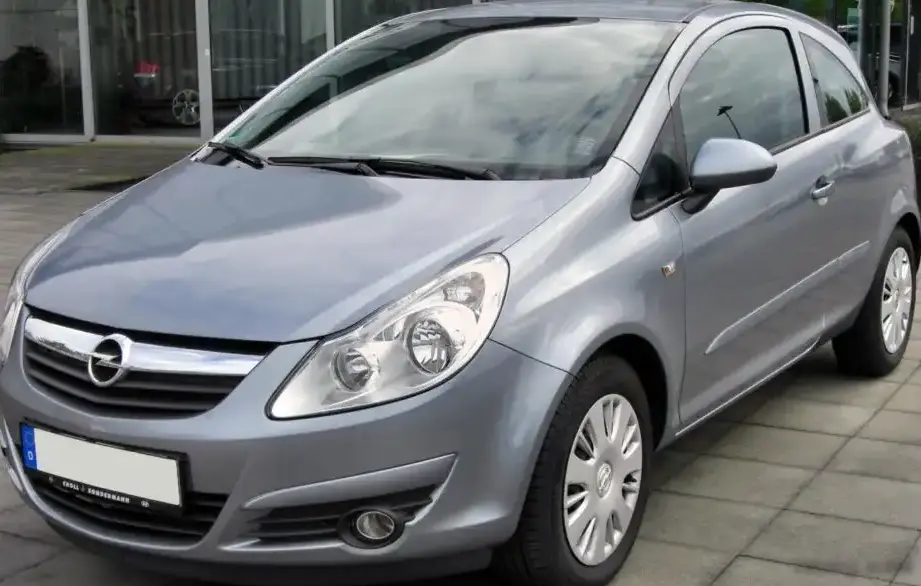
The Opel Corsa D 3-door 1.7 CDTI, produced from October 2006 to February 2010, represented a significant offering in the European subcompact hatchback market. Positioned as a fuel-efficient and relatively sporty option within the Corsa D range, this variant combined a turbocharged diesel engine with a six-speed manual transmission. It was part of the Corsa D generation (2006-2014), built on the GM Gamma platform, and aimed at buyers seeking a practical, economical, and reasonably engaging driving experience. This particular 3-door configuration emphasized a more youthful and dynamic aesthetic compared to the five-door model.
Technical Specifications
| Brand | Opel |
| Model | Corsa |
| Generation | Corsa D 3-door |
| Type (Engine) | 1.7 CDTI (125 Hp) |
| Start of production | October, 2006 |
| End of production | February, 2010 |
| Powertrain Architecture | Internal Combustion engine |
| Body type | Hatchback |
| Seats | 5 |
| Doors | 3 |
| Fuel consumption (urban) | 6.2 l/100 km (37.9 US mpg, 45.6 UK mpg, 16.1 km/l) |
| Fuel consumption (extra urban) | 4 l/100 km (58.8 US mpg, 70.6 UK mpg, 25 km/l) |
| Fuel consumption (combined) | 4.8 l/100 km (49 US mpg, 58.9 UK mpg, 20.8 km/l) |
| CO2 emissions | 183 g/km |
| Fuel Type | Diesel |
| Acceleration 0 – 100 km/h | 10.1 sec |
| Acceleration 0 – 62 mph | 10.1 sec |
| Acceleration 0 – 60 mph | 9.6 sec |
| Maximum speed | 195 km/h (121.17 mph) |
| Emission standard | Euro 4 |
| Weight-to-power ratio | 9.4 kg/Hp, 106.8 Hp/tonne |
| Weight-to-torque ratio | 4.2 kg/Nm, 239.3 Nm/tonne |
| Power | 125 Hp @ 4000 rpm |
| Power per litre | 74.1 Hp/l |
| Torque | 280 Nm @ 2300 rpm (206.52 lb.-ft. @ 2300 rpm) |
| Engine layout | Front, Transverse |
| Engine Model/Code | Z17DTR |
| Engine displacement | 1686 cm3 (102.89 cu. in.) |
| Number of cylinders | 4 |
| Engine configuration | Inline |
| Cylinder Bore | 79 mm (3.11 in.) |
| Piston Stroke | 86 mm (3.39 in.) |
| Compression ratio | 18:1 |
| Number of valves per cylinder | 4 |
| Fuel injection system | Diesel Commonrail |
| Engine aspiration | Turbocharger, Intercooler |
| Valvetrain | DOHC |
| Engine oil capacity | 5.4 l (5.71 US qt | 4.75 UK qt) |
| Coolant | 7.1 l (7.5 US qt | 6.25 UK qt) |
| Kerb Weight | 1170 kg (2579.41 lbs.) |
| Max. weight | 1670 kg (3681.72 lbs.) |
| Max load | 500 kg (1102.31 lbs.) |
| Trunk (boot) space – minimum | 285 l (10.06 cu. ft.) |
| Trunk (boot) space – maximum | 1050 l (37.08 cu. ft.) |
| Fuel tank capacity | 44 l (11.62 US gal | 9.68 UK gal) |
| Length | 3999 mm (157.44 in.) |
| Width | 1737 mm (68.39 in.) |
| Height | 1488 mm (58.58 in.) |
| Wheelbase | 2511 mm (98.86 in.) |
| Front track | 1485 mm (58.46 in.) |
| Rear (Back) track | 1478 mm (58.19 in.) |
| Drag coefficient (Cd) | 0.32 |
| Minimum turning circle | 10.4 m (34.12 ft.) |
| Drivetrain Architecture | ICE, Front wheel drive |
| Drive wheel | Front wheel drive |
| Number of gears | 6 gears, manual transmission |
| Front suspension | Independent, McPherson with coil spring and anti-roll bar |
| Rear suspension | Rigid axle suspension |
| Front brakes | Ventilated discs |
| Rear brakes | Disc |
| Assisting systems | ABS (Anti-lock braking system) |
| Steering type | Steering rack and pinion |
| Tires size | 185/65 R15 |
| Wheel rims size | 15 |
Powertrain & Engine Architecture
The heart of the Corsa D 1.7 CDTI was the Z17DTR engine, a 1.7-liter inline-four cylinder diesel. This engine was a member of Opel/Fiat’s family of common-rail direct injection diesels. It featured a turbocharger with an intercooler to boost power and efficiency. The common-rail direct injection system, supplied by Bosch, allowed for precise fuel delivery and optimized combustion. The engine utilized a double overhead camshaft (DOHC) valvetrain with four valves per cylinder, contributing to its relatively high output for its displacement. The six-speed manual transmission, a Getrag unit, was well-matched to the engine’s torque curve, providing good acceleration and highway cruising ability. The engine’s 18:1 compression ratio was typical for a diesel engine, maximizing thermal efficiency.
Driving Characteristics
The 1.7 CDTI with the six-speed manual offered a surprisingly engaging driving experience for a subcompact diesel. While not a performance car, the 125 horsepower and 280 Nm (206 lb-ft) of torque provided ample power for everyday driving and overtaking maneuvers. The turbocharger did exhibit some lag at lower RPMs, but once spooled up, it delivered a noticeable surge of power. The six-speed gearbox allowed drivers to keep the engine in its optimal power band, enhancing responsiveness. Compared to the lower-powered 1.0-liter or 1.2-liter petrol versions, the 1.7 CDTI offered significantly more torque and a more relaxed driving experience, especially on the highway. It wasn’t as quick as the later OPC (Vauxhall/Opel’s performance division) models, but it provided a good balance of performance and economy.
Equipment & Trim Levels
The Corsa D 1.7 CDTI typically came with a reasonable level of standard equipment. This included power steering, ABS brakes, front airbags, and a basic audio system. Higher trim levels, such as ‘Sport’ or ‘Cosmo’, added features like alloy wheels, air conditioning, electric windows, and a more sophisticated audio system with CD player. Optional extras included a sunroof, parking sensors, and upgraded upholstery. Interior materials were generally durable but not luxurious, reflecting the car’s price point. The 3-door model often featured sportier seat fabrics and a more youthful interior design compared to the five-door version.
Chassis & Braking
The Corsa D utilized a MacPherson strut front suspension and a torsion beam rear suspension. This setup provided a good compromise between ride comfort and handling. The front brakes were ventilated discs, while the rear brakes were solid discs, providing adequate stopping power for the car’s weight and performance. ABS (Anti-lock Braking System) was standard. The steering was a rack and pinion system, offering precise and responsive control. The relatively lightweight construction of the Corsa D contributed to its nimble handling characteristics.
Market Reception & Comparison
The Opel Corsa D 1.7 CDTI was generally well-received by automotive critics for its fuel efficiency, comfortable ride, and surprisingly capable engine. It was often praised as a practical and economical choice for city driving and commuting. Compared to other subcompact diesels of the time, such as the Volkswagen Polo or Ford Fiesta, the Corsa D offered a competitive level of performance and equipment at a reasonable price. However, some critics noted that the interior quality wasn’t quite as refined as some of its rivals. Fuel economy was a major selling point, consistently achieving around 4.8 l/100km (49 US mpg) in combined driving.
Legacy
The Z17DTR engine, while generally reliable, is known to require regular maintenance, particularly regarding the diesel particulate filter (DPF) and the EGR valve. Proper servicing and the use of high-quality diesel fuel are crucial for long-term reliability. Today, used Corsa D 1.7 CDTI models are relatively affordable and can be a good value for buyers seeking an economical and practical hatchback. However, potential buyers should be aware of the potential maintenance costs associated with diesel engines, particularly as they age. The Corsa D 1.7 CDTI remains a common sight on European roads, a testament to its durability and fuel efficiency.