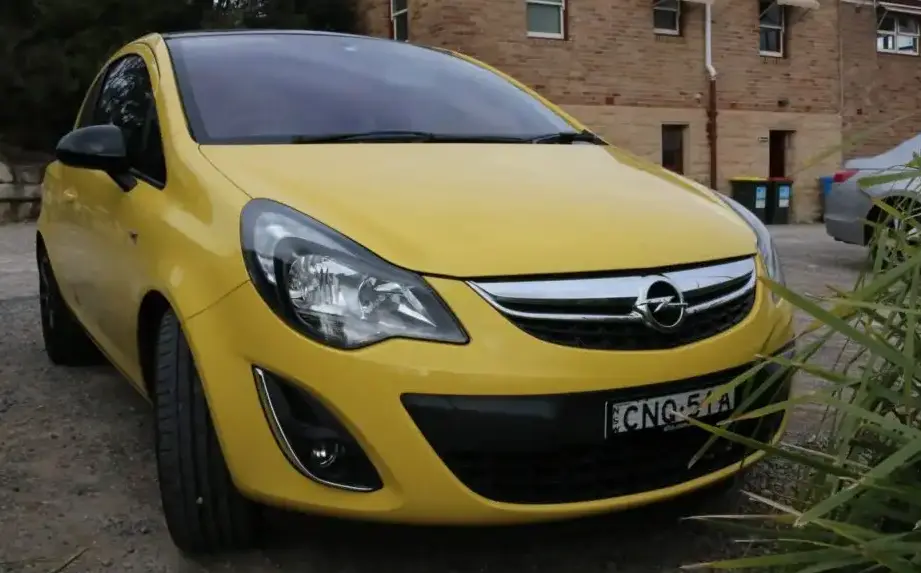
The Opel Corsa D (Facelift, produced from 2011 to August 2014) 3-door 1.3 CDTI, equipped with a 75 horsepower diesel engine, represented an entry-level offering within the Corsa D range. Positioned as a fuel-efficient and economical choice, this variant targeted buyers prioritizing low running costs over outright performance. It was a key model in the European small car segment, competing with vehicles like the Volkswagen Polo, Ford Fiesta, and Renault Clio. The facelift brought styling updates and minor mechanical revisions to the Corsa D, enhancing its appeal in a competitive market.
Technical Specifications
| Brand | Opel |
| Model | Corsa |
| Generation | Corsa D (Facelift 2011) 3-door |
| Type (Engine) | 1.3 CDTI (75 Hp) |
| Start of production | 2011 |
| End of production | August, 2014 |
| Powertrain Architecture | Internal Combustion engine |
| Body type | Hatchback |
| Seats | 5 |
| Doors | 3 |
| Fuel consumption (urban) | 4.8 l/100 km (49 US mpg, 58.9 UK mpg, 20.8 km/l) |
| Fuel consumption (extra urban) | 3.5 l/100 km (67.2 US mpg, 80.7 UK mpg, 28.6 km/l) |
| Fuel consumption (combined) | 4 l/100 km (58.8 US mpg, 70.6 UK mpg, 25 km/l) |
| Fuel Type | Diesel |
| Acceleration 0 – 100 km/h | 14.5 sec |
| Acceleration 0 – 62 mph | 14.5 sec |
| Acceleration 0 – 60 mph | 13.8 sec |
| Maximum speed | 163 km/h (101.28 mph) |
| Emission standard | Euro 5 |
| Weight-to-power ratio | 15.1 kg/Hp, 66.4 Hp/tonne |
| Weight-to-torque ratio | 6.7 kg/Nm, 149.6 Nm/tonne |
| Power | 75 Hp @ 4000 rpm |
| Power per litre | 60.1 Hp/l |
| Torque | 169 Nm @ 1750-2250 rpm (124.65 lb.-ft. @ 1750-2250 rpm) |
| Engine layout | Front, Transverse |
| Engine Model/Code | A13DTC |
| Engine displacement | 1248 cm3 (76.16 cu. in.) |
| Number of cylinders | 4 |
| Engine configuration | Inline |
| Compression ratio | 16.8:1 |
| Number of valves per cylinder | 4 |
| Fuel injection system | Diesel Commonrail |
| Engine aspiration | Turbocharger, Intercooler |
| Engine oil capacity | 3.5 l (3.7 US qt | 3.08 UK qt) |
| Coolant capacity | 6.3 l (6.66 US qt | 5.54 UK qt) |
| Kerb Weight | 1130 kg (2491.22 lbs.) |
| Max. weight | 1555 kg (3428.19 lbs.) |
| Max load | 425 kg (936.96 lbs.) |
| Trunk (boot) space – minimum | 285 l (10.06 cu. ft.) |
| Trunk (boot) space – maximum | 1050 l (37.08 cu. ft.) |
| Fuel tank capacity | 45 l (11.89 US gal | 9.9 UK gal) |
| Length | 3999 mm (157.44 in.) |
| Width | 1737 mm (68.39 in.) |
| Width including mirrors | 1944 mm (76.54 in.) |
| Height | 1488 mm (58.58 in.) |
| Wheelbase | 2511 mm (98.86 in.) |
| Front track | 1485 mm (58.46 in.) |
| Rear (Back) track | 1478 mm (58.19 in.) |
| Ride height (ground clearance) | 140 mm (5.51 in.) |
| Drag coefficient (Cd) | 0.32 |
| Minimum turning circle | 10.4 m (34.12 ft.) |
| Drivetrain Architecture | Front wheel drive |
| Number of gears and type of gearbox | 5 gears, manual transmission |
| Assisting systems | ABS (Anti-lock braking system) |
| Steering type | Steering rack and pinion |
| Tires size | 185/70 R14 |
| Wheel rims size | 14 |
Introduction
The Opel Corsa D facelift, launched in 2011, continued the success of the Corsa D generation, which was based on the GM’s global Gamma platform (also known as 1HX0/A3). The 1.3 CDTI 75 hp 3-door model was a significant part of the lineup, particularly in markets where diesel engines were favored for their fuel efficiency. This variant aimed to provide affordable transportation with a focus on economy, making it a popular choice for first-time car buyers, city commuters, and those seeking a low-cost-to-operate vehicle. The three-door body style added a touch of sportiness to the practical hatchback.
Powertrain & Engine Architecture
The heart of this Corsa variant is the 1.3 CDTI engine, designated with the code A13DTC. This is a four-cylinder, inline diesel engine featuring a turbocharger and intercooler to enhance power and efficiency. The engine utilizes a common rail direct injection system, delivering fuel directly into the combustion chamber at high pressure for optimized combustion. The engine’s 16.8:1 compression ratio is typical for a diesel engine, contributing to its thermal efficiency. The 75 horsepower output is achieved at 4000 rpm, while the peak torque of 169 Nm (124.65 lb-ft) is available between 1750 and 2250 rpm. This torque curve provides reasonable pulling power for everyday driving. The engine is paired with a five-speed manual transmission, chosen for its simplicity and cost-effectiveness. While an automatic transmission was available on other Corsa D models, it wasn’t offered with this specific engine and power output.
Driving Characteristics
The 1.3 CDTI 75 hp Corsa D offers a driving experience focused on fuel economy rather than outright performance. Acceleration from 0 to 100 km/h (0-62 mph) takes around 14.5 seconds, and the top speed is 163 km/h (101.28 mph). The five-speed manual transmission is geared to maximize fuel efficiency, meaning the engine can feel somewhat strained when accelerating hard or climbing hills. The torque delivery is relatively flat, providing adequate power for merging onto highways and overtaking slower vehicles, but it lacks the punch of higher-powered Corsa variants like the 1.4 Turbo or the 1.7 CDTI. The steering is light and precise, making it easy to maneuver in urban environments. Overall, the driving experience is best described as practical and undemanding.
Equipment & Trim Levels
The 1.3 CDTI 75 hp Corsa D typically came with a basic level of equipment, reflecting its position as an entry-level model. Standard features generally included power steering, ABS brakes, a driver’s airbag, and basic audio system. Interior upholstery was typically cloth, and the dashboard featured a functional but relatively simple design. Optional extras included air conditioning, electric windows, alloy wheels, and a CD player. Higher trim levels, such as the Enjoy or Cosmo, added more features, but the 1.3 CDTI was often purchased as a base model by buyers prioritizing affordability.
Chassis & Braking
The Corsa D’s chassis is a typical front-wheel-drive configuration with MacPherson strut suspension at the front and a torsion beam axle at the rear. The suspension setup is tuned for comfort and ride quality, rather than sporty handling. The braking system on the 1.3 CDTI typically featured disc brakes at the front and drum brakes at the rear. This configuration was chosen to keep costs down. ABS (Anti-lock Braking System) was standard, providing enhanced braking performance and stability. The relatively light weight of the vehicle (1130 kg / 2491.22 lbs) helps to compensate for the modest braking power.
Market Reception & Comparison
The Opel Corsa D 1.3 CDTI 75 hp was generally well-received by critics as a practical and economical small car. Its fuel efficiency was a major selling point, and it was praised for its low running costs. However, its performance was often criticized as being somewhat underwhelming, particularly when compared to higher-powered Corsa variants or competitors like the Ford Fiesta EcoBoost. The 1.7 CDTI offered significantly more power and torque, but at a higher price point. The 1.4-liter petrol engine provided a more responsive driving experience, but with lower fuel economy. Compared to the petrol versions, the 1.3 CDTI offered superior fuel economy, making it a popular choice for drivers covering high mileages.
Legacy
The A13DTC engine, while not known for being particularly exciting, proved to be a relatively reliable unit when properly maintained. Common issues include turbocharger wear and potential problems with the diesel particulate filter (DPF), particularly on vehicles that primarily see short journeys. In the used car market, the Corsa D 1.3 CDTI 75 hp remains an affordable option for those seeking a cheap and economical runabout. Its simplicity and relatively low maintenance costs make it an attractive choice for budget-conscious buyers. However, potential buyers should be aware of the potential DPF issues and ensure the vehicle has been regularly serviced.