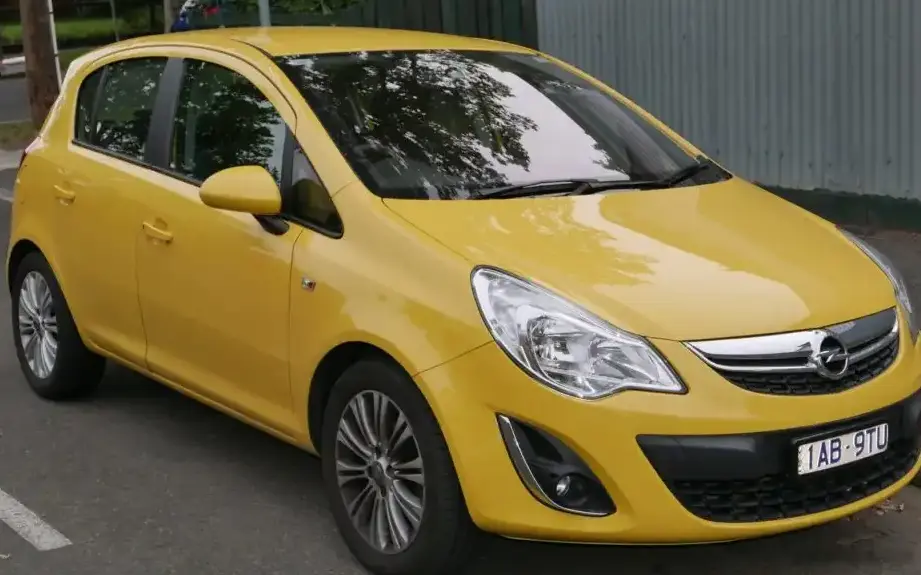
The Opel Corsa D (Facelift, produced from 2011 to August 2014) 5-door 1.3 CDTI, generating 95 horsepower, represented a key entry point into the Corsa range for European buyers seeking fuel efficiency and practicality. Positioned as a diesel-powered option within the fourth generation Corsa (launched in 2006), this variant aimed to balance affordability with the benefits of modern common-rail diesel technology. It was a popular choice in markets where diesel fuel was heavily favored, offering a compelling alternative to gasoline-powered Corsas and competitors like the Ford Fiesta and Volkswagen Polo.
Technical Specifications
| Brand | Opel |
| Model | Corsa |
| Generation | Corsa D (Facelift 2011) 5-door |
| Type (Engine) | 1.3 CDTI (95 Hp) |
| Start of production | 2011 |
| End of production | August, 2014 |
| Powertrain Architecture | Internal Combustion engine |
| Body type | Hatchback |
| Seats | 5 |
| Doors | 5 |
| Fuel consumption (urban) | 5.4 l/100 km (43.6 US mpg, 52.3 UK mpg, 18.5 km/l) |
| Fuel consumption (extra urban) | 3.8 l/100 km (61.9 US mpg, 74.3 UK mpg, 26.3 km/l) |
| Fuel consumption (combined) | 4.4 l/100 km (53.5 US mpg, 64.2 UK mpg, 22.7 km/l) |
| Fuel Type | Diesel |
| Acceleration 0 – 100 km/h | 12.7 sec |
| Acceleration 0 – 62 mph | 12.7 sec |
| Acceleration 0 – 60 mph | 12.1 sec |
| Maximum speed | 172 km/h (106.88 mph) |
| Emission standard | Euro 5 |
| Weight-to-power ratio | 12.3 kg/Hp, 81.2 Hp/tonne |
| Weight-to-torque ratio | 5.6 kg/Nm, 179.5 Nm/tonne |
| Power | 95 Hp @ 4000 rpm |
| Power per litre | 76.1 Hp/l |
| Torque | 210 Nm @ 1750-2500 rpm (154.89 lb.-ft. @ 1750-2500 rpm) |
| Engine layout | Front, Transverse |
| Engine Model/Code | A13DTR |
| Engine displacement | 1248 cm3 (76.16 cu. in.) |
| Number of cylinders | 4 |
| Engine configuration | Inline |
| Compression ratio | 16.8:1 |
| Number of valves per cylinder | 4 |
| Fuel injection system | Diesel Commonrail |
| Engine aspiration | Turbocharger, Intercooler |
| Engine oil capacity | 3.5 l (3.7 US qt | 3.08 UK qt) |
| Coolant capacity | 6.3 l (6.66 US qt | 5.54 UK qt) |
| Kerb Weight | 1170 kg (2579.41 lbs.) |
| Max. weight | 1570 kg (3461.26 lbs.) |
| Max load | 400 kg (881.85 lbs.) |
| Trunk (boot) space – minimum | 285 l (10.06 cu. ft.) |
| Trunk (boot) space – maximum | 1100 l (38.85 cu. ft.) |
| Fuel tank capacity | 45 l (11.89 US gal | 9.9 UK gal) |
| Length | 3999 mm (157.44 in.) |
| Width | 1737 mm (68.39 in.) |
| Width including mirrors | 1944 mm (76.54 in.) |
| Height | 1488 mm (58.58 in.) |
| Wheelbase | 2511 mm (98.86 in.) |
| Front track | 1485 mm (58.46 in.) |
| Rear (Back) track | 1478 mm (58.19 in.) |
| Ride height (ground clearance) | 140 mm (5.51 in.) |
| Minimum turning circle | 10.4 m (34.12 ft.) |
| Drivetrain Architecture | Front wheel drive |
| Number of gears | 6 |
| Type of gearbox | Manual transmission |
| Assisting systems | ABS (Anti-lock braking system) |
| Steering type | Steering rack and pinion |
| Tires size | 185/65 R15 |
| Wheel rims size | 15 |
INTRODUCTION
The Opel Corsa D facelift, introduced in 2011, brought revised styling and updated technology to Opel’s popular supermini. The 1.3 CDTI 95 hp 5-door model was a significant offering, particularly in Europe, where smaller, fuel-efficient diesel cars were highly sought after. Built on the 1HX0/A3 platform, this variant aimed to provide a practical and economical transportation solution for a broad range of customers. It slotted into the Corsa D range below the more powerful 1.7 CDTI models and above the entry-level 1.0 and 1.2 petrol engines.
Powertrain & Engine Architecture
The heart of this Corsa variant is the A13DTR engine, a 1.3-liter inline-four cylinder diesel. This engine is a common-rail direct injection diesel, meaning fuel is delivered to the cylinders at extremely high pressure via a sophisticated common rail system. This system, coupled with a turbocharger and intercooler, allows for a good balance of power and fuel efficiency. The engine utilizes four valves per cylinder and a compression ratio of 16.8:1. The 95 horsepower output is achieved at 4000 rpm, while peak torque of 210 Nm (154.89 lb.-ft.) is available between 1750 and 2500 rpm. This broad torque curve contributes to the engine’s usability in everyday driving. The engine is paired with a six-speed manual transmission, chosen for its efficiency and driver engagement. While an automatic transmission was available on some Corsa D models, it wasn’t typically offered with this specific engine and power output.
Driving Characteristics
The 1.3 CDTI 95 hp Corsa D offers a driving experience focused on economy and practicality rather than outright performance. Acceleration from 0-100 km/h (0-62 mph) takes around 12.7 seconds, and top speed is 172 km/h (106.88 mph). The six-speed manual transmission helps to keep the engine in its optimal torque band, providing adequate power for most driving situations. The gear ratios are relatively long, prioritizing fuel efficiency over rapid acceleration. Compared to the more powerful 1.7 CDTI variants, the 1.3 CDTI feels noticeably less responsive, especially at higher speeds or when carrying a full load. However, the engine is surprisingly refined for its size, with relatively low levels of noise and vibration. The steering is light and precise, making the Corsa easy to maneuver in urban environments.
Equipment & Trim Levels
The 1.3 CDTI 95 hp Corsa D typically came equipped with a reasonable level of standard equipment. This included central locking, power steering, electric front windows, and an ABS anti-lock braking system. Air conditioning was often an optional extra, as were alloy wheels, a CD/radio system, and front fog lights. Interior upholstery was typically cloth, with a functional and durable design. Higher trim levels offered upgrades such as more premium cloth or leather upholstery, upgraded audio systems, and additional comfort features. The dashboard layout was straightforward and easy to use, with clearly labeled controls.
Chassis & Braking
The Corsa D’s chassis is based on a MacPherson strut front suspension and a torsion beam rear suspension. This setup provides a good balance of ride comfort and handling. The front brakes are typically disc brakes, while the rear brakes are drum brakes on most variants, although some higher-spec models featured rear disc brakes. The steering is a rack and pinion system, providing precise and responsive steering feel. Stabilizer bars are fitted to both the front and rear axles to reduce body roll during cornering. The suspension is tuned for comfort, but it also provides adequate control in most driving situations.
Market Reception & Comparison
The Opel Corsa D 1.3 CDTI 95 hp was generally well-received by critics as a practical and economical small car. It was praised for its fuel efficiency, low running costs, and comfortable ride. However, some critics noted that the engine lacked outright performance and could feel strained when fully loaded or driving uphill. Compared to the 1.7 CDTI variants, the 1.3 CDTI offered significantly better fuel economy but at the expense of performance. It also represented a more affordable entry point into the Corsa range, making it an attractive option for budget-conscious buyers. Against competitors like the Ford Fiesta and Volkswagen Polo, the Corsa D 1.3 CDTI offered a competitive package in terms of price, fuel economy, and practicality.
Legacy
The A13DTR engine, found in the Corsa D 1.3 CDTI, has proven to be a relatively reliable unit when properly maintained. Common issues include occasional problems with the turbocharger and diesel particulate filter (DPF), particularly on cars that have primarily been used for short journeys. However, with regular servicing and careful driving, these engines can cover high mileages without major issues. On the used car market, the Corsa D 1.3 CDTI 95 hp remains a popular choice for buyers seeking an affordable and fuel-efficient small car. Its low running costs and relatively simple mechanical design make it an attractive option for first-time drivers or those looking for a dependable city car.