Technical Specifications
| Brand | Opel |
| Model | Corsa |
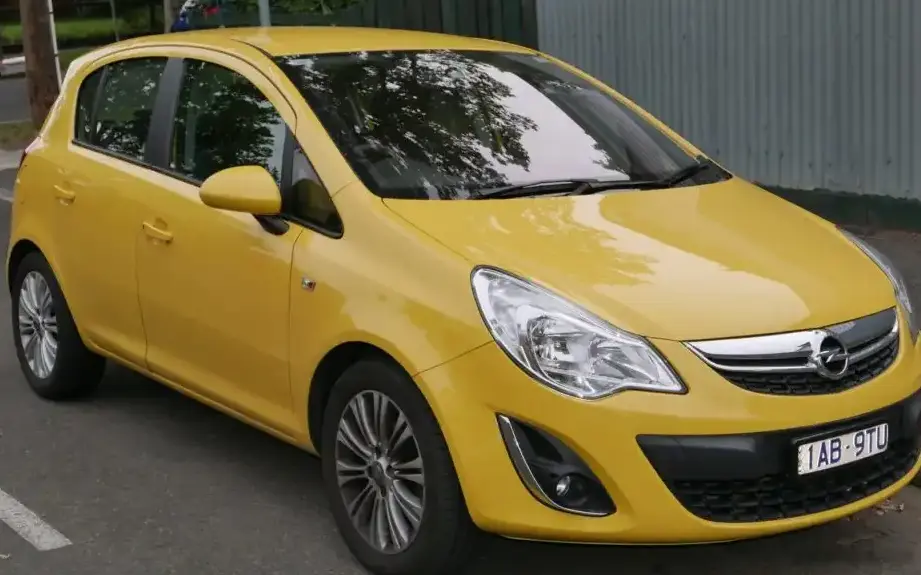
| Generation | Corsa D (Facelift 2011) 5-door |
| Type (Engine) | 1.3 CDTI (95 Hp) Start/Stop |
| Start of production | 2011 |
| End of production | August, 2014 |
| Powertrain Architecture | Internal Combustion engine |
| Body type | Hatchback |
| Seats | 5 |
| Doors | 5 |
| Fuel consumption (urban) | 4.5 l/100 km (52.3 US mpg, 62.8 UK mpg, 22.2 km/l) |
| Fuel consumption (extra urban) | 3.1 l/100 km (75.9 US mpg, 91.1 UK mpg, 32.3 km/l) |
| Fuel consumption (combined) | 3.6 l/100 km (65.3 US mpg, 78.5 UK mpg, 27.8 km/l) |
| Fuel Type | Diesel |
| Emission standard | Euro 5 |
| Weight-to-power ratio | 12.2 kg/Hp, 81.9 Hp/tonne |
| Weight-to-torque ratio | 6.1 kg/Nm, 163.8 Nm/tonne |
| Power | 95 Hp @ 4000 rpm |
| Power per litre | 76.1 Hp/l |
| Torque | 190 Nm @ 1750-3250 rpm (140.14 lb.-ft. @ 1750-3250 rpm) |
| Engine layout | Front, Transverse |
| Engine Model/Code | A13DTE |
| Engine displacement | 1248 cm3 (76.16 cu. in.) |
| Number of cylinders | 4 |
| Engine configuration | Inline |
| Compression ratio | 16.8:1 |
| Number of valves per cylinder | 4 |
| Fuel injection system | Diesel Commonrail |
| Engine aspiration | Turbocharger, Intercooler |
| Engine oil capacity | 3.5 l (3.7 US qt | 3.08 UK qt) |
| Coolant capacity | 6.3 l (6.66 US qt | 5.54 UK qt) |
| Kerb Weight | 1160 kg (2557.36 lbs.) |
| Max. weight | 1585 kg (3494.33 lbs.) |
| Max load | 425 kg (936.96 lbs.) |
| Trunk (boot) space – minimum | 285 l (10.06 cu. ft.) |
| Trunk (boot) space – maximum | 1100 l (38.85 cu. ft.) |
| Fuel tank capacity | 42 l (11.1 US gal | 9.24 UK gal) |
| Length | 3999 mm (157.44 in.) |
| Width | 1737 mm (68.39 in.) |
| Width including mirrors | 1944 mm (76.54 in.) |
| Height | 1488 mm (58.58 in.) |
| Wheelbase | 2511 mm (98.86 in.) |
| Front track | 1485 mm (58.46 in.) |
| Rear (Back) track | 1478 mm (58.19 in.) |
| Ride height (ground clearance) | 140 mm (5.51 in.) |
| Drag coefficient (Cd) | 0.32 |
| Minimum turning circle | 10.4 m (34.12 ft.) |
| Drivetrain Architecture | Front wheel drive |
| Number of gears and type of gearbox | 5 gears, manual transmission |
| Assisting systems | ABS (Anti-lock braking system) |
| Steering type | Steering rack and pinion |
The Opel Corsa D facelift, launched in 2011, represented a significant refresh of Opel’s popular supermini. The 1.3 CDTI 95 Hp Start/Stop variant was a key component of this update, specifically targeted at buyers prioritizing fuel economy and low running costs. Built on the GM Gamma platform (also known as the 1HX0/A3 platform), the Corsa D competed directly with vehicles like the Ford Fiesta, Volkswagen Polo, and Renault Clio. This particular engine and transmission combination occupied an entry-to-mid-range position within the Corsa D lineup, offering a practical balance between affordability and usability.
Powertrain & Engine Architecture
The 1.3 CDTI 95 Hp variant is powered by the A13DTE engine, a 1.3-liter inline-four cylinder diesel. This engine utilizes common rail direct injection (CDI) technology, employing piezo injectors for precise fuel metering. A turbocharger, working in conjunction with an intercooler, enhances power and torque output while maintaining respectable fuel efficiency. The engine generates 95 horsepower at 4000 rpm and 190 Nm (140 lb-ft) of torque between 1750 and 3250 rpm. The inclusion of a Start/Stop system automatically shuts down the engine when the vehicle is stationary – at traffic signals, for example – to further minimize fuel consumption and emissions. The engine’s 16.8:1 compression ratio is characteristic of diesel engines and contributes to its efficiency. A five-speed manual transmission was the standard gearbox for this model, providing a direct and engaging driving experience.
Driving Characteristics
The Corsa D 1.3 CDTI 95 Hp offered a pragmatic, though not particularly sporty, driving experience. Acceleration was sufficient for daily commutes and routine driving tasks, but it wasn’t geared towards quick overtaking maneuvers. The engine’s torque peak, readily available from low engine speeds, provided adequate responsiveness in urban settings. The five-speed manual transmission was well-suited to the engine’s power delivery, with gear ratios optimized for fuel economy. Compared to the more powerful Corsa D variants, such as the 1.4 Turbo, this model felt noticeably slower. However, it delivered significantly superior fuel economy. In comparison to the 1.7 CDTI, the 1.3 offered a slightly less refined experience, with more audible engine noise and vibration, but at a lower purchase price.
Equipment & Trim Levels
The Corsa D 1.3 CDTI 95 Hp Start/Stop typically included a standard set of features. These generally encompassed power steering, central locking, electric front windows, and an ABS anti-lock braking system. Air conditioning was frequently offered as an optional upgrade, alongside alloy wheels and a CD/MP3 compatible stereo system. Interior upholstery was typically cloth, and the dashboard layout was functional, if somewhat basic. Higher trim levels provided enhancements such as climate control, upgraded audio systems, and more premium interior materials. Safety features included driver and passenger airbags, and seatbelt pretensioners.
Chassis & Braking
The Corsa D employed a MacPherson strut front suspension and a torsion beam rear suspension. This configuration delivered a comfortable ride quality, well-suited for everyday driving conditions. The front brakes were typically ventilated discs, while the rear brakes utilized drum brakes in most configurations – a cost-saving measure. The steering system was a rack and pinion design, providing reasonably precise handling. Stabilizer bars were fitted to both the front and rear axles to minimize body roll during cornering. The Corsa D’s relatively lightweight construction contributed to its overall agility.
Market Reception & Comparison
The Corsa D 1.3 CDTI 95 Hp Start/Stop was generally well-received by automotive critics as a sensible and economical choice. Its fuel efficiency was a major selling point, particularly in European markets where diesel fuel was often competitively priced. However, some reviewers pointed out that the engine could be somewhat noisy and lacked the refinement found in some competing models. Compared to the gasoline-powered Corsa D variants, the diesel model offered substantially better fuel economy, albeit at a higher initial cost. The 1.7 CDTI provided more power and a more refined driving experience, but came with a corresponding price increase. The Corsa D consistently performed well in running cost and reliability surveys.
Legacy
The 1.3 CDTI engine, in its various iterations, proved to be a generally reliable powerplant. While not entirely without potential issues – such as diesel particulate filter clogging and occasional turbocharger concerns – it typically offered good longevity with consistent maintenance. Today, used Corsa D 1.3 CDTI models represent an affordable and economical option for buyers seeking a small, practical hatchback. The Start/Stop system, while beneficial for fuel economy, can potentially require maintenance as it ages. Overall, the Corsa D 1.3 CDTI 95 Hp Start/Stop remains a popular choice in the used car market, particularly for those prioritizing low running costs and fuel efficiency.