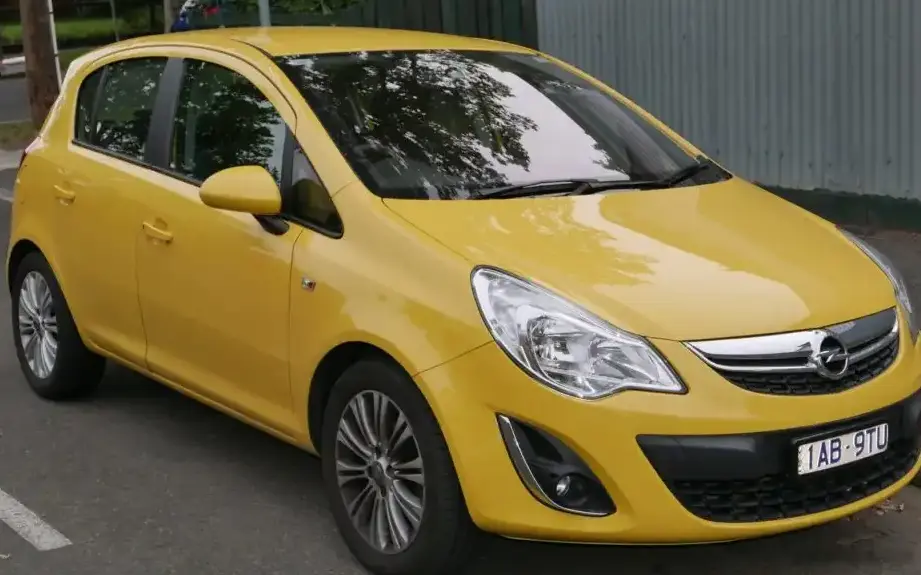
The Opel Corsa D (Facelift, produced from 2011 to August 2014) 5-door 1.4 XER (100 hp) Automatic represents a mainstream offering within the fourth generation of Opel’s popular supermini. Positioned as a practical and economical choice, this variant aimed to provide comfortable transportation for urban and suburban drivers. It sat in the mid-range of the Corsa D lineup, offering a step up from the base 1.2-liter engine while remaining more affordable than the sportier 1.6-liter options. The facelift brought styling updates and minor mechanical revisions to the Corsa D, enhancing its appeal in a competitive market segment.
Technical Specifications
| Brand | Opel |
| Model | Corsa |
| Generation | Corsa D (Facelift 2011) 5-door |
| Type (Engine) | 1.4 XER (100 Hp) Automatic |
| Start of production | 2011 |
| End of production | August, 2014 |
| Powertrain Architecture | Internal Combustion engine |
| Body type | Hatchback |
| Seats | 5 |
| Doors | 5 |
| Fuel consumption (urban) | 7.5 l/100 km (31.4 US mpg, 37.7 UK mpg, 13.3 km/l) |
| Fuel consumption (extra urban) | 4.7 l/100 km (50 US mpg, 60.1 UK mpg, 21.3 km/l) |
| Fuel consumption (combined) | 5.7 l/100 km (41.3 US mpg, 49.6 UK mpg, 17.5 km/l) |
| Fuel Type | Petrol (Gasoline) |
| Acceleration 0 – 100 km/h | 13.9 sec |
| Acceleration 0 – 62 mph | 13.9 sec |
| Acceleration 0 – 60 mph | 13.2 sec |
| Maximum speed | 172 km/h (106.88 mph) |
| Emission standard | Euro 5 |
| Weight-to-power ratio | 11 kg/Hp, 90.9 Hp/tonne |
| Weight-to-torque ratio | 8.5 kg/Nm, 118.2 Nm/tonne |
| Power | 100 Hp @ 6000 rpm |
| Power per litre | 71.5 Hp/l |
| Torque | 130 Nm @ 4000 rpm (95.88 lb.-ft. @ 4000 rpm) |
| Engine layout | Front, Transverse |
| Engine Model/Code | A14XER |
| Engine displacement | 1398 cm3 (85.31 cu. in.) |
| Number of cylinders | 4 |
| Engine configuration | Inline |
| Cylinder Bore | 73.4 mm (2.89 in.) |
| Piston Stroke | 82.6 mm (3.25 in.) |
| Compression ratio | 10.5:1 |
| Number of valves per cylinder | 4 |
| Fuel injection system | Multi-port manifold injection |
| Engine aspiration | Naturally aspirated engine |
| Engine oil capacity | 4 l (4.23 US qt | 3.52 UK qt) |
| Coolant | 6 l (6.34 US qt | 5.28 UK qt) |
| Kerb Weight | 1100 kg (2425.08 lbs.) |
| Max. weight | 1665 kg (3670.7 lbs.) |
| Max load | 565 kg (1245.61 lbs.) |
| Trunk (boot) space – minimum | 285 l (10.06 cu. ft.) |
| Trunk (boot) space – maximum | 1100 l (38.85 cu. ft.) |
| Fuel tank capacity | 42 l (11.1 US gal | 9.24 UK gal) |
| Length | 3999 mm (157.44 in.) |
| Width | 1737 mm (68.39 in.) |
| Width including mirrors | 1944 mm (76.54 in.) |
| Height | 1488 mm (58.58 in.) |
| Wheelbase | 2511 mm (98.86 in.) |
| Front track | 1485 mm (58.46 in.) |
| Rear (Back) track | 1478 mm (58.19 in.) |
| Ride height (ground clearance) | 140 mm (5.51 in.) |
| Drag coefficient (Cd) | 0.32 |
| Minimum turning circle | 10.4 m (34.12 ft.) |
| Drivetrain Architecture | ICE to Front Wheels |
| Drive wheel | Front wheel drive |
| Number of gears and type of gearbox | 4 gears, automatic transmission |
| Assisting systems | ABS (Anti-lock braking system) |
| Steering type | Steering rack and pinion |
| Tires size | 185/65 R15 |
| Wheel rims size | 15 |
INTRODUCTION
The Opel Corsa D facelift, launched in 2011, represented a significant refresh of Opel’s popular supermini. Built on the 1HX0/A3 platform shared with Fiat and other Stellantis brands, the Corsa D aimed to offer a blend of practicality, affordability, and modern features. The 1.4 XER 100 hp Automatic variant was a key part of this strategy, providing a comfortable and convenient option for drivers who preferred an automatic transmission. This model year ran from 2011 through August of 2014.
Powertrain & Engine Architecture
At the heart of the Corsa D 1.4 XER Automatic lies the A14XER engine, a 1.4-liter (1398 cc) inline-four cylinder petrol engine. This engine utilizes a multi-port fuel injection system and a naturally aspirated design. The XER series of engines were known for their relatively simple construction and reasonable reliability. The engine produces 100 horsepower at 6000 rpm and 130 Nm (95.88 lb-ft) of torque at 4000 rpm. The engine features a single overhead camshaft (SOHC) valvetrain with four valves per cylinder. Paired with this engine is a four-speed automatic transmission. While not the most modern transmission available, it provided smooth shifts and ease of use, appealing to a broad range of drivers. The transmission’s gear ratios were optimized for fuel efficiency and everyday driving, rather than outright performance.
Driving Characteristics
The 1.4 XER Automatic Corsa D offered a comfortable, if not particularly exhilarating, driving experience. The 100 hp output and four-speed automatic resulted in a 0-60 mph time of around 13.2 seconds and a top speed of 172 km/h (106.88 mph). Compared to the manual transmission version of the same engine, acceleration was slightly slower due to the transmission’s inherent efficiency losses. Compared to the more powerful 1.6-liter variants, the 1.4 Automatic felt noticeably less responsive, particularly during overtaking maneuvers. However, the automatic transmission made it a more relaxed choice for city driving and commuting. The gear ratios were spaced to prioritize fuel economy, resulting in a relatively quiet and refined ride at cruising speeds.
Equipment & Trim Levels
The Corsa D 1.4 XER Automatic typically came equipped with a reasonable level of standard features. These included power steering, central locking, electric front windows, and an audio system with CD player. Air conditioning was often included, or available as an option. Interior upholstery was typically cloth, with a functional and durable design. Higher trim levels offered options such as alloy wheels, upgraded audio systems, and parking sensors. The dashboard layout was straightforward and user-friendly, with clearly labeled controls. Safety features included ABS brakes and driver and passenger airbags.
Chassis & Braking
The Corsa D utilized a MacPherson strut front suspension and a torsion beam rear suspension. This setup provided a good balance between ride comfort and handling. The front brakes were typically disc brakes, while the rear brakes were drum brakes on most variants, though some higher trim levels featured rear discs. The steering was a rack and pinion system, providing precise and responsive control. The 1.4 Automatic models typically featured a slightly softer suspension setup compared to the sportier 1.6-liter versions, prioritizing ride comfort over handling sharpness.
Market Reception & Comparison
The Opel Corsa D 1.4 XER Automatic was generally well-received as a practical and affordable supermini. Critics praised its comfortable ride, ease of use, and reasonable fuel economy. However, some reviewers noted that the engine lacked outright power and the four-speed automatic transmission felt dated compared to more modern offerings. Compared to the 1.3 CDTi diesel variant, the 1.4 Automatic offered less fuel economy but a smoother and quieter driving experience. Against the 1.6-liter petrol models, it offered a lower price point but sacrificed performance. The Corsa D competed with rivals such as the Ford Fiesta, Volkswagen Polo, and Renault Clio.
Legacy
The Opel Corsa D 1.4 XER Automatic has proven to be a relatively reliable powertrain in the used car market. The A14XER engine is known for its durability, and the four-speed automatic transmission, while not cutting-edge, is generally robust. Common issues include occasional oil leaks and wear on suspension components. Today, these Corsas represent an affordable and practical option for budget-conscious buyers. Their simple mechanical design makes them relatively easy and inexpensive to maintain, and parts availability remains good. While not a performance icon, the Corsa D 1.4 XER Automatic remains a testament to Opel’s commitment to providing reliable and accessible transportation.