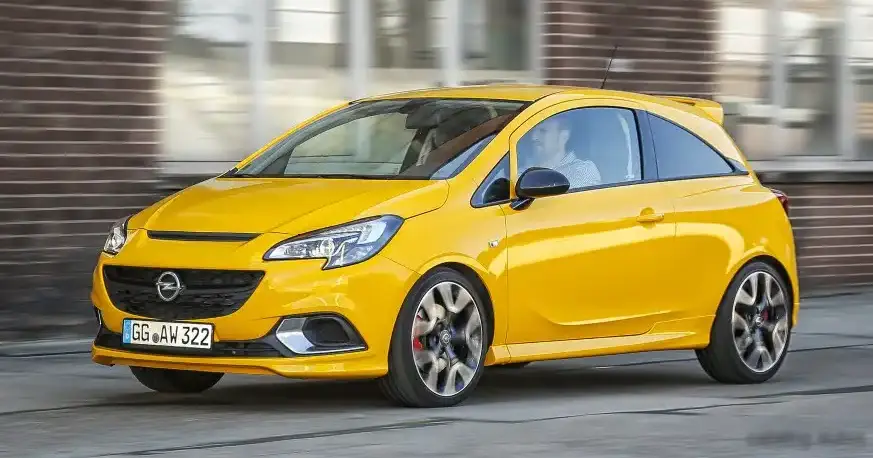
The Opel Corsa E 3-door 1.0 Turbo ECOTEC (115 hp) start&stop, produced from January 2015 to 2018, represented a significant step forward for Opel’s popular subcompact. Positioned as a mid-range offering within the Corsa E lineup, it aimed to balance fuel efficiency with a respectable level of performance. This variant was a key component of Opel’s strategy to offer a diverse range of options to appeal to a broad customer base in the European market. The Corsa E itself was built on the General Motors Gamma II platform, shared with other vehicles like the Chevrolet Trax and Buick Encore, and represented a complete redesign of the Corsa, moving away from the previous generation’s platform.
Technical Specifications
| Brand | Opel |
| Model | Corsa |
| Generation | Corsa E 3-door |
| Type (Engine) | 1.0 Turbo ECOTEC (115 Hp) start&stop |
| Start of production | January, 2015 |
| End of production | 2018 |
| Powertrain Architecture | Internal Combustion engine |
| Body type | Hatchback |
| Seats | 5 |
| Doors | 3 |
| Fuel consumption (urban) | 6 l/100 km (39.2 US mpg, 47.1 UK mpg, 16.7 km/l) |
| Fuel consumption (extra urban) | 4.3 l/100 km (54.7 US mpg, 65.7 UK mpg, 23.3 km/l) |
| Fuel consumption (combined) | 4.9 l/100 km (48 US mpg, 57.6 UK mpg, 20.4 km/l) |
| CO2 emissions | 115 g/km |
| Fuel Type | Petrol (Gasoline) |
| Acceleration 0 – 100 km/h | 10.3 sec |
| Acceleration 0 – 62 mph | 10.3 sec |
| Acceleration 0 – 60 mph | 9.8 sec |
| Maximum speed | 195 km/h (121.17 mph) |
| Emission standard | Euro 6 |
| Weight-to-power ratio | 9.5 kg/Hp, 105.7 Hp/tonne |
| Weight-to-torque ratio | 6.4 kg/Nm, 156.3 Nm/tonne |
| Power | 115 Hp @ 5000-6000 rpm |
| Power per litre | 115.1 Hp/l |
| Torque | 170 Nm @ 1800-4500 rpm (125.39 lb.-ft. @ 1800-4500 rpm) |
| Engine layout | Front, Transverse |
| Engine Model/Code | B10XFT |
| Engine displacement | 999 cm3 (60.96 cu. in.) |
| Number of cylinders | 3 |
| Engine configuration | Inline |
| Cylinder Bore | 74 mm (2.91 in.) |
| Piston Stroke | 77.4 mm (3.05 in.) |
| Compression ratio | 10.5:1 |
| Number of valves per cylinder | 4 |
| Fuel injection system | Direct injection |
| Engine aspiration | Turbocharger, Intercooler |
| Engine oil capacity | 4 l (4.23 US qt | 3.52 UK qt) |
| Coolant | 4.6 l (4.86 US qt | 4.05 UK qt) |
| Kerb Weight | 1088 kg (2398.63 lbs.) |
| Max. weight | 1635 kg (3604.56 lbs.) |
| Max load | 547 kg (1205.93 lbs.) |
| Trunk (boot) space – minimum | 285 l (10.06 cu. ft.) |
| Trunk (boot) space – maximum | 1090 l (38.49 cu. ft.) |
| Fuel tank capacity | 45 l (11.89 US gal | 9.9 UK gal) |
| Max. roof load | 75 kg (165.35 lbs.) |
| Permitted trailer load with brakes (12%) | 1200 kg (2645.55 lbs.) |
| Permitted trailer load without brakes | 560 kg (1234.59 lbs.) |
| Length | 4021 mm (158.31 in.) |
| Width | 1736 mm (68.35 in.) |
| Width including mirrors | 1944 mm (76.54 in.) |
| Height | 1479 mm (58.23 in.) |
| Wheelbase | 2510 mm (98.82 in.) |
| Front track | 1472 mm (57.95 in.) |
| Rear (Back) track | 1464 mm (57.64 in.) |
| Minimum turning circle | 11.00 m (36.09 ft.) |
| Drivetrain Architecture | The Internal combustion engine (ICE) drives the front wheels of the vehicle. |
| Drive wheel | Front wheel drive |
| Number of gears and type of gearbox | 6 gears, manual transmission |
| Front suspension | Independent type McPherson |
| Rear suspension | Semi-independent, coil spring |
| Front brakes | Disc |
| Rear brakes | Disc |
| Assisting systems | ABS (Anti-lock braking system) |
| Steering type | Steering rack and pinion |
| Tires size | 185/65 R15 88H; 185/70 R14 88T |
| Wheel rims size | 6.0J x 15; 5.5J x 14 |
Powertrain & Engine Architecture
The heart of this Corsa variant is the B10XFT, a 1.0-liter turbocharged three-cylinder engine. This engine is part of Opel’s ECOTEC family, known for its focus on efficiency and reduced emissions. The B10XFT utilizes direct fuel injection, a technology that precisely meters fuel into the combustion chamber, improving combustion efficiency and reducing knock. The engine also features a turbocharger with an intercooler, which forces more air into the cylinders, boosting power output. The valvetrain employs four valves per cylinder, optimizing gas flow for improved performance. The engine is transversely mounted at the front of the vehicle, driving the front wheels. The 6-speed manual transmission was the standard offering, providing a balance between fuel economy and driver engagement. The start&stop system further enhances fuel efficiency by automatically shutting off the engine when the vehicle is stationary, such as at traffic lights.
Driving Characteristics
The 115 hp output, combined with 170 Nm (125 lb-ft) of torque, provided adequate performance for everyday driving. While not a sports car, the Corsa E 1.0 Turbo offered a noticeable improvement in acceleration compared to the base 1.2-liter naturally aspirated engine. The turbocharger provides a boost in power at lower RPMs, making it feel responsive in urban environments. However, the three-cylinder engine can feel somewhat coarse and vibrate more than a four-cylinder unit. The 6-speed manual transmission allows for precise gear selection, and the gear ratios are well-suited for both city and highway driving. Compared to the higher-output 1.4-liter Turbo models, this variant felt less powerful, particularly during overtaking maneuvers. However, it offered a more economical and refined driving experience than the base engine.
Equipment & Trim Levels
The Corsa E 1.0 Turbo ECOTEC (115 hp) typically came equipped with features such as air conditioning, power windows, central locking, and a basic audio system with USB connectivity. Higher trim levels added features like alloy wheels, a touchscreen infotainment system with Bluetooth connectivity, cruise control, and parking sensors. Interior upholstery was typically cloth, with options for upgraded materials on higher trims. Safety features included ABS, ESP (Electronic Stability Program), and multiple airbags. Optional extras included a panoramic sunroof, heated seats, and a more advanced navigation system.
Chassis & Braking
The Corsa E utilized a McPherson strut front suspension and a semi-independent torsion beam rear suspension. This setup provided a comfortable ride quality, suitable for everyday driving. The front brakes were ventilated discs, while the rear brakes were solid discs. ABS (Anti-lock Braking System) was standard, enhancing braking performance and stability. The steering was a rack and pinion system, providing precise and responsive handling. The relatively lightweight construction of the Corsa E contributed to its nimble handling characteristics.
Market Reception & Comparison
The Corsa E 1.0 Turbo ECOTEC (115 hp) was generally well-received by automotive critics. It was praised for its fuel efficiency, responsive engine, and comfortable ride. However, some critics noted the engine’s slightly rough character and the limited space in the rear seats. Compared to other trims in the Corsa E lineup, this variant offered a good balance between performance and economy. The 1.4-liter Turbo models provided more power but were more expensive and less fuel-efficient. The base 1.2-liter engine was more affordable but lacked the punch of the 1.0 Turbo. In terms of fuel economy, the 1.0 Turbo consistently outperformed the larger-displacement engines.
Legacy
The B10XFT engine, and the Corsa E 1.0 Turbo variant, have proven to be relatively reliable in the long term. Common issues are typically related to the turbocharger and the direct injection system, but these are not widespread. On the used car market, the Corsa E 1.0 Turbo ECOTEC (115 hp) represents a good value proposition, offering a fuel-efficient and practical small car with reasonable performance. Its compact size and nimble handling make it well-suited for urban driving, and its relatively low running costs make it an attractive option for budget-conscious buyers. The engine’s design and technology have continued to evolve in subsequent Opel/Vauxhall models, demonstrating its lasting impact on the brand’s powertrain strategy.