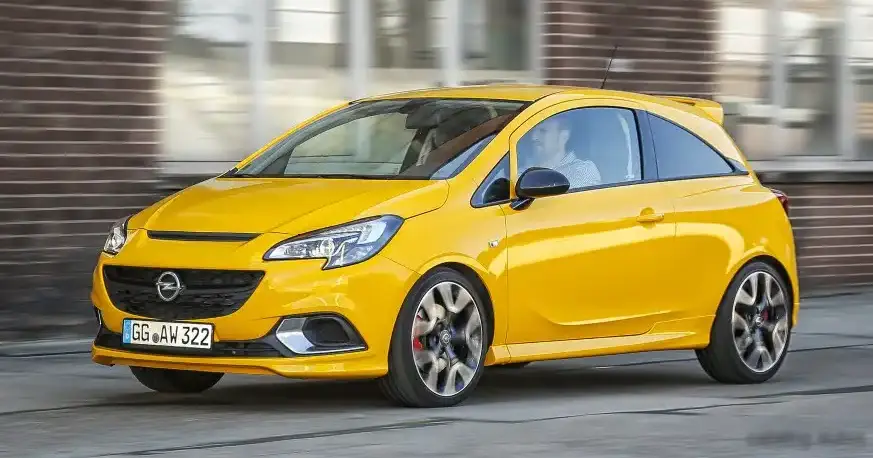
The Opel Corsa E 3-door 1.0 Turbo ECOTEC (90 hp) start&stop was a popular subcompact hatchback produced from January 2015 to 2018. Positioned as an entry-level offering within the Corsa E range, it aimed to provide fuel efficiency and affordability to buyers in the European market. This variant was part of the fifth generation of the Corsa (Corsa E), built on the General Motors Gamma II platform, also shared with models like the Vauxhall/Opel Adam. The 3-door body style offered a sportier aesthetic compared to the 5-door version, appealing to a younger demographic or those prioritizing a more compact footprint.
Technical Specifications
| Brand | Opel |
| Model | Corsa |
| Generation | Corsa E 3-door |
| Type (Engine) | 1.0 Turbo ECOTEC (90 Hp) start&stop |
| Start of production | January, 2015 |
| End of production | 2018 |
| Powertrain Architecture | Internal Combustion engine |
| Body type | Hatchback |
| Seats | 5 |
| Doors | 3 |
| Fuel consumption (urban) | 5.4 l/100 km (43.6 US mpg, 52.3 UK mpg, 18.5 km/l) |
| Fuel consumption (extra urban) | 3.7 l/100 km (63.6 US mpg, 76.3 UK mpg, 27 km/l) |
| Fuel consumption (combined) | 4.3 l/100 km (54.7 US mpg, 65.7 UK mpg, 23.3 km/l) |
| CO2 emissions | 102 g/km |
| Fuel Type | Petrol (Gasoline) |
| Acceleration 0 – 100 km/h | 11.9 sec |
| Acceleration 0 – 62 mph | 11.9 sec |
| Acceleration 0 – 60 mph | 11.3 sec |
| Maximum speed | 180 km/h (111.85 mph) |
| Emission standard | Euro 6 |
| Weight-to-power ratio | 12.1 kg/Hp, 82.7 Hp/tonne |
| Weight-to-torque ratio | 6.4 kg/Nm, 156.3 Nm/tonne |
| Power | 90 Hp @ 3700-6000 rpm |
| Power per litre | 90.1 Hp/l |
| Torque | 170 Nm @ 1800-3700 rpm (125.39 lb.-ft. @ 1800-3700 rpm) |
| Engine layout | Front, Transverse |
| Engine Model/Code | B10XFT |
| Engine displacement | 999 cm3 (60.96 cu. in.) |
| Number of cylinders | 3 |
| Engine configuration | Inline |
| Cylinder Bore | 74 mm (2.91 in.) |
| Piston Stroke | 77.4 mm (3.05 in.) |
| Compression ratio | 10.5:1 |
| Number of valves per cylinder | 4 |
| Fuel injection system | Direct injection |
| Engine aspiration | Turbocharger, Intercooler |
| Engine oil capacity | 4 l (4.23 US qt | 3.52 UK qt) |
| Coolant | 4.6 l (4.86 US qt | 4.05 UK qt) |
| Kerb Weight | 1088 kg (2398.63 lbs.) |
| Max. weight | 1635 kg (3604.56 lbs.) |
| Max load | 547 kg (1205.93 lbs.) |
| Trunk (boot) space – minimum | 285 l (10.06 cu. ft.) |
| Trunk (boot) space – maximum | 1090 l (38.49 cu. ft.) |
| Fuel tank capacity | 45 l (11.89 US gal | 9.9 UK gal) |
| Max. roof load | 75 kg (165.35 lbs.) |
| Permitted trailer load with brakes (12%) | 1200 kg (2645.55 lbs.) |
| Permitted trailer load without brakes | 560 kg (1234.59 lbs.) |
| Length | 4021 mm (158.31 in.) |
| Width | 1736 mm (68.35 in.) |
| Width including mirrors | 1944 mm (76.54 in.) |
| Height | 1479 mm (58.23 in.) |
| Wheelbase | 2510 mm (98.82 in.) |
| Front track | 1472 mm (57.95 in.) |
| Rear (Back) track | 1464 mm (57.64 in.) |
| Minimum turning circle | 11.00 m (36.09 ft.) |
| Drivetrain Architecture | Front wheel drive |
| Number of gears and type of gearbox | 6 gears, manual transmission |
| Front suspension | Independent type McPherson |
| Rear suspension | Semi-independent, coil spring |
| Front brakes | Disc |
| Rear brakes | Disc |
| Assisting systems | ABS (Anti-lock braking system) |
| Steering type | Steering rack and pinion |
| Tires size | 185/65 R15 88H; 185/70 R14 88T |
| Wheel rims size | 6.0J x 15; 5.5J x 14 |
Powertrain & Engine Architecture
The heart of the Corsa E 1.0 Turbo ECOTEC was the B10XFT engine, a 999cc, three-cylinder turbocharged petrol engine. This engine was part of Opel/Vauxhall’s ‘Small Engine Family’ and represented a shift towards downsizing and turbocharging for improved fuel economy. The B10XFT featured direct fuel injection, a single overhead camshaft with four valves per cylinder, and a low-inertia turbocharger. The turbocharger, coupled with an intercooler, helped to deliver a relatively punchy 170 Nm (125 lb-ft) of torque from 1800-3700 rpm. The engine incorporated start&stop technology to further reduce fuel consumption in urban driving conditions. The standard transmission was a 6-speed manual gearbox, designed to maximize the engine’s efficiency and provide reasonable acceleration.
Driving Characteristics
The 90 hp 1.0 Turbo ECOTEC, paired with the 6-speed manual transmission, offered a balanced driving experience. While not particularly quick – 0-60 mph took around 11.3 seconds – it provided sufficient power for everyday driving and overtaking maneuvers. The turbocharger did result in some turbo lag at lower engine speeds, but once spooled up, the engine delivered a noticeable surge of power. The gear ratios were well-chosen to keep the engine within its optimal torque band. Compared to higher-output Corsa E variants, such as those with the 1.4-liter engine, this version prioritized fuel economy over outright performance. The manual transmission offered a more engaging driving experience than the optional automatic, providing greater control over the engine’s power delivery.
Equipment & Trim Levels
The Corsa E 1.0 Turbo ECOTEC (90 hp) typically came equipped with a reasonable level of standard features. These included air conditioning, power steering, electric front windows, a basic audio system with USB connectivity, and ABS brakes. Higher trim levels, such as ‘Energy’ or ‘Sportive’, added features like alloy wheels, cruise control, a touchscreen infotainment system, and upgraded interior trim. Interior upholstery was typically cloth, with a functional and durable design. Optional extras included parking sensors, a rearview camera, and a panoramic sunroof.
Chassis & Braking
The Corsa E featured a McPherson strut front suspension and a semi-independent torsion beam rear suspension. This setup provided a comfortable ride quality, suitable for everyday driving. The front brakes were ventilated discs, while the rear brakes were solid discs. ABS (Anti-lock Braking System) was standard, enhancing safety. The steering was a rack and pinion system, offering precise and responsive handling. The 3-door model, being slightly lighter than the 5-door version, benefited from a marginally improved weight-to-power ratio.
Market Reception & Comparison
The Opel Corsa E 1.0 Turbo ECOTEC (90 hp) was generally well-received by critics for its fuel efficiency and affordability. It was seen as a practical and economical choice for city driving. Compared to other trims in the Corsa E lineup, this variant offered the best fuel economy, making it attractive to budget-conscious buyers. However, some reviewers noted that the engine could feel strained when fully loaded or driving on steep inclines. Competitors in this segment included the Volkswagen Polo, Ford Fiesta, and Renault Clio, all of which offered similar levels of equipment and performance.
Legacy
The B10XFT engine proved to be a relatively reliable unit, although some owners have reported issues with the timing chain. Regular maintenance, including oil changes and timing chain inspections, is crucial for long-term reliability. In the used car market, the Corsa E 1.0 Turbo ECOTEC (90 hp) remains a popular choice due to its low running costs and affordability. It represents a good value proposition for buyers seeking a practical and economical subcompact hatchback. The engine’s fuel efficiency and relatively low emissions continue to make it a relevant option in an increasingly environmentally conscious automotive landscape.