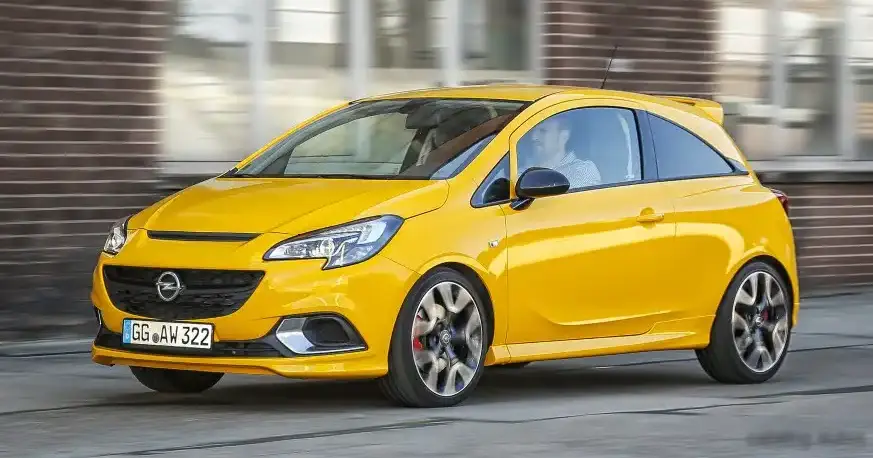
The Opel Corsa E 3-door 1.2 (70 hp) was a subcompact hatchback produced from May 2018 to June 2019. Positioned as an entry-level offering within the Corsa E range, it represented a cost-effective and fuel-efficient option for buyers in the European market. This variant utilized a naturally aspirated 1.2-liter gasoline engine paired with a five-speed manual transmission, targeting drivers prioritizing economy over outright performance. It was built on the General Motors Gamma II platform, shared with other small Opel/Vauxhall and Chevrolet models.
Technical Specifications
| Brand | Opel |
| Model | Corsa |
| Generation | Corsa E 3-door |
| Type (Engine) | 1.2 (70 Hp) |
| Start of production | May, 2018 |
| End of production | June, 2019 |
| Powertrain Architecture | Internal Combustion engine |
| Body type | Hatchback |
| Seats | 5 |
| Doors | 3 |
| Fuel consumption (urban) | 7.2-7.4 l/100 km (32.7 – 31.8 US mpg, 39.2 – 38.2 UK mpg, 13.9 – 13.5 km/l) |
| Fuel consumption (extra urban) | 4.8-5.0 l/100 km (49 – 47 US mpg, 58.9 – 56.5 UK mpg, 20.8 – 20 km/l) |
| Fuel consumption (combined) | 5.6-5.9 l/100 km (42 – 39.9 US mpg, 50.4 – 47.9 UK mpg, 17.9 – 16.9 km/l) |
| CO2 emissions | 129-134 g/km |
| Fuel Type | Petrol (Gasoline) |
| Acceleration 0 – 100 km/h | 16 sec |
| Acceleration 0 – 62 mph | 16 sec |
| Acceleration 0 – 60 mph | 15.2 sec |
| Maximum speed | 162 km/h (100.66 mph) |
| Emission standard | Euro 6d-Temp |
| Weight-to-power ratio | 15.1 kg/Hp, 66 Hp/tonne |
| Weight-to-torque ratio | 9.2 kg/Nm, 108.5 Nm/tonne |
| Power | 70 Hp @ 5600 rpm |
| Power per litre | 57 Hp/l |
| Torque | 115 Nm @ 4000 rpm (84.82 lb.-ft. @ 4000 rpm) |
| Engine layout | Front, Transverse |
| Engine Model/Code | D12XEL |
| Engine displacement | 1229 cm3 (75 cu. in.) |
| Number of cylinders | 4 |
| Engine configuration | Inline |
| Cylinder Bore | 73.4 mm (2.89 in.) |
| Piston Stroke | 72.6 mm (2.86 in.) |
| Compression ratio | 10.5:1 |
| Engine aspiration | Naturally aspirated engine |
| Engine oil capacity | 4 l (4.23 US qt | 3.52 UK qt) |
| Coolant | 5.1 l (5.39 US qt | 4.49 UK qt) |
| Kerb Weight | 1060 kg (2336.9 lbs.) |
| Max. weight | 1590 kg (3505.35 lbs.) |
| Max load | 530 kg (1168.45 lbs.) |
| Trunk (boot) space – minimum | 280 l (9.89 cu. ft.) |
| Trunk (boot) space – maximum | 1090 l (38.49 cu. ft.) |
| Fuel tank capacity | 45 l (11.89 US gal | 9.9 UK gal) |
| Max. roof load | 75 kg (165.35 lbs.) |
| Permitted trailer load with brakes (12%) | 700 kg (1543.24 lbs.) |
| Permitted trailer load without brakes | 540 kg (1190.5 lbs.) |
| Length | 4021 mm (158.31 in.) |
| Width | 1736 mm (68.35 in.) |
| Width including mirrors | 1944 mm (76.54 in.) |
| Height | 1479 mm (58.23 in.) |
| Wheelbase | 2510 mm (98.82 in.) |
| Front track | 1472 mm (57.95 in.) |
| Rear (Back) track | 1464 mm (57.64 in.) |
| Minimum turning circle | 11.2 m (36.75 ft.) |
| Drivetrain Architecture | The Internal combustion engine (ICE) drives the front wheels of the vehicle. |
| Drive wheel | Front wheel drive |
| Number of gears and type of gearbox | 5 gears, manual transmission |
| Front brakes | Disc |
| Rear brakes | Drum |
| Assisting systems | ABS (Anti-lock braking system) |
| Steering type | Steering rack and pinion |
| Power steering | Electric Steering |
| Tires size | 185/70 R14; 185/65 R15; 195/55 R16 |
| Wheel rims size | 14; 15; 16 |
Powertrain & Engine Architecture
The Corsa E 1.2 (70 hp) was powered by the D12XEL engine, a 1.229-liter inline-four cylinder gasoline engine. This engine belonged to Opel’s Family 0 small engine family. It featured a single overhead camshaft (SOHC) valvetrain with two valves per cylinder. Fuel delivery was managed by a multi-point fuel injection system. The engine’s modest output was a result of its relatively small displacement and conservative tuning, prioritizing fuel efficiency and low emissions. The five-speed manual transmission offered a standard gear ratio spread, designed for everyday driving rather than sporty performance. The transmission was a conventional setup, known for its durability and relatively low maintenance requirements.
Driving Characteristics
The 1.2-liter, 70 hp Corsa E 3-door offered modest performance. Acceleration from 0 to 100 km/h (0-62 mph) took approximately 16 seconds. Real-world driving revealed a lack of urgency, particularly when accelerating or overtaking. The engine required frequent downshifts to maintain momentum, especially when loaded or on inclines. Compared to higher-output versions of the Corsa E, such as the 1.4-liter turbo, the 1.2 felt significantly underpowered. However, the light clutch and precise gear changes of the manual transmission made it relatively easy to drive in urban environments. The gear ratios were optimized for fuel economy, resulting in a higher engine speed at highway cruising speeds.
Equipment & Trim Levels
The 1.2 (70 hp) Corsa E typically served as the base trim level. Standard equipment generally included power steering, ABS brakes, a driver’s airbag, and basic audio system. Interior upholstery was typically cloth, with a functional but basic dashboard layout. Optional extras included air conditioning, alloy wheels, and upgraded audio systems. Higher trim levels, such as the Enjoy and Cosmo, added features like electric windows, central locking, and more sophisticated infotainment systems. The base trim focused on providing essential transportation at an affordable price point.
Chassis & Braking
The Corsa E 3-door featured a MacPherson strut front suspension and a torsion beam rear suspension. The torsion beam rear setup was a cost-effective solution, prioritizing space efficiency over outright handling precision. Front brakes were disc brakes, while rear brakes were drum brakes – a common configuration for entry-level models. The steering was electrically assisted, providing light and easy steering feel. The suspension was tuned for comfort, absorbing bumps and imperfections in the road surface reasonably well. Stabilizer bars were present, but relatively thin, contributing to a moderate level of body roll during cornering.
Market Reception & Comparison
The Opel Corsa E 1.2 (70 hp) was generally viewed as a practical and economical city car. Critics praised its fuel efficiency and low running costs, but noted its lack of performance. Compared to other engines in the Corsa E lineup, such as the 1.0-liter turbo or the 1.4-liter naturally aspirated engine, the 1.2 offered the least amount of power. However, it was often the most affordable option. In terms of reliability, the D12XEL engine proved to be generally dependable, with relatively few reported issues. Fuel economy figures were competitive within its segment, making it an attractive option for budget-conscious buyers.
Legacy
The Opel Corsa E 1.2 (70 hp) remains a relatively common sight on the used car market. Its simple mechanical design and proven reliability contribute to its continued appeal. While not a performance car, it offers a dependable and economical mode of transportation. Maintenance costs are generally low, and spare parts are readily available. The D12XEL engine is known for its longevity, provided it receives regular servicing. Today, these Corsas represent an affordable entry point into car ownership, particularly for first-time drivers or those seeking a basic and reliable city car.