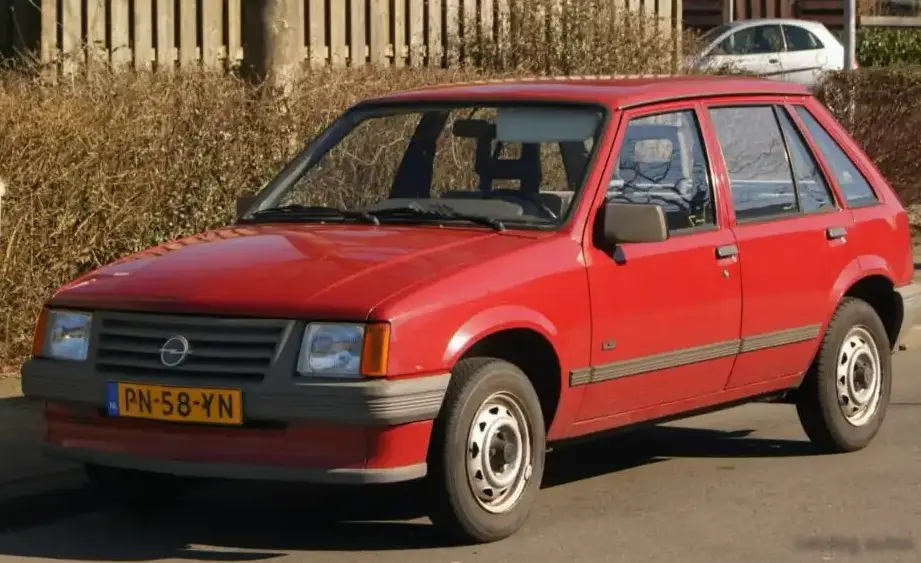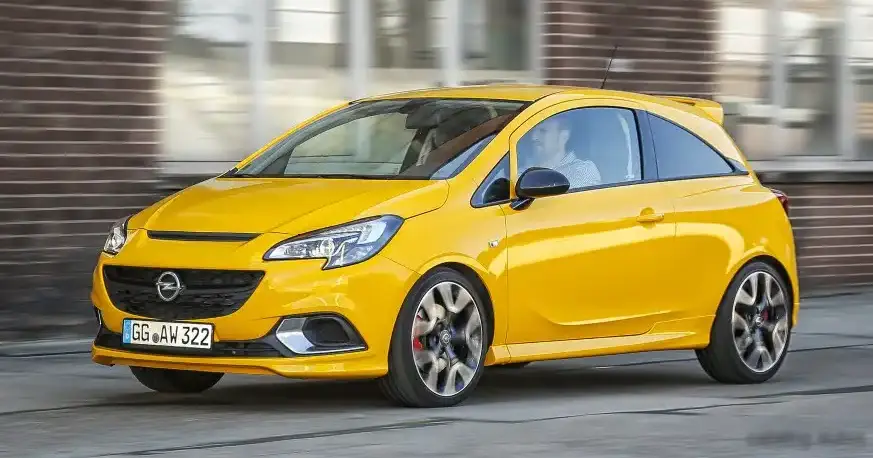
The Opel Corsa E 3-door 1.3 CDTI ECOTEC (95 hp) start/stop was a subcompact hatchback produced from January 2015 to June 2018. Positioned as an entry-level offering within the Corsa E range, it aimed to provide fuel efficiency and affordability to buyers in the European market. This variant represented a key part of Opel’s strategy to offer a diverse lineup catering to various customer needs, particularly those prioritizing low running costs. It was built on the General Motors Gamma II platform, shared with other small Opel/Vauxhall and Chevrolet models.
Technical Specifications
| Brand | Opel |
| Model | Corsa |
| Generation | Corsa E 3-door |
| Type (Engine) | 1.3 CDTI ECOTEC (95 Hp) start/stop |
| Start of production | January, 2015 |
| End of production | June, 2018 |
| Powertrain Architecture | Internal Combustion engine |
| Body type | Hatchback |
| Seats | 5 |
| Doors | 3 |
| Fuel consumption (urban) | 3.7 l/100 km (63.6 US mpg, 76.3 UK mpg, 27 km/l) |
| Fuel consumption (extra urban) | 3 l/100 km (78.4 US mpg, 94.2 UK mpg, 33.3 km/l) |
| Fuel consumption (combined) | 3.3 l/100 km (71.3 US mpg, 85.6 UK mpg, 30.3 km/l) |
| CO2 emissions | 87 g/km |
| Fuel Type | Diesel |
| Acceleration 0 – 100 km/h | 11.9 sec |
| Acceleration 0 – 62 mph | 11.9 sec |
| Acceleration 0 – 60 mph | 11.3 sec |
| Maximum speed | 182 km/h (113.09 mph) |
| Emission standard | Euro 6 |
| Weight-to-power ratio | 11.8 kg/Hp, 84.5 Hp/tonne |
| Weight-to-torque ratio | 5.9 kg/Nm, 169 Nm/tonne |
| Power | 95 Hp @ 3750 rpm |
| Power per litre | 76.1 Hp/l |
| Torque | 190 Nm @ 1500-3500 rpm (140.14 lb.-ft. @ 1500-3500 rpm) |
| Engine layout | Front, Transverse |
| Engine Model/Code | B13DTE |
| Engine displacement | 1248 cm3 (76.16 cu. in.) |
| Number of cylinders | 4 |
| Engine configuration | Inline |
| Cylinder Bore | 69.6 mm (2.74 in.) |
| Piston Stroke | 82 mm (3.23 in.) |
| Compression ratio | 16.25:1 |
| Number of valves per cylinder | 4 |
| Fuel injection system | Diesel Commonrail |
| Engine aspiration | Turbocharger, Intercooler |
| Engine oil capacity | 4 l (4.23 US qt | 3.52 UK qt) |
| Coolant | 6 l (6.34 US qt | 5.28 UK qt) |
| Kerb Weight | 1124 kg (2478 lbs.) |
| Max. weight | 1665 kg (3670.7 lbs.) |
| Max load | 541 kg (1192.7 lbs.) |
| Trunk (boot) space – minimum | 285 l (10.06 cu. ft.) |
| Trunk (boot) space – maximum | 1090 l (38.49 cu. ft.) |
| Fuel tank capacity | 45 l (11.89 US gal | 9.9 UK gal) |
| Permitted trailer load with brakes (12%) | 1150 kg (2535.32 lbs.) |
| Permitted trailer load without brakes | 580 kg (1278.68 lbs.) |
| Length | 4021 mm (158.31 in.) |
| Width | 1736 mm (68.35 in.) |
| Width including mirrors | 1944 mm (76.54 in.) |
| Height | 1479 mm (58.23 in.) |
| Wheelbase | 2510 mm (98.82 in.) |
| Front track | 1472 mm (57.95 in.) |
| Rear (Back) track | 1464 mm (57.64 in.) |
| Minimum turning circle | 11.00 m (36.09 ft.) |
| Drivetrain Architecture | The Internal combustion engine (ICE) drives the front wheels of the vehicle. |
| Drive wheel | Front wheel drive |
| Number of gears and type of gearbox | 5 gears, manual transmission |
| Front suspension | Independent type McPherson |
| Rear suspension | Semi-independent, coil spring |
| Front brakes | Disc |
| Rear brakes | Disc |
| Assisting systems | ABS (Anti-lock braking system) |
| Steering type | Steering rack and pinion |
| Tires size | 185/65 R15 88H; 185/70 R14 88T |
| Wheel rims size | 6.0J x 15; 5.5J x 14 |
Powertrain & Engine Architecture
The heart of this Corsa variant is the 1.3 CDTI (B13DTE) engine, a four-cylinder, inline diesel engine. This engine is part of Opel’s ECOTEC family, known for its focus on efficiency. It utilizes a common rail direct injection system, delivering fuel directly into the combustion chamber at extremely high pressure for optimized combustion. A turbocharger with an intercooler is employed to boost power output and improve torque across a wider rev range. The engine’s 16.25:1 compression ratio is typical for a diesel engine, contributing to its thermal efficiency. The 95 horsepower is achieved at 3750 rpm, while the peak torque of 190 Nm (140 lb-ft) is available between 1500 and 3500 rpm. The engine is paired with a five-speed manual transmission, chosen for its simplicity and cost-effectiveness in this entry-level model. The Start/Stop system, standard on this trim, automatically shuts off the engine when the vehicle is stationary (e.g., at traffic lights) to further reduce fuel consumption and emissions.
Driving Characteristics
The 1.3 CDTI 95 hp engine, coupled with the five-speed manual gearbox, provides adequate, though not exhilarating, performance. Acceleration from 0 to 100 km/h (0-62 mph) takes around 11.9 seconds. The engine’s strength lies in its low-end torque, making it reasonably responsive in urban driving conditions. However, overtaking maneuvers on highways require careful planning. Compared to higher-output Corsa E variants, such as those with the 1.0 Turbo petrol engine or the 1.4 Turbo Diesel, this version feels noticeably less powerful. The gear ratios are tuned for fuel economy rather than outright performance. The clutch feel is generally light, and the gearshift action is precise, but it doesn’t offer the sporty engagement found in some competitor models. The Start/Stop system, while effective in reducing fuel consumption, can sometimes exhibit a slight delay when restarting the engine.
Equipment & Trim Levels
The 1.3 CDTI ECOTEC 95 hp start/stop typically represented a base or near-base trim level in the Corsa E lineup. Standard equipment generally included air conditioning, power steering, electric front windows, a basic audio system with USB connectivity, and ABS brakes. Safety features such as driver and passenger airbags were also standard. Interior upholstery was typically cloth, and the dashboard featured a functional, if somewhat basic, design. Optional extras included alloy wheels, a more advanced infotainment system with touchscreen display, parking sensors, and cruise control. The overall interior ambiance was focused on practicality and durability rather than luxury.
Chassis & Braking
The Corsa E 3-door utilized a McPherson strut suspension setup at the front and a semi-independent torsion beam suspension at the rear. This configuration provides a reasonable balance between ride comfort and handling. The front brakes are disc brakes, while the rear brakes are also disc brakes, providing adequate stopping power for the vehicle’s weight and performance. ABS (Anti-lock Braking System) is standard. The steering is rack and pinion, offering a direct and responsive feel. The relatively lightweight nature of the Corsa E contributes to its agility in city driving.
Market Reception & Comparison
The Opel Corsa E 1.3 CDTI 95 hp start/stop was generally well-received by critics for its fuel efficiency and affordability. It was seen as a practical choice for urban commuters and those seeking a low-cost-to-operate vehicle. However, some reviewers noted its lack of outright performance compared to rival models and higher-spec Corsa E variants. Fuel economy figures of around 3.3 l/100 km (71.3 US mpg) were consistently reported, making it one of the most economical options in its class. Compared to the 1.0 Turbo petrol version, the 1.3 CDTI offered better fuel economy but less overall power. The 1.4 Turbo Diesel provided more performance but came at a higher price point.
Legacy
The 1.3 CDTI engine, while not known for being particularly exciting, proved to be relatively reliable in the Corsa E. Common issues, when they arose, often related to the diesel particulate filter (DPF) requiring regeneration, particularly on vehicles primarily used for short trips. The Start/Stop system could also occasionally experience minor glitches. On the used car market, these models are generally affordable and represent a good value for buyers prioritizing fuel economy. However, potential buyers should carefully check the service history and ensure the DPF has been properly maintained. The Corsa E 1.3 CDTI remains a popular choice for those seeking a practical and economical small hatchback.