Technical Specifications
| Brand | Opel |
| Model | Corsa |
| Generation | Corsa E 3-door |
| Type (Engine) | 1.4 (90 Hp) Automatic |
| Start of production | May, 2018 |
| End of production | June, 2019 |
| Powertrain Architecture | Internal Combustion engine |
| Body type | Hatchback |
| Seats | 5 |
| Doors | 3 |
| Fuel consumption (urban) | 7.3-7.7 l/100 km (32.2 – 30.5 US mpg) |
| Fuel consumption (extra urban) | 5.1-5.4 l/100 km (46.1 – 43.6 US mpg) |
| Fuel consumption (combined) | 5.9-6.2 l/100 km (39.9 – 37.9 US mpg) |
| CO2 emissions | 136-142 g/km |
| Fuel Type | Petrol (Gasoline) |
| Acceleration 0 – 100 km/h | 13.9 sec |
| Acceleration 0 – 62 mph | 13.9 sec |
| Acceleration 0 – 60 mph | 13.2 sec |
| Maximum speed | 170 km/h (105.63 mph) |
| Emission standard | Euro 6d-Temp |
| Weight-to-power ratio | 12.3 kg/Hp |
| Weight-to-torque ratio | 8.5 kg/Nm |
| Power | 90 Hp @ 6000 rpm |
| Torque | 130 Nm @ 4000 rpm (95.88 lb.-ft. @ 4000 rpm) |
| Engine layout | Front, Transverse |
| Engine Model/Code | D14XEL |
| Engine displacement | 1398 cm3 (85.31 cu. in.) |
| Number of cylinders | 4 |
| Engine configuration | Inline |
| Cylinder Bore | 73.4 mm (2.89 in.) |
| Piston Stroke | 82.6 mm (3.25 in.) |
| Compression ratio | 10.5:1 |
| Number of valves per cylinder | 4 |
| Engine oil capacity | 4 l (4.23 US qt | 3.52 UK qt) |
| Coolant capacity | 5.1 l (5.39 US qt | 4.49 UK qt) |
| Kerb Weight | 1103 kg (2431.7 lbs.) |
| Max. weight | 1630 kg (3593.53 lbs.) |
| Max load | 527 kg (1161.84 lbs.) |
| Trunk (boot) space – minimum | 280 l (9.89 cu. ft.) |
| Trunk (boot) space – maximum | 1090 l (38.49 cu. ft.) |
| Fuel tank capacity | 45 l (11.89 US gal | 9.9 UK gal) |
| Max. roof load | 75 kg (165.35 lbs.) |
| Permitted trailer load with brakes (12%) | 800 kg (1763.7 lbs.) |
| Permitted trailer load without brakes | 550 kg (1212.54 lbs.) |
| Length | 4021 mm (158.31 in.) |
| Width | 1736 mm (68.35 in.) |
| Width including mirrors | 1944 mm (76.54 in.) |
| Height | 1479 mm (58.23 in.) |
| Wheelbase | 2510 mm (98.82 in.) |
| Front track | 1472 mm (57.95 in.) |
| Rear track | 1464 mm (57.64 in.) |
| Minimum turning circle | 11.2 m (36.75 ft.) |
| Drivetrain Architecture | Front wheel drive |
| Number of gears and type of gearbox | 6 gears, automatic transmission |
| Front brakes | Disc |
| Rear brakes | Drum |
| Tires size | 185/70 R14; 185/65 R15; 195/55 R16 |
| Wheel rims size | 14; 15; 16 |
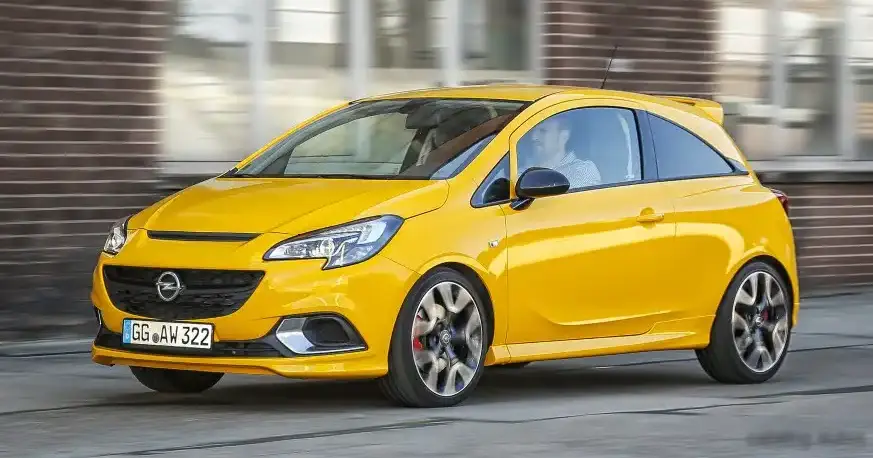
The Opel Corsa E 3-door 1.4 (90 hp) Automatic, produced from May 2018 to June 2019, represented an entry-level offering within the fifth generation of Opel’s popular supermini. Positioned as a practical and affordable option, this variant aimed at buyers prioritizing ease of use and lower running costs over outright performance. It was part of the broader Corsa E range, which utilized the GM Gamma II platform (also known as the 1HX0/A3 platform) and served as Opel’s competitor in the highly competitive European small car segment. This particular configuration – the 1.4-liter engine paired with a six-speed automatic transmission – offered a balance between fuel efficiency and convenience, though it came with compromises in acceleration and driving engagement compared to its manual counterparts.
Powertrain & Engine Architecture
The Corsa E 1.4 Automatic utilized the D14XEL engine code, a naturally aspirated 1.4-liter inline-four cylinder petrol engine. This engine featured multi-point fuel injection and a single overhead camshaft (SOHC) valvetrain with four valves per cylinder. The D14XEL was a relatively simple and robust design, prioritizing reliability and fuel economy over high performance. The six-speed automatic transmission, sourced from AISIN, was a conventional torque converter automatic, offering smooth shifts but contributing to a slight power loss compared to a manual transmission. This transmission was chosen for its affordability and ease of use, aligning with the target demographic of this particular Corsa variant. The engine’s 90 horsepower output at 6000 rpm and 130 Nm (95.88 lb-ft) of torque at 4000 rpm were modest, but sufficient for urban and suburban driving.
Driving Characteristics
The 1.4 Automatic Corsa E offered a comfortable, if uninspiring, driving experience. Acceleration was noticeably slower than the 1.0-liter turbocharged or 1.4-liter manual versions of the Corsa E. The automatic transmission, while smooth, tended to hold onto gears for longer to maximize fuel efficiency, resulting in a somewhat sluggish response during overtaking maneuvers. The gear ratios were optimized for economy rather than performance. In real-world conditions, the car felt best suited to city driving and relaxed highway cruising. The automatic transmission eliminated the need for clutch operation, making it an appealing choice for drivers prioritizing convenience, particularly in congested urban environments.
Equipment & Trim Levels
The 1.4 Automatic trim typically included standard features such as air conditioning, power steering, electric front windows, a basic audio system with USB connectivity, and ABS brakes. Safety features included multiple airbags and stability control. Interior upholstery was typically cloth, with a functional but basic dashboard layout. Optional extras included alloy wheels, a touchscreen infotainment system with Apple CarPlay and Android Auto compatibility, and parking sensors. The trim level generally sat in the lower-mid range of the Corsa E lineup, offering a step up from the very basic entry-level models but lacking the premium features found in higher-spec trims.
Chassis & Braking
The Corsa E 3-door 1.4 Automatic featured a MacPherson strut front suspension and a torsion beam rear suspension. The rear brakes were drum brakes, a cost-saving measure common in this segment and weight class. The electric power steering provided light and easy steering, ideal for urban maneuvering. Stabilizer bars were fitted to both the front and rear axles to reduce body roll during cornering, though the overall handling was geared more towards comfort than sporty dynamics. The suspension was tuned to provide a compliant ride, absorbing bumps and imperfections in the road surface effectively.
Market Reception & Comparison
Critics generally viewed the Corsa E 1.4 Automatic as a sensible and practical choice, but not a particularly exciting one. Its fuel economy was competitive, but not class-leading, and its performance was considered adequate but uninspiring. Compared to the more powerful turbocharged versions of the Corsa E, the 1.4 Automatic offered significantly less performance but also lower running costs and potentially greater long-term reliability. The manual transmission versions of the 1.4-liter engine provided a more engaging driving experience and slightly better fuel economy. The 1.0-liter turbocharged engine offered a better balance of performance and efficiency, but at a slightly higher price point.
Legacy
The D14XEL engine and the AISIN six-speed automatic transmission used in the Corsa E 1.4 Automatic have proven to be relatively reliable powertrains. Common issues are generally limited to routine maintenance items such as spark plugs, air filters, and oil changes. On the used car market, this variant represents an affordable and practical option for buyers seeking a small, economical hatchback. While it may not offer the performance or features of more expensive trims, its simplicity and reliability make it a sensible choice for those prioritizing value and low running costs. The Corsa E, as a whole, helped solidify Opel’s position as a major player in the European small car market, and the 1.4 Automatic variant provided a crucial entry point for budget-conscious buyers.