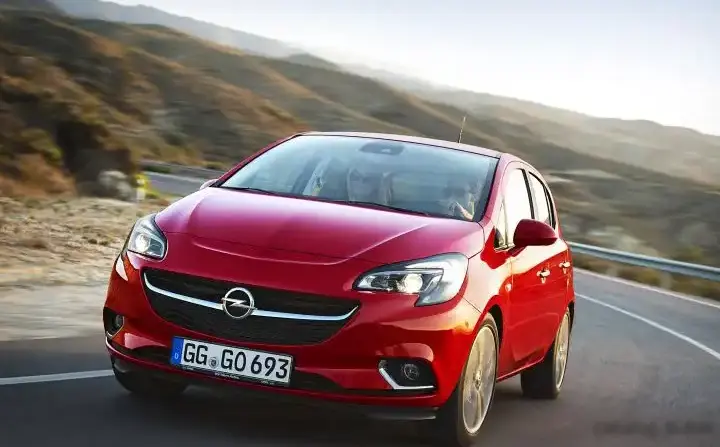
The Opel Corsa E 5-door 1.0 Turbo ECOTEC (90 hp) start&stop was a popular subcompact hatchback produced from January 2015 to June 2018. Positioned as an entry-level offering within the Corsa E range, it aimed to provide affordable and fuel-efficient transportation. This variant was a key part of Opel’s strategy to offer a diverse lineup catering to various customer needs, particularly in European markets where small, economical cars are highly sought after. It utilized the General Motors’ Gamma II platform, also known as the 1HX0/A3 platform, shared with other vehicles like the Chevrolet Trax and Buick Encore.
Technical Specifications
| Brand | Opel |
| Model | Corsa |
| Generation | Corsa E 5-door |
| Type (Engine) | 1.0 Turbo ECOTEC (90 Hp) start&stop |
| Start of production | January, 2015 |
| End of production | June, 2018 |
| Powertrain Architecture | Internal Combustion engine |
| Body type | Hatchback |
| Seats | 5 |
| Doors | 5 |
| Fuel consumption (urban) | 5.5 l/100 km (42.8 US mpg, 51.4 UK mpg, 18.2 km/l) |
| Fuel consumption (extra urban) | 3.9 l/100 km (60.3 US mpg, 72.4 UK mpg, 25.6 km/l) |
| Fuel consumption (combined) | 4.5 l/100 km (52.3 US mpg, 62.8 UK mpg, 22.2 km/l) |
| CO2 emissions | 106 g/km |
| Fuel Type | Petrol (Gasoline) |
| Acceleration 0 – 100 km/h | 11.9 sec |
| Acceleration 0 – 62 mph | 11.9 sec |
| Acceleration 0 – 60 mph | 11.3 sec |
| Maximum speed | 180 km/h (111.85 mph) |
| Emission standard | Euro 6 |
| Weight-to-power ratio | 12.5 kg/Hp, 80.1 Hp/tonne |
| Weight-to-torque ratio | 6.6 kg/Nm, 151.2 Nm/tonne |
| Power | 90 Hp @ 3700-6000 rpm |
| Power per litre | 90.1 Hp/l |
| Torque | 170 Nm @ 1800-3700 rpm (125.39 lb.-ft. @ 1800-3700 rpm) |
| Engine layout | Front, Transverse |
| Engine Model/Code | B10XFT |
| Engine displacement | 999 cm3 (60.96 cu. in.) |
| Number of cylinders | 3 |
| Engine configuration | Inline |
| Cylinder Bore | 74 mm (2.91 in.) |
| Piston Stroke | 77.4 mm (3.05 in.) |
| Compression ratio | 10.5:1 |
| Number of valves per cylinder | 4 |
| Fuel injection system | Direct injection |
| Engine aspiration | Turbocharger, Intercooler |
| Engine oil capacity | 4 l (4.23 US qt | 3.52 UK qt) |
| Coolant | 4.6 l (4.86 US qt | 4.05 UK qt) |
| Kerb Weight | 1124 kg (2478 lbs.) |
| Max. weight | 1665 kg (3670.7 lbs.) |
| Max load | 541 kg (1192.7 lbs.) |
| Trunk (boot) space – minimum | 285 l (10.06 cu. ft.) |
| Trunk (boot) space – maximum | 1120 l (39.55 cu. ft.) |
| Fuel tank capacity | 45 l (11.89 US gal | 9.9 UK gal) |
| Max. roof load | 75 kg (165.35 lbs.) |
| Permitted trailer load with brakes (12%) | 1200 kg (2645.55 lbs.) |
| Permitted trailer load without brakes | 560 kg (1234.59 lbs.) |
| Length | 4021 mm (158.31 in.) |
| Width | 1746 mm (68.74 in.) |
| Width including mirrors | 1944 mm (76.54 in.) |
| Height | 1481 mm (58.31 in.) |
| Wheelbase | 2510 mm (98.82 in.) |
| Front track | 1472 mm (57.95 in.) |
| Rear (Back) track | 1464 mm (57.64 in.) |
| Minimum turning circle | 11.00 m (36.09 ft.) |
| Drivetrain Architecture | The Internal combustion engine (ICE) drives the front wheels of the vehicle. |
| Drive wheel | Front wheel drive |
| Number of gears and type of gearbox | 6 gears, manual transmission |
| Front suspension | Independent type McPherson |
| Rear suspension | Semi-independent, coil spring |
| Front brakes | Disc |
| Rear brakes | Disc |
| Assisting systems | ABS (Anti-lock braking system) |
| Steering type | Steering rack and pinion |
| Tires size | 185/70 R14 88T; 185/65 R15 88H |
| Wheel rims size | 5.5J x 14; 6.0J x 15 |
Powertrain & Engine Architecture
The heart of this Corsa E variant is the B10XFT, a 1.0-liter turbocharged three-cylinder engine. This engine is part of Opel’s ECOTEC family, designed for efficiency and reduced emissions. It features direct fuel injection, a technology that improves combustion efficiency and power output. The turbocharger, coupled with an intercooler, helps to boost power and torque despite the small displacement. The engine produces 90 horsepower at 3700-6000 rpm and 170 Nm (125 lb-ft) of torque between 1800-3700 rpm. The engine utilizes a timing chain, contributing to lower maintenance costs compared to timing belts. The 6-speed manual transmission was standard, offering a good balance between fuel economy and driver engagement. The start&stop system further enhances fuel efficiency by automatically shutting off the engine when the vehicle is stationary.
Driving Characteristics
The 1.0 Turbo ECOTEC (90 hp) with a manual transmission provided adequate, though not exhilarating, performance. Acceleration from 0-60 mph took around 11.3 seconds, and the top speed was 180 km/h (112 mph). The engine felt responsive at lower RPMs thanks to the turbocharger, making it suitable for city driving. However, when fully loaded or tackling steep inclines, the engine could feel strained. Compared to higher-output Corsa E models, such as those with the 1.4-liter engine, this variant offered less power but significantly better fuel economy. The gear ratios were tuned for efficiency, prioritizing fuel savings over outright performance. The manual transmission provided a more engaging driving experience than the optional automatic, allowing drivers to better control the engine’s power band.
Equipment & Trim Levels
The 1.0 Turbo ECOTEC (90 hp) typically served as a mid-range trim level. Standard equipment generally included air conditioning, power windows, central locking, and a basic audio system with USB connectivity. Safety features such as ABS, ESP (Electronic Stability Program), and multiple airbags were also standard. Optional extras included alloy wheels, a touchscreen infotainment system with Apple CarPlay and Android Auto compatibility, cruise control, and parking sensors. Interior upholstery was typically cloth, with a functional and durable design. Higher trim levels offered upgraded interior materials and additional comfort features.
Chassis & Braking
The Corsa E utilized a McPherson strut front suspension and a semi-independent torsion beam rear suspension. This setup provided a comfortable ride quality, suitable for everyday driving. The front brakes were ventilated discs, while the rear brakes were solid discs. ABS (Anti-lock Braking System) was standard, enhancing braking performance and safety. The steering was electrically assisted, providing light and precise control. The chassis was designed to be lightweight, contributing to the car’s overall fuel efficiency.
Market Reception & Comparison
The Opel Corsa E 1.0 Turbo ECOTEC (90 hp) was generally well-received by critics for its fuel efficiency and affordability. It was seen as a practical and economical choice for urban commuters and first-time car buyers. Compared to other trims in the Corsa E lineup, this variant offered the best fuel economy, making it an attractive option for those prioritizing running costs. However, some reviewers noted that the engine lacked the power and refinement of the larger-displacement options. Competitors in this segment included the Volkswagen Polo, Ford Fiesta, and Renault Clio.
Legacy
The B10XFT engine, while not without its quirks, proved to be a relatively reliable powertrain. Common issues reported by owners include occasional turbocharger problems and oil leaks. However, with regular maintenance, these engines can provide many years of service. In the used car market, the Corsa E 1.0 Turbo ECOTEC (90 hp) remains a popular choice due to its affordability and fuel efficiency. It represents a good value proposition for buyers seeking a practical and economical subcompact hatchback. Its reputation for reasonable reliability and low running costs continues to make it a competitive option in the used car segment.