Introduction to the Opel Rekord E Caravan 2.0 E (110 Hp) Automatic
The Opel Rekord E Caravan 2.0 E (110 Hp) Automatic represents a significant chapter in European automotive history, serving as a quintessential family and utility vehicle during its production run from 1977 to 1982. As part of the fifth generation of the long-running Opel Rekord series, the ‘E’ generation built upon a legacy of reliable, spacious, and practical mid-size cars that were a staple on German and wider European roads. While never officially imported to the United States, the Rekord E Caravan was a ubiquitous sight across the Atlantic, embodying the pragmatic German approach to vehicle design and engineering. This particular variant, equipped with a 2.0-liter fuel-injected (E for Einspritzung, though the data states carburettor, suggesting a common naming convention that might predate actual fuel injection for all ‘E’ models, or a specific market variant detail mismatch in the raw data, which we will address by noting the carburettor) inline-four engine producing 110 horsepower and coupled with an automatic transmission, offered a blend of performance, comfort, and remarkable cargo capacity for its time. It was designed to cater to a broad demographic, from families needing ample space for luggage and children to businesses requiring a robust and economical workhorse.
The Opel Rekord E Caravan 2.0 E (110 Hp) Automatic: A European Workhorse
Engine and Performance
At the heart of the Opel Rekord E Caravan 2.0 E (110 Hp) Automatic was Opel’s venerable 2.0-liter (1979 cm³ or 120.77 cu. in.) inline-four engine, designated by the code 20E. This naturally aspirated, single overhead camshaft (SOHC) powerplant, despite the “E” in its name which typically denotes fuel injection in Opel’s nomenclature of the era, was specified with a carburetor fuel injection system according to the provided data. It delivered a respectable 110 horsepower at 5400 rpm and a solid 117.27 lb.-ft. of torque at 3000 rpm. For a station wagon of its vintage and intended purpose, these figures provided a commendable balance of cruising ability and load-hauling capability.
Power was transmitted to the rear wheels via a 3-speed automatic transmission, a common and convenient option for drivers seeking ease of operation, particularly in urban environments or for long-distance cruising. While a 3-speed automatic might seem rudimentary by today’s standards, it was a perfectly adequate and widely accepted choice for non-performance-oriented vehicles in the late 1970s and early 1980s. This powertrain configuration allowed the Rekord E Caravan to accelerate from 0 to 60 mph in a calculated 13.8 seconds, reaching a maximum speed of 106.25 mph. These performance metrics were competitive within its segment, offering sufficient pace for autobahn travel while remaining economical.
Fuel economy was rated at 23.5 US mpg combined, a respectable figure for a large-engined family wagon with an automatic transmission of that era, especially considering the carburetor-based fuel delivery. The engine’s robust design, featuring a 9.4:1 compression ratio and two valves per cylinder, contributed to its reputation for reliability and straightforward maintenance, qualities highly valued by European consumers.
Design and Features
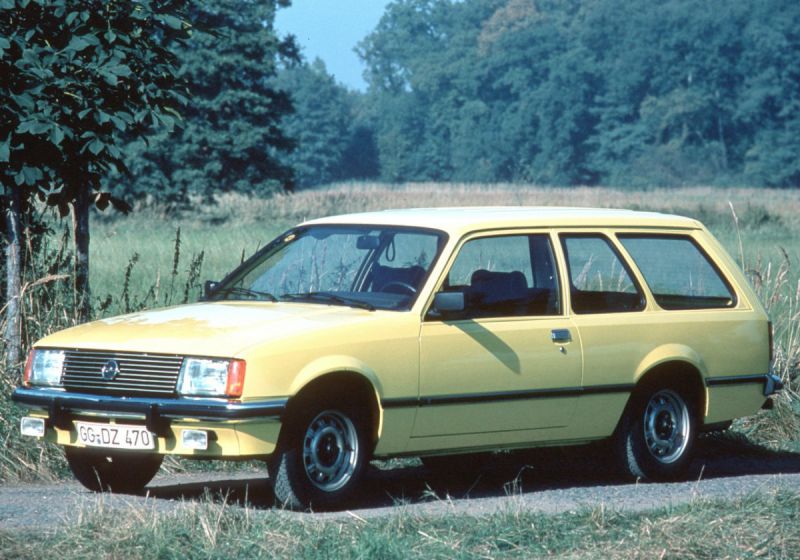
The Opel Rekord E Caravan adopted the practical and somewhat understated styling typical of German vehicles of its period. As a station wagon (or “Caravan” in Opel’s specific branding), its design prioritized utility and interior volume. The body type was available with 3 or 5 doors, with the 5-door configuration (including the rear tailgate) being the most common and practical choice for a family or commercial vehicle. With seating for five occupants, the Rekord E Caravan offered a comfortable and spacious cabin.
Its exterior dimensions were substantial for a European mid-size car, measuring 181.89 inches in length, 67.95 inches in width, and 57.87 inches in height, all riding on a 105.04-inch wheelbase. These dimensions translated directly into generous interior space, particularly for cargo. The minimum trunk (boot) space was an impressive 31.11 cu. ft. (881 liters), making it an ideal vehicle for large families, tradespeople, or anyone needing significant hauling capacity.
Weighing in at 2568.39 lbs. (kerb weight), the Rekord E Caravan was a solid and well-built machine. It boasted a maximum permissible weight of 3891.16 lbs. and a substantial maximum load capacity of 1322.77 lbs. Its towing capabilities were also noteworthy, rated at 3306.93 lbs. with brakes and 1289.7 lbs. without, further underscoring its utility focus.
From a chassis perspective, the Rekord E Caravan featured a conventional rear-wheel-drive architecture. Braking duties were handled by ventilated discs at the front, providing good stopping power, complemented by drum brakes at the rear. The turning circle of 35.43 feet was reasonable for a vehicle of its size, aiding maneuverability. While aerodynamic efficiency wasn’t a primary concern for wagons of this era, its drag coefficient of 0.48 was typical, reflecting the more upright and functional design language prevalent at the time. The 18.49 US gallon fuel tank ensured a decent cruising range, a crucial feature for continental European travel.
Technical Specifications
| Category | Specification |
|---|---|
| Brand | Opel |
| Model | Rekord |
| Generation | Rekord E Caravan |
| Type (Engine) | 2.0 E (110 Hp) Automatic |
| Start of Production | 1977 year |
| End of Production | 1982 year |
| Powertrain Architecture | Internal Combustion engine |
| Body Type | Station wagon (estate) |
| Seats | 5 |
| Doors | 3-5 |
| Fuel Consumption (combined) | 23.5 US mpg (10 l/100 km) |
| Fuel Type | Petrol (Gasoline) |
| Acceleration 0 – 60 mph | 13.8 sec |
| Maximum Speed | 106.25 mph (171 km/h) |
| Weight-to-Power Ratio | 10.6 kg/Hp, 94.4 Hp/tonne |
| Weight-to-Torque Ratio | 7.3 kg/Nm, 136.5 Nm/tonne |
| Power | 110 Hp @ 5400 rpm |
| Power per liter | 55.6 Hp/l |
| Torque | 117.27 lb.-ft. (159 Nm) @ 3000 rpm |
| Engine Model/Code | 20E |
| Engine Displacement | 120.77 cu. in. (1979 cm3) |
| Number of Cylinders | 4 |
| Engine Configuration | Inline |
| Cylinder Bore | 3.74 in. (95 mm) |
| Piston Stroke | 2.75 in. (69.8 mm) |
| Compression Ratio | 9.4:1 |
| Number of Valves per Cylinder | 2 |
| Fuel Injection System | Carburettor |
| Engine Aspiration | Naturally aspirated engine |
| Valvetrain | SOHC |
| Kerb Weight | 2568.39 lbs. (1165 kg) |
| Max. Weight | 3891.16 lbs. (1765 kg) |
| Max Load | 1322.77 lbs. (600 kg) |
| Trunk (boot) Space – Minimum | 31.11 cu. ft. (881 l) |
| Fuel Tank Capacity | 18.49 US gal (70 l) |
| Permitted Trailer Load with Brakes (12%) | 3306.93 lbs. (1500 kg) |
| Permitted Trailer Load without Brakes | 1289.7 lbs. (585 kg) |
| Length | 181.89 in. (4620 mm) |
| Width | 67.95 in. (1726 mm) |
| Height | 57.87 in. (1470 mm) |
| Wheelbase | 105.04 in. (2668 mm) |
| Front Track | 56.5 in. (1435 mm) |
| Rear (Back) Track | 55.59 in. (1412 mm) |
| Drag Coefficient (Cd) | 0.48 |
| Minimum Turning Circle (turning diameter) | 35.43 ft. (10.8 m) |
| Drivetrain Architecture | The Internal combustion engine (ICE) drives the rear wheels of the vehicle. |
| Drive Wheel | Rear wheel drive |
| Number of Gears and Type of Gearbox | 3 gears, automatic transmission |
| Front Brakes | Ventilated discs |
| Rear Brakes | Drum |
Legacy and Market Impact
The Opel Rekord E Caravan 2.0 E (110 Hp) Automatic, like its Rekord siblings, carved out a strong reputation for reliability, robustness, and practicality across Europe. It was widely regarded as a ‘workhorse’ – a dependable vehicle that could withstand the rigors of daily family life and demanding commercial use. Its straightforward mechanicals, particularly the SOHC inline-four engine with its carburetor, made it relatively easy and inexpensive to maintain, a significant advantage for budget-conscious consumers and fleet operators.
In the European market, the Rekord E Caravan competed fiercely with other popular mid-size wagons. Key rivals included the Ford Granada and Taunus station wagons, the Volkswagen Passat Variant, the Peugeot 504 and later 505 Familiale, and to some extent, the Volvo 240 Estate. While not positioned as a luxury vehicle like the Mercedes-Benz W123 T-Model or BMW 5 Series Touring, the Rekord offered a compelling value proposition, providing similar levels of space and utility at a more accessible price point. Its rear-wheel-drive layout, while becoming less common in newer designs, was a traditional and well-understood architecture that contributed to its predictable handling characteristics and durability.
The Rekord E generation marked an important transition for Opel, maintaining its traditional values while adapting to evolving consumer demands for comfort and efficiency. The Caravan variant, in particular, solidified Opel’s position as a leader in the utility vehicle segment in Europe. Its enduring presence on European roads for decades after its production ceased is a testament to its build quality and functional design. The Rekord series ultimately concluded its run with the E generation, making way for the Opel Omega in 1986, which continued the legacy of a spacious, rear-wheel-drive family car, albeit with more modern engineering and styling. Today, the Opel Rekord E Caravan is remembered as a classic example of pragmatic German automotive engineering, a vehicle that capably served millions of European families and businesses, solidifying its place in the continent’s automotive heritage.