The Opel Rekord E Caravan 2.0 S (101 Hp) Automatic: A European Workhorse
The Opel Rekord E Caravan 2.0 S (101 Hp) Automatic, produced from 1977 to 1982, represents a significant chapter in European automotive history, particularly for the German automaker Opel. As the fifth generation of the long-running Rekord series, the ‘E’ iteration continued the model’s tradition as a reliable, spacious, and practical family or fleet vehicle. While not directly sold in the United States, the Rekord E was a ubiquitous sight on European roads, serving as a quintessential mid-size car, offering a blend of utility, comfort, and straightforward engineering. The Caravan, or station wagon variant, was especially popular, providing ample cargo space alongside passenger comfort, making it a versatile choice for a wide range of buyers. This particular specification, featuring the 2.0 S engine paired with an automatic transmission, aimed to offer a balance of adequate power and ease of driving for the discerning European consumer.
Engine and Performance: Powering the Opel Rekord E Caravan
Under the hood of the 1977-1982 Opel Rekord E Caravan 2.0 S lay a robust 2.0-liter (1979 cm³) inline-four engine, designated with the code ’20S’. This naturally aspirated gasoline engine featured a Single Overhead Camshaft (SOHC) valvetrain with two valves per cylinder, a common and reliable configuration for its era. Fuel was delivered via a carburetor, a technology that was still prevalent in the late 1970s before widespread adoption of fuel injection. The engine produced a respectable 101 horsepower at 5200 rpm, translating to a power-per-liter output of 51 horsepower per liter. Torque was rated at 114.32 lb.-ft. (155 Nm), available across a useful band from 3400 to 3800 rpm, ensuring decent pulling power for everyday driving and hauling. The engine’s bore and stroke measured 3.74 inches (95 mm) and 2.75 inches (69.8 mm) respectively, with a compression ratio of 9.4:1.
Power was sent to the rear wheels via a 3-speed automatic transmission. While modern automatics boast many more gears, a 3-speed unit was typical for many mainstream cars of this period, prioritizing smooth shifts and ease of use over outright performance or fuel efficiency. The Rekord E Caravan 2.0 S (101 Hp) Automatic achieved a 0 to 60 mph acceleration in a calculated 14.3 seconds, with a top speed of 102.53 mph (165 km/h). These figures positioned it as a competent, rather than sporty, performer, perfectly adequate for the demands of European highways and urban environments. Fuel economy, while not a primary selling point for all vehicles in the 70s, was rated at a combined 23.5 US mpg (10 l/100 km), which was competitive for a mid-size wagon with an automatic transmission at the time.
Design and Features of the Opel Rekord E Caravan
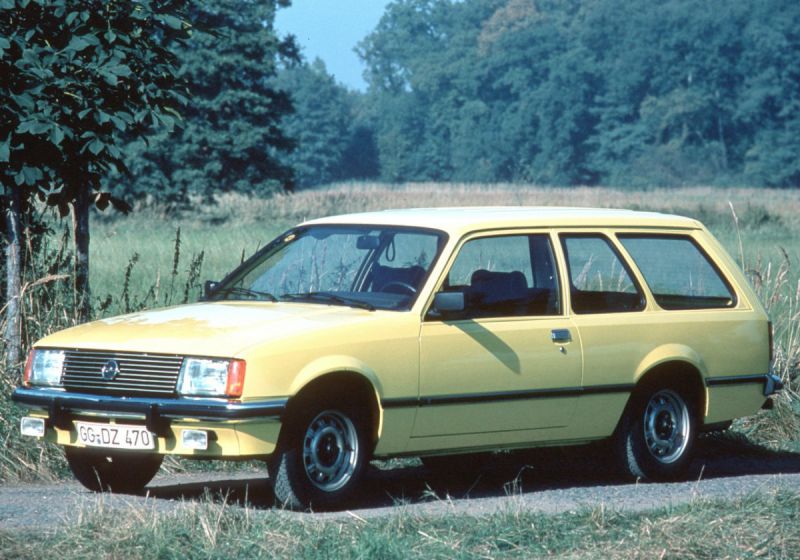
The Opel Rekord E Caravan embodied the functional and somewhat conservative design philosophy prevalent in European family cars of the late 1970s. Its body type was a station wagon, known as an “estate” in many European markets, and typically featured 5 doors, though the data mentions a 3-5 door configuration, likely accounting for commercial van variants or earlier 3-door wagon options. With a length of 181.89 inches (4620 mm), a width of 67.95 inches (1726 mm), and a height of 57.87 inches (1470 mm), the Rekord E Caravan offered substantial interior space for five occupants and their luggage. The wheelbase of 105.04 inches (2668 mm) contributed to a stable ride and generous passenger room.
One of the Rekord Caravan’s most compelling features was its cavernous cargo capacity. With a minimum trunk space of 31.11 cubic feet (881 liters), it was perfectly suited for family vacations, commercial deliveries, or simply hauling groceries. This practicality was a cornerstone of the Rekord’s appeal. The car’s design was characterized by clean, straight lines, large glass areas for good visibility, and a robust, no-nonsense aesthetic that prioritized durability and ease of repair. While advanced safety features like airbags were decades away, the Rekord E would have incorporated standard passive safety measures of its time, such as seatbelts and a sturdy body structure. The braking system comprised ventilated discs at the front and drum brakes at the rear, a common and effective setup for a vehicle of its weight and performance. The relatively high drag coefficient of 0.48 was typical for station wagons of this era, reflecting less aerodynamic optimization compared to modern vehicles.
Technical Specifications
| Category | Specification | US Equivalent (where applicable) |
|---|---|---|
| Brand | Opel | |
| Model | Rekord | |
| Generation | Rekord E Caravan | |
| Type (Engine) | 2.0 S (101 Hp) Automatic | |
| Start of production | 1977 year | |
| End of production | 1982 year | |
| Powertrain Architecture | Internal Combustion engine | |
| Body type | Station wagon (estate) | |
| Seats | 5 | |
| Doors | 3-5 | |
| Performance Specs | ||
| Fuel consumption (economy) – combined | 10 l/100 km | 23.5 US mpg |
| Fuel Type | Petrol (Gasoline) | |
| Acceleration 0 – 60 mph | 14.3 sec | |
| Maximum speed | 165 km/h | 102.53 mph |
| Weight-to-power ratio | 11.5 kg/Hp, 86.7 Hp/tonne | |
| Weight-to-torque ratio | 7.5 kg/Nm, 133 Nm/tonne | |
| Engine Specs | ||
| Power | 101 Hp @ 5200 rpm. | |
| Power per liter | 51 Hp/l | |
| Torque | 155 Nm @ 3400-3800 rpm. | 114.32 lb.-ft. @ 3400-3800 rpm. |
| Engine Model/Code | 20S | |
| Engine displacement | 1979 cm3 | 120.77 cu. in. |
| Number of cylinders | 4 | |
| Engine configuration | Inline | |
| Cylinder Bore | 95 mm | 3.74 in. |
| Piston Stroke | 69.8 mm | 2.75 in. |
| Compression ratio | 9.4:1 | |
| Number of valves per cylinder | 2 | |
| Fuel injection system | Carburetor | |
| Engine aspiration | Naturally aspirated engine | |
| Valvetrain | SOHC | |
| Space, Volume and Weights | ||
| Kerb Weight | 1165 kg | 2568.39 lbs. |
| Max. weight | 1765 kg | 3891.16 lbs. |
| Max load | 600 kg | 1322.77 lbs. |
| Trunk (boot) space – minimum | 881 l | 31.11 cu. ft. |
| Fuel tank capacity | 70 l | 18.49 US gal |
| Permitted trailer load with brakes (12%) | 1500 kg | 3306.93 lbs. |
| Permitted trailer load without brakes | 585 kg | 1289.7 lbs. |
| Dimensions | ||
| Length | 4620 mm | 181.89 in. |
| Width | 1726 mm | 67.95 in. |
| Height | 1470 mm | 57.87 in. |
| Wheelbase | 2668 mm | 105.04 in. |
| Front track | 1435 mm | 56.5 in. |
| Rear (Back) track | 1412 mm | 55.59 in. |
| Drag coefficient (Cd) | 0.48 | |
| Minimum turning circle (turning diameter) | 10.8 m | 35.43 ft. |
| Drivetrain, Brakes and Suspension Specs | ||
| Drivetrain Architecture | The Internal combustion engine (ICE) drives the rear wheels of the vehicle. | |
| Drive wheel | Rear wheel drive | |
| Number of gears and type of gearbox | 3 gears, automatic transmission | |
| Front brakes | Ventilated discs | |
| Rear brakes | Drum | |
Legacy and Market Impact of the Opel Rekord E Caravan
The Opel Rekord E, and particularly its Caravan variant, played a pivotal role in the European automotive landscape during its production run. As one of Opel’s core models, it was a direct competitor to other popular European mid-size cars such as the Ford Taunus and Granada, the Volkswagen Passat (though the Passat was transitioning to front-wheel drive and a slightly smaller segment), and various offerings from French and Italian manufacturers. The Rekord’s enduring appeal stemmed from its reputation for rugged reliability, generous interior space, and straightforward, owner-friendly mechanics. These attributes made it an ideal choice for families, small businesses, and fleet operators across Germany and much of Western Europe.
The 2.0 S engine, offering 101 horsepower, represented a good mid-range option, providing sufficient power without excessive fuel consumption, which was an increasing concern after the oil crises of the 1970s. The availability of an automatic transmission further broadened its appeal, catering to drivers seeking convenience and comfort in increasingly congested urban environments. The Rekord E was often praised for its comfortable ride, predictable handling, and robust build quality, characteristics that cemented Opel’s image as a producer of dependable, value-oriented vehicles.
The Rekord E generation continued a legacy that began in the 1950s, evolving with each iteration to meet contemporary demands while retaining its core identity. Its successor, the Opel Omega, would eventually take over the mantle, but the Rekord E remains a classic example of a utilitarian European car designed for the masses. Its absence from the American market meant it never gained the same recognition stateside, yet it was a fundamental component of daily life for millions of Europeans. Today, the Opel Rekord E Caravan is remembered as a sturdy, practical, and unassuming workhorse that faithfully served its owners, embodying the pragmatic spirit of late 20th-century German engineering and contributing significantly to Opel’s heritage.