The Opel Rekord E Caravan 2.3 D (65 Hp): A European Workhorse of the Late 1970s
Introduction to the Opel Rekord E Caravan
The Opel Rekord E Caravan 2.3 D (65 Hp) represents a significant chapter in European automotive history, serving as a reliable and practical family and utility vehicle during a pivotal era for the industry. Produced by German automaker Opel, a subsidiary of General Motors, the Rekord line had long been a staple in the mid-size segment across the continent. The “E” generation, launched in 1977, continued this tradition, evolving with the times while retaining its core values of durability and functionality. The Caravan, or station wagon variant, was particularly popular for its generous cargo capacity and versatility, making it a common sight on European roads from its introduction in 1978 until the end of its production run in 1982.
In an automotive landscape increasingly concerned with fuel efficiency following the oil crises of the 1970s, the 2.3 D (65 Hp) diesel engine offered a compelling proposition for buyers prioritizing economy and longevity over outright performance. While not sold in the United States, the Opel Rekord E Caravan played a crucial role in Europe, providing an accessible and robust option for families and businesses alike, embodying the pragmatic approach to motoring that defined much of the European market. This article will delve into the technical specifications, design philosophies, and lasting impact of this quintessential European classic.
Engine and Performance of the Opel Rekord E Caravan 2.3 D (65 Hp)
At the heart of the Opel Rekord E Caravan 2.3 D (65 Hp) was a robust 2.3-liter (2260 cubic centimeters, or 137.91 cubic inches) naturally aspirated inline-four diesel engine, designated as the 23D. This powerplant was engineered for reliability and fuel economy, characteristics highly valued in its primary European market during the late 1970s and early 1980s. It produced a modest 65 horsepower at 4200 revolutions per minute (rpm) and 93.67 pound-feet of torque at a low 2500 rpm. While these figures might seem humble by modern standards, they were entirely adequate for the vehicle’s intended purpose as a family hauler and long-distance cruiser.
The engine featured a single overhead camshaft (SOHC) valvetrain with two valves per cylinder, a common and proven design for durability and ease of maintenance. Its precombustion chamber injection system was a standard diesel technology of the era, contributing to its characteristic diesel clatter but also to its impressive fuel efficiency. With a high compression ratio of 22:1, the engine was designed to maximize thermodynamic efficiency, resulting in a combined fuel economy rating of approximately 27.7 US miles per gallon.
Performance-wise, the Rekord E Caravan 2.3 D was not built for speed. Its acceleration from 0 to 60 miles per hour was a leisurely 23.8 seconds, and its top speed reached approximately 86.99 mph. These figures underscored its role as a practical, rather than performance-oriented, vehicle. Power was sent to the rear wheels via a durable 4-speed manual transmission, a setup that provided a direct and engaging driving experience while also being simple and robust. The vehicle’s weight-to-power ratio stood at 19.5 kilograms per horsepower, or 51.2 horsepower per tonne, reflecting its focus on utility over acceleration. Despite its unhurried pace, the Rekord’s mechanical simplicity and the inherent torque of its diesel engine made it a capable vehicle for daily tasks and light towing, with a permitted trailer load of up to 2755.78 pounds with brakes.
Design and Features
The Functional Aesthetic of the Opel Rekord E Caravan
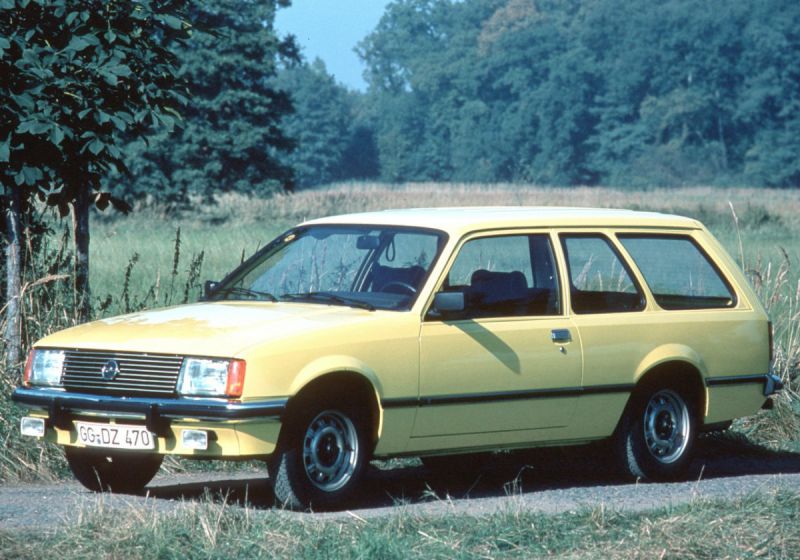
The Opel Rekord E Caravan embodied the design ethos of late 1970s European family cars: practical, spacious, and unpretentious. Its body type was a classic station wagon (referred to as “estate” in many European markets), characterized by a long, squared-off roofline that maximized interior volume. The vehicle typically featured five doors, though some regional configurations might have offered a three-door utility version. With seating for five occupants, the Rekord E Caravan was designed to accommodate families and their luggage comfortably.
Measuring 181.89 inches in length, 67.95 inches in width, and 57.87 inches in height, the Rekord E Caravan offered substantial interior space. Its wheelbase of 105.04 inches contributed to a stable ride, a crucial factor for a vehicle often used for long-distance travel. The most significant feature of the Caravan was its cargo capacity, boasting a minimum trunk space of 31.11 cubic feet (881 liters) with the rear seats in place. This made it an ideal choice for hauling groceries, luggage, or even small commercial loads. The design, while boxy, was functional, providing excellent visibility and a straightforward, no-nonsense aesthetic. The drag coefficient (Cd) of 0.48 was typical for a station wagon of its era, reflecting the priority placed on interior volume and utility rather than aerodynamic sleekness.
In terms of mechanical features, the Rekord E Caravan utilized a conventional and reliable setup. The front brakes were ventilated discs, offering decent stopping power, while the rear brakes were traditional drums, a common configuration for the time. The steering system, with a minimum turning circle of 36.75 feet, facilitated maneuverability in urban environments despite its overall length. The interior, though basic by today’s standards, was durable and ergonomically sound, designed to withstand the rigors of family life. Features focused on practicality, such as a large 18.49 US gallon fuel tank, providing an excellent range for the economical diesel engine. The Rekord E Caravan was a testament to functional design, prioritizing utility, space, and reliability over flamboyant styling or cutting-edge technology.
Technical Specifications: Opel Rekord E Caravan 2.3 D (65 Hp)
| Category | Specification | Value |
|---|---|---|
General Information |
||
| Brand | Opel | |
| Model | Rekord | |
| Generation | Rekord E Caravan | |
| Type (Engine) | 2.3 D (65 Hp) | |
| Start of production | 1978 year | |
| End of production | 1982 year | |
| Powertrain Architecture | Internal Combustion engine | |
| Body type | Station wagon (estate) | |
| Seats | 5 | |
| Doors | 3-5 | |
Performance Specs |
||
| Fuel consumption (economy) – combined | 8.5 l/100 km | 27.7 US mpg |
| Fuel Type | Diesel | |
| Acceleration 0 – 60 mph | 23.8 sec | |
| Maximum speed | 140 km/h | 86.99 mph |
| Weight-to-power ratio | 19.5 kg/Hp | 51.2 Hp/tonne |
| Weight-to-torque ratio | 10 kg/Nm | 100 Nm/tonne |
Engine Specs |
||
| Power | 65 Hp @ 4200 rpm. | |
| Power per liter | 28.8 Hp/l | |
| Torque | 127 Nm @ 2500 rpm. | 93.67 lb.-ft. @ 2500 rpm. |
| Engine Model/Code | 23D | |
| Engine displacement | 2260 cm3 | 137.91 cu. in. |
| Number of cylinders | 4 | |
| Engine configuration | Inline | |
| Cylinder Bore | 92 mm | 3.62 in. |
| Piston Stroke | 85 mm | 3.35 in. |
| Compression ratio | 22:1 | |
| Number of valves per cylinder | 2 | |
| Fuel injection system | Precombustion chamber injection | |
| Engine aspiration | Naturally aspirated engine | |
| Valvetrain | SOHC | |
Space, Volume and Weights |
||
| Kerb Weight | 1270 kg | 2799.87 lbs. |
| Max. weight | 1890 kg | 4166.74 lbs. |
| Max load | 620 kg | 1366.87 lbs. |
| Trunk (boot) space – minimum | 881 l | 31.11 cu. ft. |
| Fuel tank capacity | 70 l | 18.49 US gal |
| Permitted trailer load with brakes (12%) | 1250 kg | 2755.78 lbs. |
| Permitted trailer load without brakes | 655 kg | 1444.03 lbs. |
Dimensions |
||
| Length | 4620 mm | 181.89 in. |
| Width | 1726 mm | 67.95 in. |
| Height | 1470 mm | 57.87 in. |
| Wheelbase | 2668 mm | 105.04 in. |
| Front track | 1435 mm | 56.5 in. |
| Rear (Back) track | 1412 mm | 55.59 in. |
| Drag coefficient (Cd) | 0.48 | |
| Minimum turning circle (turning diameter) | 11.2 m | 36.75 ft. |
Drivetrain, Brakes and Suspension Specs |
||
| Drivetrain Architecture | The Internal combustion engine (ICE) drives the rear wheels of the vehicle. | |
| Drive wheel | Rear wheel drive | |
| Number of gears and type of gearbox | 4 gears, manual transmission | |
| Front brakes | Ventilated discs | |
| Rear brakes | Drum | |
Legacy and Market Impact of the Opel Rekord E Caravan
The Opel Rekord E Caravan 2.3 D (65 Hp) carved out a significant niche in the European automotive market, becoming synonymous with dependability and cost-effective family transport. In an era when European consumers were increasingly conscious of running costs, especially fuel prices, the diesel-powered Rekord offered a compelling value proposition. It was a true workhorse, equally at home ferrying families on vacation as it was delivering goods for small businesses.
Its primary competitors in the European mid-size segment included vehicles like the Ford Granada, Volvo 240, and various offerings from French and Italian manufacturers such as the Peugeot 504 and Fiat 131. While some rivals might have offered more luxurious appointments or sportier performance, the Rekord E Caravan stood out for its robust construction, straightforward mechanics, and excellent practicality. The diesel variant, in particular, was lauded for its longevity and impressive fuel economy, making it a popular choice for high-mileage drivers and taxi fleets.
The Rekord E’s impact was largely defined by its accessibility and utility. It wasn’t a status symbol, but rather a reliable tool that facilitated daily life for countless European households. Its design, though conservative, proved enduring, and its mechanical simplicity meant that maintenance was relatively straightforward and affordable. The Rekord series, culminating with the E generation, laid much of the groundwork for Opel’s subsequent success in the mid-size segment, eventually being succeeded by the Opel Omega in 1986.
Today, the Opel Rekord E Caravan is appreciated by classic car enthusiasts not for its speed or extravagance, but for its historical significance as a quintessential example of practical European motoring. It represents an era when vehicles were designed with a clear purpose: to be reliable, economical, and spacious. Its enduring presence in classic car rallies and enthusiast circles is a testament to its robust build quality and the fond memories it evokes for those who grew up with it. The 2.3 D (65 Hp) variant, in particular, is remembered as a testament to diesel power’s early role in providing efficient and durable transportation for the masses, securing its place as an important piece of Opel’s heritage and European automotive history.