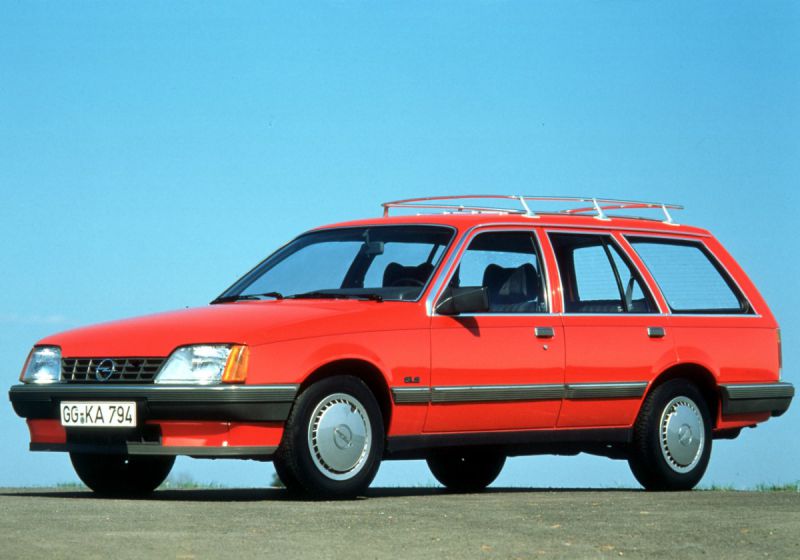
The Opel Rekord E Caravan (facelift 1982) 1.8 S (90 Hp): A European Workhorse
The Opel Rekord E Caravan (facelift 1982) 1.8 S (90 Hp) represents a significant iteration of Opel’s popular mid-size family car, primarily serving the European market during the 1980s. Produced by the German automaker Opel, a subsidiary of General Motors, the Rekord series was renowned for its reliability, practicality, and value. The E generation, launched in 1977, received a substantial facelift in September 1982, bringing updated styling and mechanical refinements that kept it competitive in a fiercely contested segment. This particular variant, the 1.8 S, was a staple in the Rekord E lineup, offering a balanced combination of performance and economy for families and businesses alike.
As a station wagon (known as an “estate car” in Europe), the Rekord E Caravan was designed with utility at its core. It provided ample cargo space and comfortable seating for five, making it an ideal choice for long journeys and everyday hauling. While never officially sold in the United States, the Rekord played a crucial role in Opel’s strategy to capture a broad customer base across Europe, competing fiercely with rivals from Ford, Volkswagen, and other European manufacturers. The 1982 facelift ensured the Rekord remained a contemporary option until its production concluded in August 1986, paving the way for the more modern Opel Omega.
Engine and Performance of the Opel Rekord E Caravan (facelift 1982)
Under the hood, the Opel Rekord E Caravan (facelift 1982) 1.8 S (90 Hp) featured a robust and well-proven 1.8-liter (1796 cm3, or 109.6 cu. in.) inline four-cylinder engine. Codenamed 18S, this naturally aspirated unit was designed for longevity and straightforward maintenance, characteristics highly valued by European consumers of the era. It produced a respectable 90 horsepower (Hp) at 5400 rpm, delivering adequate power for a family wagon of its size and purpose. Torque output was equally pragmatic, peaking at 143 Nm (105.47 lb.-ft.) between 3000 and 3400 rpm, providing decent pulling power for everyday driving and light towing.
The engine utilized a single overhead camshaft (SOHC) valvetrain with two valves per cylinder, a common and reliable configuration for mass-market vehicles at the time. Fuel delivery was managed by a carburetor, a ubiquitous system before the widespread adoption of electronic fuel injection. With a compression ratio of 9.2:1, the engine was designed to run on standard petrol (gasoline). Power was sent to the rear wheels via a five-speed manual transmission, a desirable feature for the early 1980s, offering improved fuel economy over four-speed units and better highway cruising.
Performance figures for the 1.8 S were typical for a non-sporting family car of the era. It could accelerate from 0 to 60 mph in a calculated 14.3 seconds (or 0-100 km/h in 15 seconds), with a maximum speed of 103.77 mph (167 km/h). Fuel economy was a significant selling point, with a combined consumption rating of 8.4 liters per 100 kilometers, translating to an estimated 28 US mpg. This efficiency, combined with a generous 18.49 US gallon (70-liter) fuel tank, provided a substantial cruising range, a practical advantage for family trips across Europe. The powertrain architecture, driving the rear wheels, offered predictable handling and was a hallmark of traditional European family cars before the move to front-wheel drive became more prevalent.
Design and Features
The design of the Opel Rekord E Caravan (facelift 1982) 1.8 S (90 Hp) embodied the functional aesthetic prevalent in early 1980s European automotive design. The facelift in 1982 brought subtle yet effective changes, primarily to the front fascia, including a redesigned grille, headlights, and bumpers, giving the car a more modern and aerodynamic appearance. With a drag coefficient (Cd) of 0.40, it was reasonably slippery for a boxy station wagon of its time, contributing to its fuel efficiency.
The body type was a classic 3-5 door station wagon, emphasizing practicality and cargo capacity. Measuring 184.17 inches (4678 mm) in length, 67.72 inches (1720 mm) in width, and 58.07 inches (1475 mm) in height, the Rekord E Caravan offered a substantial footprint for its class. Its wheelbase of 105.04 inches (2668 mm) contributed to a stable ride and generous interior space for five occupants. The interior, though utilitarian by modern standards, was ergonomically designed, with durable materials and clear instrumentation, focusing on driver and passenger comfort for long journeys.
Key features for the era included a robust unibody construction, providing a solid and safe platform. The braking system comprised ventilated discs at the front and drum brakes at the rear, a common and effective setup for the period. The suspension system, designed for a balance of comfort and load-carrying capability, ensured a smooth ride even when fully laden. The Rekord E Caravan’s minimum turning circle of 35.43 feet (10.8 meters) made it maneuverable in urban environments, despite its size. Its curb weight of 2480.2 lbs (1125 kg) highlighted its robust construction, while a maximum payload capacity of 1421.98 lbs (645 kg) underscored its utility as a versatile family and commercial vehicle. It could also tow a trailer with brakes up to 2204.62 lbs (1000 kg).
Technical Specifications
| Category | Specification |
|---|---|
| Brand | Opel |
| Model | Rekord |
| Generation | Rekord E Caravan (facelift 1982) |
| Engine Type | 1.8 S (90 Hp) |
| Production Start | September, 1982 |
| Production End | August, 1986 |
| Powertrain Architecture | Internal Combustion engine, Rear-wheel drive |
| Body Type | Station wagon (estate) |
| Seats | 5 |
| Doors | 3-5 |
| Performance Specs | |
| Fuel Consumption (Combined) | 8.4 l/100 km (28 US mpg) |
| Fuel Type | Petrol (Gasoline) |
| Acceleration 0-60 mph | 14.3 sec |
| Acceleration 0-100 km/h | 15 sec |
| Maximum Speed | 103.77 mph (167 km/h) |
| Weight-to-Power Ratio | 12.5 kg/Hp (80 Hp/tonne) |
| Weight-to-Torque Ratio | 7.9 kg/Nm (127.1 Nm/tonne) |
| Engine Specs | |
| Power | 90 Hp @ 5400 rpm |
| Power per liter | 50.1 Hp/l |
| Torque | 143 Nm (105.47 lb.-ft.) @ 3000-3400 rpm |
| Engine Model/Code | 18S |
| Engine Displacement | 1796 cm3 (109.6 cu. in.) |
| Number of Cylinders | 4 |
| Engine Configuration | Inline |
| Cylinder Bore | 3.34 in. (84.8 mm) |
| Piston Stroke | 3.13 in. (79.5 mm) |
| Compression Ratio | 9.2:1 |
| Valves per Cylinder | 2 |
| Fuel Injection System | Carburetor |
| Engine Aspiration | Naturally aspirated |
| Valvetrain | SOHC |
| Engine Oil Capacity | 3.75 l (3.96 US qt) |
| Engine Oil Specification | Not specified in data |
| Space, Volume and Weights | |
| Kerb Weight | 2480.2 lbs (1125 kg) |
| Max. Weight (GVWR) | 3902.18 lbs (1770 kg) |
| Max Load | 1421.98 lbs (645 kg) |
| Fuel Tank Capacity | 18.49 US gal (70 l) |
| Permitted Trailer Load (with brakes, 12%) | 2204.62 lbs (1000 kg) |
| Permitted Trailer Load (without brakes) | 1179.47 lbs (535 kg) |
| Dimensions | |
| Length | 184.17 in. (4678 mm) |
| Width | 67.72 in. (1720 mm) |
| Height | 58.07 in. (1475 mm) |
| Wheelbase | 105.04 in. (2668 mm) |
| Front Track | 56.5 in. (1435 mm) |
| Rear Track | 56.38 in. (1432 mm) |
| Ride Height (Ground Clearance) | 5.51 in. (140 mm) |
| Drag Coefficient (Cd) | 0.40 |
| Minimum Turning Circle | 35.43 ft. (10.8 m) |
| Drivetrain, Brakes and Suspension Specs | |
| Drivetrain Architecture | Internal combustion engine drives the rear wheels. |
| Drive Wheel | Rear wheel drive |
| Number of Gears and Type | 5 gears, manual transmission |
| Front Brakes | Ventilated discs |
| Rear Brakes | Drum |
Legacy and Market Impact
The Opel Rekord E Caravan, particularly after its 1982 facelift, solidified its position as a cornerstone of the European mid-size segment. It built upon Opel’s long-standing reputation for producing robust, no-nonsense vehicles that offered excellent utility and reliability without breaking the bank. In its primary markets, the Rekord E Caravan 1.8 S (90 Hp) was a direct competitor to vehicles like the Ford Sierra Estate, the Volkswagen Passat Variant, and other European family-oriented station wagons. Its rear-wheel-drive architecture was increasingly becoming a traditional choice as many competitors began transitioning to front-wheel drive, giving the Rekord a distinct driving feel that some enthusiasts preferred.
The Rekord’s appeal lay in its honest approach to family motoring. It was not a car designed to excite with cutting-edge technology or blistering performance, but rather to serve faithfully as a dependable means of transport. Its spacious interior, large cargo area, and economical engine made it a favorite among families, small businesses, and fleet operators. The 1.8 S engine, in particular, was praised for its balance of power and fuel efficiency, a critical factor during a period of fluctuating fuel prices.
Historically, the Rekord E represented the end of an era for Opel’s traditional rear-wheel-drive mid-size platform, a lineage that stretched back through multiple Rekord generations. Its successor, the Opel Omega (Vauxhall Carlton in the UK), would usher in a new design philosophy and more advanced engineering, though still retaining a rear-wheel-drive layout in its initial forms. The Rekord E’s enduring legacy is one of practicality, durability, and a steadfast commitment to providing reliable transportation for the European masses. Today, well-preserved examples are cherished by classic car enthusiasts who appreciate its straightforward engineering and its role in European automotive history. It stands as a testament to Opel’s commitment to building solid, dependable cars that met the real-world needs of its customers during a pivotal decade for the automotive industry.