The Opel Rekord E Caravan (facelift 1982): A European Workhorse
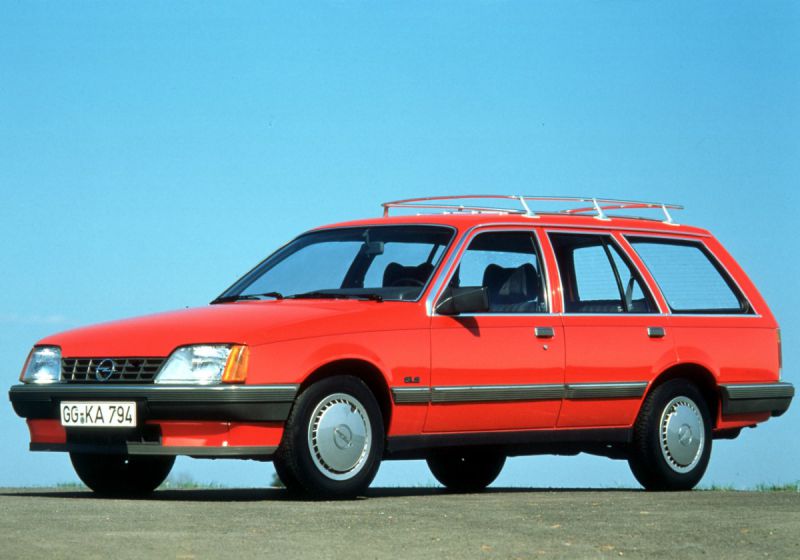
The Opel Rekord E Caravan (facelift 1982) represents a significant chapter in the history of European family vehicles, particularly within the mid-size segment. Produced by the German automaker Opel, a subsidiary of General Motors, the Rekord E series was a ubiquitous sight on European roads throughout the late 1970s and early 1980s. The 1982 facelift introduced a refreshed aesthetic and refined mechanicals, keeping the model competitive in a demanding market. This particular variant, the 2.0 E with 110 Hp and an automatic transmission, epitomized the blend of practicality, comfort, and robust engineering that made the Rekord E a popular choice for families and businesses alike in its primary European market.
While the Opel Rekord was not widely sold in the United States under its original badge, its underlying engineering principles and market positioning would be comparable to American mid-size sedans and station wagons of the era, such as the Chevrolet Celebrity or Ford LTD. Its role was to provide reliable, spacious, and economical transportation, a mission it fulfilled admirably from its facelifted introduction in September 1982 until the end of its production run in August 1984.
Engine and Performance: The Heart of the Opel Rekord E Caravan (facelift 1982)
Under the hood of the Opel Rekord E Caravan (facelift 1982) 2.0 E resided Opel’s venerable 20E inline-four engine. This naturally aspirated, single overhead camshaft (SOHC) unit featured a displacement of 1979 cubic centimeters, or approximately 2.0 Liters. Equipped with a multi-port manifold injection system, the 20E engine was a forward-thinking choice for its time, offering improved fuel efficiency and smoother power delivery compared to carbureted counterparts still common in the early 1980s. It produced a respectable 110 horsepower at 5400 rpm, with a maximum torque output of 119.49 lb.-ft. (162 Nm) achieved at a relatively low 3000 rpm. This torque characteristic ensured ample pulling power, crucial for a family station wagon often laden with passengers and cargo.
Power was sent to the rear wheels via a traditional and robust drivetrain architecture, a hallmark of Opel’s engineering philosophy for the Rekord. The transmission in this specific variant was a 3-speed automatic, designed for smooth, effortless cruising rather than spirited driving. While a 3-speed automatic might seem rudimentary by today’s standards, it was a common and reliable option during this period, prioritizing durability and ease of use. Performance figures for the Rekord 2.0 E Automatic included an acceleration time from 0 to 60 mph in 13.8 seconds and a top speed of 108.74 mph (175 km/h). These numbers were perfectly adequate for a family-oriented vehicle of its era, providing sufficient capability for highway travel and daily commutes.
Fuel economy was also a consideration, with the Rekord 2.0 E Automatic achieving a combined rating of 24.8 US mpg (9.5 l/100 km). This figure, combined with a generous 18.49 US gallon (70 liter) fuel tank, provided a practical cruising range, making it suitable for long-distance European trips. The engine’s robust design, coupled with its proven SOHC valvetrain and fuel injection, contributed to the Rekord’s reputation for reliability and relatively low maintenance for its time.
Design and Features: Practicality Meets European Styling
The Opel Rekord E Caravan (facelift 1982) was designed with an emphasis on practicality and space, characteristic of European station wagons. Its body type was a 5-door station wagon, often referred to as an “estate” in Europe, offering seating for five occupants. The facelift introduced subtle but effective styling updates, including revised front and rear fascias that gave it a more modern appearance than its pre-facelift predecessor. Despite these updates, the Rekord maintained its classically proportioned, somewhat boxy silhouette, which was advantageous for maximizing interior volume.
Dimensions for the Rekord E Caravan were substantial for its class: a length of 184.17 inches (4678 mm), a width of 67.72 inches (1720 mm), and a height of 58.07 inches (1475 mm). Its wheelbase measured 105.04 inches (2668 mm), contributing to a stable ride and generous interior room. The vehicle’s curb weight was 2623.5 pounds (1190 kg), a testament to its solid construction. The design prioritized cargo capacity, with a large rear hatch providing easy access to a cavernous load area, making it ideal for families, small businesses, and those requiring significant hauling capability. The maximum load capacity was 1344.82 pounds (610 kg), further underscoring its utility.
From a safety perspective, the Rekord E, like most cars of its generation, relied on robust structural integrity rather than advanced electronic systems. It featured ventilated disc brakes at the front for effective stopping power, complemented by drum brakes at the rear. The steering system offered a minimum turning circle of 35.43 feet (10.8 meters), providing decent maneuverability for a vehicle of its size. Aerodynamically, the facelifted Rekord E achieved a drag coefficient (Cd) of 0.40, which was a respectable figure for a station wagon of the early 1980s, contributing to its highway stability and fuel efficiency.
Technical Specifications of the Opel Rekord E Caravan (facelift 1982) 2.0 E Automatic
| Category | Specification | Details |
|---|---|---|
| Brand | Opel | |
| Model | Rekord | |
| Generation | Rekord E Caravan (facelift 1982) | |
| Type (Engine) | 2.0 E (110 Hp) Automatic | |
| Production Start | September, 1982 | |
| Production End | August, 1984 | |
| Powertrain Architecture | Internal Combustion engine | |
| Body type | Station wagon (estate) | 5 Doors, 5 Seats |
| Performance Specs | ||
| Fuel Consumption (Combined) | 9.5 l/100 km | 24.8 US mpg |
| Fuel Type | Petrol (Gasoline) | |
| Acceleration 0-60 mph | 13.8 sec | |
| Acceleration 0-100 km/h | 14.5 sec | |
| Maximum Speed | 108.74 mph | 175 km/h |
| Weight-to-power ratio | 10.8 kg/Hp | 92.4 Hp/tonne |
| Weight-to-torque ratio | 7.3 kg/Nm | 136.1 Nm/tonne |
| Engine Specs | ||
| Power | 110 Hp @ 5400 rpm | |
| Power per liter | 55.6 Hp/l | |
| Torque | 119.49 lb.-ft. @ 3000 rpm | 162 Nm @ 3000 rpm |
| Engine Model/Code | 20E | |
| Engine Displacement | 2.0 Liters | 1979 cm3 / 120.77 cu. in. |
| Number of Cylinders | 4 | Inline configuration |
| Cylinder Bore | 3.74 in. | 95 mm |
| Piston Stroke | 2.75 in. | 69.8 mm |
| Compression Ratio | 9.4:1 | |
| Valves per Cylinder | 2 | |
| Fuel Injection System | Multi-port manifold injection | |
| Engine Aspiration | Naturally aspirated engine | |
| Valvetrain | SOHC | |
| Engine Oil Capacity | 4.02 US qt | 3.8 l |
| Coolant Capacity | 6.45 US qt | 6.1 l |
| Space, Volume and Weights | ||
| Kerb Weight | 2623.5 lbs. | 1190 kg |
| Max. Weight | 3968.32 lbs. | 1800 kg |
| Max Load | 1344.82 lbs. | 610 kg |
| Fuel Tank Capacity | 18.49 US gal | 70 l |
| Permitted Trailer Load (with brakes 12%) | 2976.24 lbs. | 1350 kg |
| Permitted Trailer Load (without brakes) | 1179.47 lbs. | 535 kg |
| Dimensions | ||
| Length | 184.17 in. | 4678 mm |
| Width | 67.72 in. | 1720 mm |
| Height | 58.07 in. | 1475 mm |
| Wheelbase | 105.04 in. | 2668 mm |
| Front Track | 56.5 in. | 1435 mm |
| Rear Track | 56.38 in. | 1432 mm |
| Ride Height (Ground Clearance) | 5.51 in. | 140 mm |
| Drag Coefficient (Cd) | 0.40 | |
| Minimum Turning Circle | 35.43 ft. | 10.8 m |
| Drivetrain, Brakes and Suspension Specs | ||
| Drivetrain Architecture | Rear-wheel drive | Internal Combustion engine (ICE) drives the rear wheels |
| Drive Wheel | Rear wheel drive | |
| Number of Gears and Type of Gearbox | 3 gears, automatic transmission | |
| Front Brakes | Ventilated discs | |
| Rear Brakes | Drum | |
Legacy and Market Impact
The Opel Rekord E Caravan (facelift 1982) 2.0 E Automatic holds a significant place in European automotive history as a quintessential family and utility vehicle of its era. It was a cornerstone of Opel’s lineup, competing robustly against contemporaries like the Ford Sierra, Volkswagen Passat, Peugeot 505, and even more premium offerings such as the Volvo 240. Its reputation was built on a foundation of reliability, durability, and practical utility, making it a trusted choice for a wide spectrum of buyers.
The Rekord E’s impact stemmed from its ability to offer a sensible and spacious package at a competitive price point. The facelift in 1982, with its updated styling and the continued availability of fuel-injected engines like the 2.0 E, ensured it remained relevant in a rapidly evolving market. The shift from carbureted engines to multi-port fuel injection was a significant technological advancement for the mainstream segment, improving performance, efficiency, and emissions, even if rudimentary by today’s standards.
As a station wagon, the Rekord E Caravan was particularly valued for its versatility. It served as a reliable daily driver for families, a dependable hauler for tradespeople, and a comfortable cruiser for vacations. Its robust rear-wheel-drive architecture, while traditional, was appreciated by many for its straightforward mechanics and predictable handling, especially when carrying heavy loads or towing. The large fuel tank and decent fuel economy further cemented its reputation as a practical long-distance vehicle.
Although eventually replaced by the more aerodynamically styled Opel Omega in 1986, the Rekord E’s legacy endures as a symbol of mid-century German automotive engineering focused on pragmatic design and enduring quality. It wasn’t a groundbreaking performance machine, nor was it a luxury icon, but it was precisely what millions of Europeans needed and wanted: a dependable, spacious, and honest car that simply got the job done, day in and day out.