The Opel Rekord E Caravan (facelift 1982) 2.0 S (100 Hp): A European Workhorse of the Early 1980s
The Opel Rekord E Caravan (facelift 1982) 2.0 S (100 Hp) represents a significant chapter in European automotive history, embodying the practical, reliable, and unpretentious family and business transportation of its era. Produced by the German automaker Opel, a subsidiary of General Motors, the Rekord line had been a cornerstone of the European market since the mid-20th century, offering a range of body styles from sedans to coupes and, crucially, station wagons (known as “Caravan” in Opel parlance). The E generation, launched in 1977, received a notable facelift in September 1982, bringing subtle yet effective updates to its styling and engineering, which are characteristic of the model under discussion. This particular variant, the 2.0 S with 100 horsepower, was a popular choice for its blend of adequate performance and economical operation, positioning itself as a strong contender in the competitive European mid-size segment. While never officially sold in the United States, the Rekord’s influence on global GM design and engineering philosophies was undeniable, and its role as a robust, everyday vehicle in countries across Europe, Africa, and parts of Asia cemented its legacy.
Evolution and Market Positioning of the Opel Rekord E Caravan (facelift 1982) 2.0 S (100 Hp)
The Opel Rekord E series was designed as a modern, spacious vehicle intended to replace the outgoing Rekord D. It faced the challenge of meeting evolving consumer demands for better fuel economy, improved safety, and more refined driving dynamics, all while maintaining Opel’s reputation for durability and value. The 1982 facelift was a strategic update, intended to keep the Rekord E competitive against newer rivals and to refresh its appearance for the mid-1980s market. Changes included redesigned front and rear fascias, updated interior trim, and minor mechanical refinements. The Caravan, or station wagon, body style was particularly vital for Opel, catering to families and tradespeople who required substantial cargo capacity alongside comfortable passenger accommodation. With its robust rear-wheel-drive architecture and a range of efficient engines, the Rekord E Caravan became a familiar sight on European roads, prized for its utility and straightforward engineering.
Engine and Performance: The Opel Rekord E Caravan (facelift 1982) 2.0 S (100 Hp) Powertrain
At the heart of this particular Rekord E Caravan was the venerable 2.0 S inline-four engine, designated by the engine code “20S.” This naturally aspirated, carbureted powerplant delivered a respectable 100 horsepower at 5400 rpm and 115.06 lb.-ft. of torque at 3800 rpm. With an engine displacement of 1979 cm³ (120.77 cubic inches), its design featured a single overhead camshaft (SOHC) and two valves per cylinder, a common and reliable configuration for its time. The 9:1 compression ratio was typical for a gasoline engine designed to run on the standard unleaded fuels available in Europe.
Power was sent to the rear wheels via a four-speed manual transmission, a setup that provided a direct and engaging driving experience, albeit one focused more on durability and efficiency than outright sportiness. For a family station wagon weighing 2535.32 lbs., the performance figures were quite adequate for the era. The Opel Rekord E Caravan (facelift 1982) 2.0 S (100 Hp) could accelerate from 0 to 60 mph in an estimated 12.8 seconds, reaching a top speed of 108.74 mph. While these numbers might seem modest by today’s standards, they represented competent performance for a utility-focused vehicle in the early 1980s European market, allowing for comfortable cruising on autobahns and effortless hauling of cargo. Fuel economy was rated at a combined 25.8 US mpg, a respectable figure given the carbureted engine and the vehicle’s size and weight.
Design and Features of the Opel Rekord E Caravan (facelift 1982)
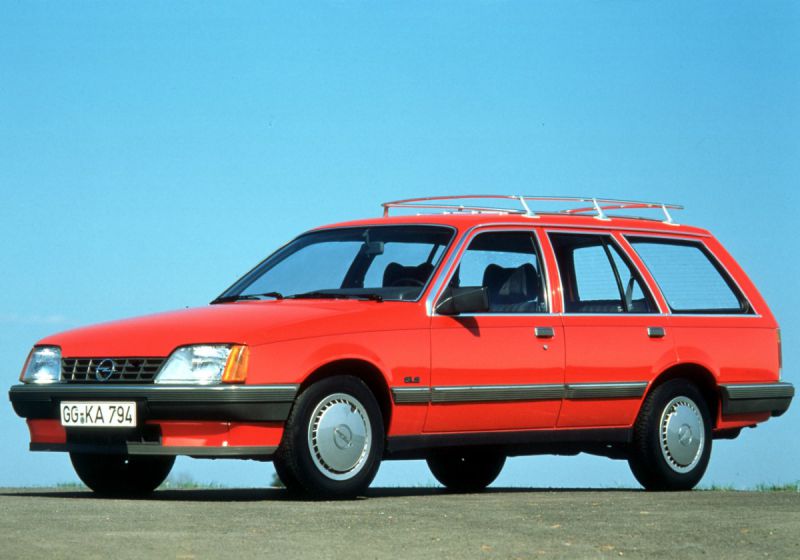
The design philosophy of the Opel Rekord E Caravan was rooted in practicality and functional aesthetics. Its body type, a station wagon, was characterized by a spacious, boxy profile that maximized interior volume, particularly for cargo. The 1982 facelift brought subtle refinements rather than a complete overhaul, ensuring the Rekord E remained fresh without alienating its established customer base. These updates typically included revised grilles, headlamps, taillights, and bumper designs, which gave the car a slightly more modern appearance.
Measuring 184.17 inches in length, 67.72 inches in width, and 58.07 inches in height, with a wheelbase of 105.04 inches, the Rekord E Caravan offered generous interior space for five occupants. The availability of both 3-door and 5-door configurations for the Caravan provided options for different consumer needs, with the 5-door being the more popular and practical choice for families. The minimum trunk (boot) space of 31.11 cubic feet was highly competitive, making it an ideal vehicle for family vacations, hauling groceries, or transporting goods for small businesses.
Inside, the Rekord E featured a straightforward and ergonomic dashboard layout, prioritizing ease of use and durability. Materials were robust, designed to withstand years of daily use. While luxurious amenities were not its primary focus, the Rekord offered comfortable seating and a decent level of standard equipment for its class. Safety features for the early 1980s included a sturdy body structure and disc brakes at the front (ventilated) paired with drum brakes at the rear, a common setup for mid-range cars of the period, providing reliable stopping power. The drag coefficient (Cd) of 0.4 was typical for a boxy station wagon of the era, reflecting a design focused more on utility than aerodynamic sleekness.
Technical Specifications
| Category | Specification |
|---|---|
| Brand | Opel |
| Model | Rekord E Caravan (facelift 1982) |
| Type (Engine) | 2.0 S (100 Hp) |
| Production Start | September, 1982 |
| Production End | August, 1984 |
| Powertrain Architecture | Internal Combustion Engine |
| Body Type | Station wagon (estate), 3-5 Doors |
| Seats | 5 |
| Fuel Consumption (Combined) | 9.1 l/100 km (25.8 US mpg) |
| Fuel Type | Petrol (Gasoline) |
| Acceleration 0-60 mph | 12.8 sec |
| Maximum Speed | 175 km/h (108.74 mph) |
| Power | 100 Hp @ 5400 rpm |
| Torque | 156 Nm (115.06 lb.-ft.) @ 3800 rpm |
| Engine Model/Code | 20S |
| Engine Displacement | 1979 cm³ (120.77 cu. in.) |
| Number of Cylinders | 4, Inline |
| Cylinder Bore | 95 mm (3.74 in.) |
| Piston Stroke | 69.8 mm (2.75 in.) |
| Compression Ratio | 9:1 |
| Valves per Cylinder | 2 |
| Fuel Injection System | Carburetor |
| Engine Aspiration | Naturally aspirated |
| Valvetrain | SOHC |
| Engine Oil Capacity | 3.8 l (4.02 US qt) |
| Coolant Capacity | 6.1 l (6.45 US qt) |
| Kerb Weight | 1150 kg (2535.32 lbs.) |
| Max. Weight | 1800 kg (3968.32 lbs.) |
| Max Load | 650 kg (1433 lbs.) |
| Trunk (Boot) Space – min | 881 l (31.11 cu. ft.) |
| Fuel Tank Capacity | 70 l (18.49 US gal) |
| Length | 4678 mm (184.17 in.) |
| Width | 1720 mm (67.72 in.) |
| Height | 1475 mm (58.07 in.) |
| Wheelbase | 2668 mm (105.04 in.) |
| Front Track | 1435 mm (56.5 in.) |
| Rear Track | 1432 mm (56.38 in.) |
| Ground Clearance | 140 mm (5.51 in.) |
| Drag Coefficient (Cd) | 0.4 |
| Minimum Turning Circle | 10.8 m (35.43 ft.) |
| Drivetrain Architecture | Rear-wheel drive, Internal Combustion Engine |
| Drive Wheel | Rear wheel drive |
| Gearbox | 4 gears, manual transmission |
| Front Brakes | Ventilated discs |
| Rear Brakes | Drum |
Legacy and Market Impact
The Opel Rekord E Caravan (facelift 1982) 2.0 S (100 Hp) carved out a significant niche in the European automotive landscape during its production run from 1982 to 1984. It was a vehicle that epitomized the values of reliability, practicality, and affordability, which were highly regarded by European consumers. Its reputation as a sturdy and dependable workhorse made it a popular choice not only for families but also for businesses, taxis, and public service fleets across the continent.
In its primary European market, the Rekord E Caravan competed fiercely with other established models in the mid-size segment. Key rivals included the Ford Granada and later the Ford Sierra, the Volkswagen Passat (Santana in some markets), and even more premium offerings like the Mercedes-Benz W123 T-model (station wagon). Compared to its competitors, the Rekord typically offered a compelling balance of space, comfort, and running costs. While the Ford models often emphasized more dynamic driving characteristics, and Mercedes-Benz focused on luxury and engineering prowess, the Opel Rekord positioned itself as the sensible, no-nonsense option. Its rear-wheel-drive layout, though becoming less common in mainstream cars by the mid-1980s, offered predictable handling and good towing capabilities, further enhancing its utility appeal.
The Rekord E, particularly in its Caravan guise, played a crucial role in maintaining Opel’s strong market presence. It showcased the brand’s ability to produce robust, well-engineered vehicles that met the everyday needs of a broad customer base. The 2.0 S engine, in particular, was lauded for its longevity and ease of maintenance, contributing to the Rekord’s enduring appeal. While it may not have been a trendsetter in terms of groundbreaking technology or avant-garde design, its consistent performance and unwavering utility ensured its success.
Today, the Opel Rekord E Caravan is remembered as a classic example of mainstream European motoring from the 1980s. Many examples have faded from daily use, but a dedicated enthusiast community keeps its legacy alive. Its historical significance lies in its embodiment of a transitional period in automotive design and engineering, bridging the gap between the more traditional, rear-wheel-drive cars of the 1970s and the front-wheel-drive, aerodynamically optimized vehicles that would dominate the late 1980s and beyond. The Rekord E Caravan stands as a testament to Opel’s commitment to providing reliable, spacious, and efficient transportation solutions for the everyday European consumer, a true automotive workhorse that served its purpose admirably.