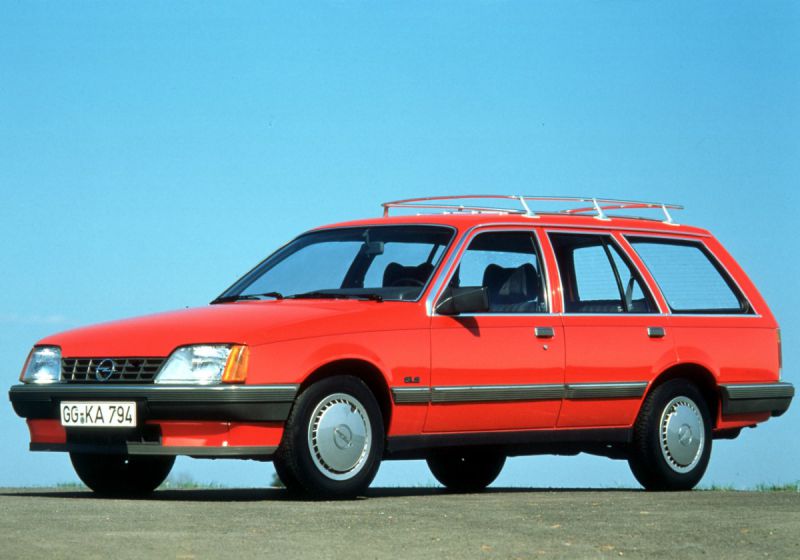
Opel Rekord E Caravan (facelift 1982) 2.0 S (101 Hp): A European Workhorse
The Opel Rekord E Caravan (facelift 1982) represents a significant chapter in European automotive history, embodying the practical, reliable, and value-oriented ethos that defined Opel for decades. Launched in September 1982 as a refreshed version of the fifth-generation Rekord (E2), this particular variant, the 2.0 S, was a popular choice for families and businesses across the continent. While never officially imported to the United States, the Rekord E played a crucial role in Opel’s strategy as a mainstream, rear-wheel-drive family car, offering a blend of spaciousness, straightforward engineering, and respectable performance for its era. This station wagon, known as “Caravan” in Opel’s nomenclature, was designed to be a versatile vehicle, combining passenger comfort with substantial cargo capacity, making it a ubiquitous sight on European roads during the early to mid-1980s.
The Opel Rekord E Caravan: Engineering and Evolution
The Rekord E series, introduced in 1977, was Opel’s answer to the evolving demands of the European market, succeeding the long-running Rekord D. The 1982 facelift, often referred to as the Rekord E2, brought a series of aesthetic and mechanical refinements aimed at keeping the model competitive against rivals from Ford, Volkswagen, and Volvo. This refresh was characterized by a more aerodynamic front end, revised taillights, and interior updates, enhancing its modern appeal. The Opel Rekord E Caravan, in its 2.0 S guise, was positioned as a capable and economical option within the lineup, balancing power with fuel efficiency for everyday use. Its robust, rear-wheel-drive architecture, a hallmark of Opel’s larger models at the time, contributed to its reputation for durability and predictable handling.
Engine and Performance
Under the hood of the Opel Rekord E Caravan (facelift 1982) 2.0 S lay a reliable 2.0-liter (1979 cm3 or 120.77 cu. in.) naturally aspirated inline-four engine, designated with the code “20S.” This powerplant, featuring a single overhead camshaft (SOHC) and a carburetor fuel injection system, delivered a respectable 101 horsepower at 5400 rpm. Torque output stood at 115.06 lb.-ft. (156 Nm) at a relatively low 3800 rpm, providing ample pulling power for daily driving and highway cruising, even when fully loaded.
Mated to a four-speed manual transmission, the 2.0 S engine propelled the Rekord Caravan from 0 to 60 mph in a calculated 12.8 seconds, with a top speed of approximately 108.74 mph (175 km/h). While these figures may seem modest by today’s standards, they were competitive for a family station wagon in the early 1980s. Fuel economy was a notable strong suit for the era, with a combined consumption rating of 25.8 US mpg (9.1 l/100 km), making it an economical choice for long-distance travel. The engine’s robust design, featuring a 95 mm bore and 69.8 mm piston stroke, along with a 9:1 compression ratio, ensured a balance of responsiveness and longevity, critical attributes for a car intended for extensive use.
Design and Features
The Opel Rekord E Caravan (facelift 1982) was designed primarily for practicality and utility. Its station wagon (estate) body type offered immense versatility, with a large rear cargo area accessible via a wide tailgate. Depending on the configuration, it was available with either three or five doors, providing flexibility for different market needs, though the five-door variant was the more common and practical choice for families. The cabin comfortably seated five occupants, with a focus on durable materials and straightforward ergonomics that characterized Opel interiors of the period.
Visually, the Rekord E2 facelift introduced a more contemporary look compared to its predecessor. The front fascia received a significant update, featuring a new grille and headlights that streamlined its appearance and improved aerodynamics, contributing to a drag coefficient (Cd) of 0.40. The overall aesthetic was clean and functional, prioritizing utility over flamboyant styling. Standard features for the 2.0 S model would have included basic heating and ventilation, comfortable cloth seating, and perhaps a simple radio. Safety features, typical for the early 1980s, primarily revolved around a robust body structure, seatbelts, and a dual-circuit braking system with ventilated discs at the front and drum brakes at the rear, providing adequate stopping power for the vehicle’s weight and performance. The rear-wheel-drive architecture, while common for its time, also contributed to a balanced driving feel, especially when carrying heavy loads.
Technical Specifications
| Opel Rekord E Caravan (facelift 1982) 2.0 S (101 Hp) | |
|---|---|
| General Information | |
| Brand | Opel |
| Model | Rekord |
| Generation | Rekord E Caravan (facelift 1982) |
| Type (Engine) | 2.0 S (101 Hp) |
| Start of Production | September, 1982 |
| End of Production | August, 1984 |
| Powertrain Architecture | Internal Combustion engine |
| Body type | Station wagon (estate) |
| Seats | 5 |
| Doors | 3-5 |
| Performance Specs | |
| Fuel consumption (combined) | 25.8 US mpg (9.1 l/100 km) |
| Fuel Type | Petrol (Gasoline) |
| Acceleration 0 – 60 mph | 12.8 sec |
| Acceleration 0 – 62 mph (100 km/h) | 13.5 sec |
| Maximum speed | 108.74 mph (175 km/h) |
| Weight-to-power ratio | 11.4 kg/Hp (87.8 Hp/tonne) |
| Weight-to-torque ratio | 7.4 kg/Nm (135.7 Nm/tonne) |
| Engine Specs | |
| Power | 101 Hp @ 5400 rpm |
| Power per liter | 51 Hp/l |
| Torque | 115.06 lb.-ft. (156 Nm) @ 3800 rpm |
| Engine Model/Code | 20S |
| Engine displacement | 2.0 l (1979 cm3, 120.77 cu. in.) |
| Number of cylinders | 4 |
| Engine configuration | Inline |
| Cylinder Bore | 3.74 in. (95 mm) |
| Piston Stroke | 2.75 in. (69.8 mm) |
| Compression ratio | 9:1 |
| Number of valves per cylinder | 2 |
| Fuel injection system | Carburetor |
| Engine aspiration | Naturally aspirated engine |
| Valvetrain | SOHC |
| Engine oil capacity | 4.02 US qt (3.8 l) |
| Coolant capacity | 6.45 US qt (6.1 l) |
| Space, Volume and Weights | |
| Kerb Weight | 2535.32 lbs. (1150 kg) |
| Max. weight | 3968.32 lbs. (1800 kg) |
| Max load | 1433 lbs. (650 kg) |
| Fuel tank capacity | 18.49 US gal (70 l) |
| Permitted trailer load with brakes (12%) | 2755.78 lbs. (1250 kg) |
| Permitted trailer load without brakes | 1179.47 lbs. (535 kg) |
| Dimensions | |
| Length | 184.17 in. (4678 mm) |
| Width | 67.72 in. (1720 mm) |
| Height | 58.07 in. (1475 mm) |
| Wheelbase | 105.04 in. (2668 mm) |
| Front track | 56.5 in. (1435 mm) |
| Rear (Back) track | 56.38 in. (1432 mm) |
| Ride height (ground clearance) | 5.51 in. (140 mm) |
| Drag coefficient (Cd) | 0.40 |
| Minimum turning circle (turning diameter) | 35.43 ft. (10.8 m) |
| Drivetrain, Brakes and Suspension Specs | |
| Drivetrain Architecture | The Internal combustion engine (ICE) drives the rear wheels of the vehicle. |
| Drive wheel | Rear wheel drive |
| Number of gears and type of gearbox | 4 gears, manual transmission |
| Front brakes | Ventilated discs |
| Rear brakes | Drum |
Legacy and Market Impact of the Opel Rekord E Caravan
The Opel Rekord E Caravan (facelift 1982) cemented its place as a cornerstone of the European automotive landscape during its production run from 1982 to 1984. As a true workhorse, it was widely appreciated for its rugged dependability, generous interior space, and cost-effectiveness, appealing to a broad spectrum of buyers from families needing practical transport to businesses requiring a reliable fleet vehicle. Its rear-wheel-drive layout, while becoming less common in mainstream sedans and wagons by the mid-1980s, offered a traditional driving feel and excellent towing capabilities, with a permitted trailer load of up to 2755.78 lbs. (1250 kg) with brakes.
In its primary European markets, the Rekord E Caravan faced stiff competition from contemporaries such as the Ford Granada Turnier, the Volkswagen Passat B2 Variant, and the Volvo 240 Estate. While the Granada often offered a slightly more upmarket feel and the Volvo boasted an unparalleled reputation for safety and longevity, the Rekord carved out its niche by offering a compelling balance of all these attributes at a competitive price point. Opel’s extensive dealer network and reputation for straightforward maintenance further enhanced its appeal.
The Rekord E generation marked the end of an era for Opel, as it was the last large, rear-wheel-drive family car before the introduction of the front-wheel-drive Omega in 1986. This transition reflected the broader industry shift towards more space-efficient and often lighter front-wheel-drive platforms. Consequently, the Rekord E Caravan holds a special place in the hearts of many European enthusiasts as a symbol of traditional German engineering and a testament to a period when reliability and utility were paramount. Though it never crossed the Atlantic in significant numbers, its impact on the daily lives of millions in Europe was profound, establishing it as an iconic family and utility vehicle of its time. Even today, well-maintained examples are cherished by collectors and continue to serve as a reminder of Opel’s enduring legacy in building dependable, practical automobiles.