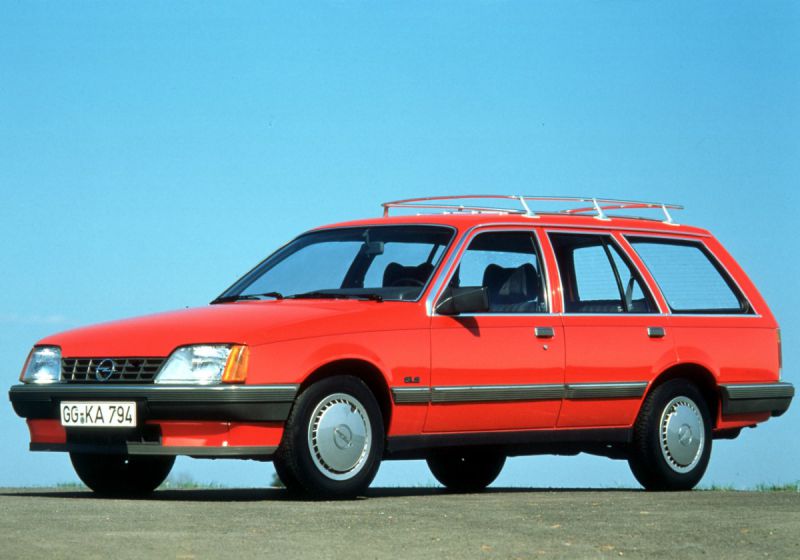
As an international automotive expert, I present a detailed analysis of the Opel Rekord E Caravan (facelift 1982) 2.0 S, a significant European family vehicle from the early 1980s. This article, presented in American English, delves into its technical specifications, design philosophy, performance characteristics, and its indelible mark on the automotive landscape of its time.
Introduction to the Opel Rekord E Caravan (facelift 1982) 2.0 S
The Opel Rekord E Caravan (facelift 1982) 2.0 S represents a pivotal moment in the history of Opel, General Motors’ European subsidiary. Launched in 1982, this particular iteration was part of the refreshed E-generation Rekord, a ubiquitous sight on European roads throughout the late 1970s and early 1980s. The Rekord series, dating back to 1953, consistently served as Opel’s mid-size workhorse, offering a blend of practicality, reliability, and conservative styling that appealed to a broad demographic, from families to small businesses. The “Caravan” designation proudly indicated its station wagon body style, emphasizing its utility and cargo-carrying capabilities – a highly popular vehicle type in Europe. The 2.0 S variant, with its 98 horsepower engine, was a well-balanced offering, providing adequate performance for the era without sacrificing fuel economy, making it a sensible choice for the European market where fuel prices were a constant consideration. While never officially sold in the United States, the Rekord E Caravan played a crucial role in shaping the perception of robust, no-nonsense family transportation across the Atlantic, embodying the pragmatic design and engineering principles characteristic of German automotive manufacturing.
Engine and Performance of the Opel Rekord E Caravan (facelift 1982)
At the heart of the Opel Rekord E Caravan (facelift 1982) 2.0 S was Opel’s venerable 2.0-liter (120.77 cubic inch) inline-four engine, designated with the code 20S. This naturally aspirated gasoline powerplant, a staple across various Opel models of the period, featured a single overhead camshaft (SOHC) valvetrain with two valves per cylinder, a common and reliable configuration for mass-market vehicles of the early 1980s. Fuel delivery was managed by a carburetor system, reflecting the prevailing technology before widespread adoption of electronic fuel injection. The engine produced a respectable 98 horsepower at 5400 rpm and 112.85 lb.-ft. of torque at 3800 rpm. This power output, while modest by today’s standards, was entirely competitive for a mainstream family station wagon of its time, especially when considering the vehicle’s curb weight of 2535.32 lbs.
Power was efficiently transmitted to the rear wheels via a five-speed manual transmission, a thoughtful inclusion that offered better fuel economy and more relaxed highway cruising compared to a four-speed unit. The rear-wheel-drive architecture was traditional for Opel’s larger models and contributed to a predictable driving dynamic. Performance figures for the 2.0 S were adequate for daily driving and long-distance travel across Europe. The Rekord E Caravan could accelerate from 0 to 60 mph in a calculated 12.8 seconds, with a top speed of 108.74 mph. Its combined fuel consumption was rated at approximately 21.4 US mpg, a reasonable figure for a vehicle of its size and era, making it an economical choice for families and businesses. The engine’s robust design and straightforward mechanics contributed to its reputation for durability and ease of maintenance, key attributes for a car intended for high mileage and practical use.
Design and Features
The Opel Rekord E Caravan (facelift 1982) retained the practical, somewhat understated styling that characterized the Rekord E generation since its introduction in 1977. The 1982 facelift brought subtle refinements, primarily focusing on updated grille designs, revised lighting elements, and minor interior tweaks to keep the model fresh against increasing competition. As a station wagon (or “estate” in European parlance), its primary design ethos revolved around utility and cargo capacity. The body featured a classic two-box silhouette, maximizing interior volume and providing a cavernous cargo area when the rear seats were folded down. The availability of both 3-door and 5-door configurations for the Caravan body type (the data specifies 3-5 doors, implying flexibility or variation across markets/trims) offered choices depending on user preference for aesthetics versus direct rear passenger access.
With an overall length of 184.17 inches, a width of 67.72 inches, and a height of 58.07 inches, the Rekord E Caravan was a substantial vehicle for its class, offering ample interior space for five occupants. The generous wheelbase of 105.04 inches contributed to a comfortable ride and stable handling, particularly on European highways. The design emphasized functionality, with large windows providing good visibility, and a relatively low loading sill for easy access to the cargo bay. While safety features by modern standards were basic, consisting primarily of seatbelts, the robust body structure and predictable handling characteristics offered a reasonable level of passive safety for the period. The drag coefficient (Cd) of 0.40, though not exceptional by today’s aerodynamic standards, was typical for a boxy station wagon of the early 1980s and was a consideration in its overall fuel efficiency.
Technical Specifications
| Category | Specification | Value |
|---|---|---|
| General Information | ||
| Brand | Opel | |
| Model | Rekord | |
| Generation | Rekord E Caravan (facelift 1982) | |
| Engine Type | 2.0 S (98 Hp) | |
| Production Start | 1982 | |
| Production End | 1984 | |
| Powertrain Architecture | Internal Combustion Engine | |
| Body Type | Station wagon (estate) | |
| Seats | 5 | |
| Doors | 3-5 | |
| Performance Specifications | ||
| Fuel Consumption (Combined) | 11 l/100 km | 21.4 US mpg |
| Fuel Type | Petrol (Gasoline) | |
| Acceleration 0-60 mph | 12.8 sec | |
| Acceleration 0-62 mph (0-100 km/h) | 13.5 sec | |
| Maximum Speed | 175 km/h | 108.74 mph |
| Weight-to-Power Ratio | 11.7 kg/Hp | 85.2 Hp/tonne |
| Weight-to-Torque Ratio | 7.5 kg/Nm | 133 Nm/tonne |
| Engine Specifications | ||
| Power | 98 Hp @ 5400 rpm | |
| Power per Liter | 49.5 Hp/l | |
| Torque | 153 Nm @ 3800 rpm | 112.85 lb.-ft. @ 3800 rpm |
| Engine Model/Code | 20S | |
| Engine Displacement | 1979 cm3 | 120.77 cu. in. (2.0 L) |
| Number of Cylinders | 4 | |
| Engine Configuration | Inline | |
| Cylinder Bore | 95 mm | 3.74 in. |
| Piston Stroke | 69.8 mm | 2.75 in. |
| Compression Ratio | 9:1 | |
| Valves per Cylinder | 2 | |
| Fuel Injection System | Carburetor | |
| Engine Aspiration | Naturally Aspirated | |
| Valvetrain | SOHC | |
| Engine Oil Capacity | 3.8 l | 4.02 US qt |
| Coolant Capacity | 6.1 l | 6.45 US qt |
| Space, Volume, and Weights | ||
| Kerb Weight | 1150 kg | 2535.32 lbs. |
| Maximum Weight | 1800 kg | 3968.32 lbs. |
| Maximum Load | 650 kg | 1433 lbs. |
| Fuel Tank Capacity | 70 l | 18.49 US gal |
| Dimensions | ||
| Length | 4678 mm | 184.17 in. |
| Width | 1720 mm | 67.72 in. |
| Height | 1475 mm | 58.07 in. |
| Wheelbase | 2668 mm | 105.04 in. |
| Front Track | 1435 mm | 56.5 in. |
| Rear Track | 1432 mm | 56.38 in. |
| Ride Height (Ground Clearance) | 140 mm | 5.51 in. |
| Drag Coefficient (Cd) | 0.40 | |
| Minimum Turning Circle | 10.8 m | 35.43 ft. |
| Drivetrain, Brakes, and Suspension | ||
| Drivetrain Architecture | Internal Combustion Engine (ICE) drives the rear wheels. | |
| Drive Wheel | Rear Wheel Drive | |
| Number of Gears | 5 | |
| Gearbox Type | Manual Transmission | |
| Front Brakes | Ventilated Discs | |
| Rear Brakes | Drum | |
Legacy and Market Impact
The Opel Rekord E Caravan (facelift 1982) 2.0 S, along with its sedan counterparts, solidified Opel’s position as a dominant force in the European mid-size segment during the early 1980s. The Rekord lineage, spanning decades, was synonymous with dependable, affordable, and spacious family transportation. The E-generation, in particular, was lauded for its robust construction, straightforward mechanics, and impressive cargo capacity, making the Caravan variant a favorite among tradespeople, large families, and those requiring significant hauling capability.
In its primary markets, particularly Germany and other Western European countries, the Rekord E Caravan faced stiff competition from rivals such as the Ford Sierra Turnier (station wagon), Volkswagen Passat Variant, and to a lesser extent, more premium offerings like the Volvo 240 Estate. While the Sierra offered more modern aerodynamics and the Passat a front-wheel-drive layout, the Rekord held its own with a reputation for traditional engineering, ease of repair, and a comfortable, if somewhat conservative, driving experience. Its rear-wheel-drive platform, while becoming less common in mainstream family cars, provided predictable handling and was favored by many for its towing capabilities.
The Rekord’s legacy is one of unwavering utility and reliability. It was not a car designed to excite with groundbreaking technology or avant-garde styling, but rather to serve faithfully as a workhorse. This pragmatic approach resonated deeply with European consumers who valued longevity and low running costs. The 2.0 S engine, in particular, was a sweet spot in the lineup, offering a good balance of power for highway cruising and sufficient torque for urban driving, all while maintaining reasonable fuel efficiency for its time. Its widespread adoption across various fleets, from police forces to taxi services, further cemented its image as a durable and trustworthy vehicle.
The Opel Rekord E Caravan’s production run concluded in 1986, making way for the Opel Omega (Vauxhall Carlton in the UK), a successor that brought more modern design and engineering. However, the Rekord’s impact on European motoring culture remains significant. It represents an era when cars were built with a clear purpose: to be functional, accessible, and durable. For many, the Rekord E Caravan evokes nostalgia for a time of simpler, more mechanically straightforward automobiles that reliably met the diverse needs of European households and businesses. Its absence from the American market meant it never gained recognition stateside, but its story is integral to understanding the evolution of the European family car.