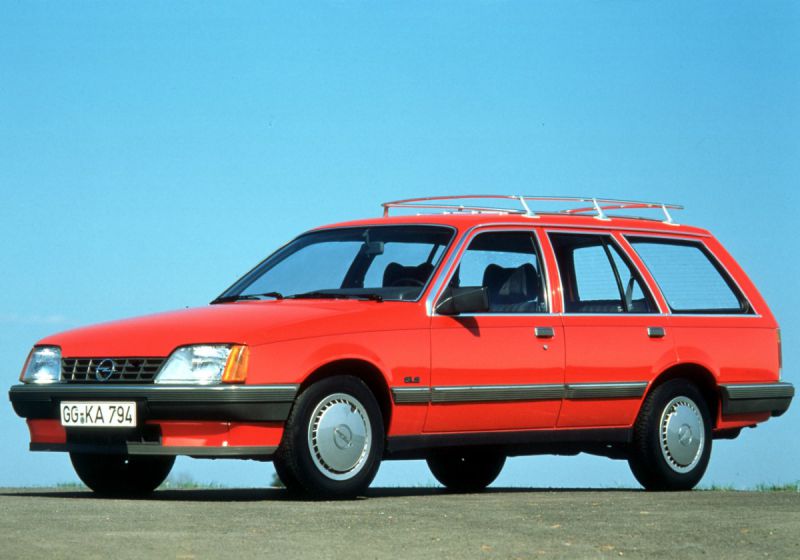
The Opel Rekord E Caravan (facelift 1982) 2.2i Automatic: A European Workhorse
The Opel Rekord E Caravan (facelift 1982) 2.2i (115 Hp) Automatic represents a significant chapter in Opel’s long-standing history as a dominant force in the European automotive market. Produced from September 1984 to August 1986, this particular iteration of the Rekord E series was a facelifted model, bringing a refreshed aesthetic and updated mechanicals to a highly successful platform. As a mid-size family car, the Rekord E was a ubiquitous sight across the continent, known for its robust construction, practicality, and dependable performance. The Caravan, or station wagon, variant was especially popular, catering to families and businesses alike who required ample cargo space without sacrificing comfortable passenger transport. While never officially sold in the United States, the Rekord’s influence as a core family vehicle in Europe during the 1970s and 1980s firmly established Opel’s reputation for producing reliable and accessible automobiles.
The Rekord E generation, launched in 1977, was Opel’s answer to the evolving demands of the European market, offering a blend of modern design, improved aerodynamics, and a range of efficient powertrains. The 1982 facelift introduced subtle yet effective changes, primarily focusing on visual updates to keep the model competitive against rivals like the Ford Sierra and Volkswagen Passat. This specific 2.2i Automatic model, available in the later years of the E generation’s production, offered a more potent engine option, providing a balance of performance and the convenience of an automatic transmission, a feature gaining traction in Europe during that era.
Engine & Performance: The 2.2i Powertrain in the Opel Rekord E Caravan (facelift 1982)
At the heart of this particular Opel Rekord E Caravan lies the 2.2-liter (2197 cm3) “22E” inline-four engine, a naturally aspirated gasoline unit that delivered a respectable 115 horsepower at 4800 rpm. This engine was a significant step up from the smaller displacement options available in the Rekord lineup, providing more confident acceleration and highway cruising capability. With 134.24 lb.-ft. of torque peaking at a relatively low 2800 rpm, the engine offered strong low-end pulling power, which was particularly beneficial for a station wagon often laden with passengers or cargo.
Power was sent to the rear wheels via a 3-speed automatic transmission, a common setup for family cars of this period. While modern automatics boast more gears and greater efficiency, the Rekord’s 3-speed unit was designed for smooth, unfussy operation, prioritizing comfort and ease of driving over outright performance. Despite the transmission’s inherent limitations compared to a manual gearbox, the Rekord E Caravan 2.2i Automatic could accelerate from 0 to 60 mph in a respectable 11.4 seconds (0-100 km/h in 12 seconds) and reach a top speed of 109.36 mph (176 km/h). These figures were competitive for a family station wagon in the mid-1980s, offering sufficient performance for daily driving and longer journeys across the autobahns and European highways.
The engine’s architecture featured a Single Overhead Camshaft (SOHC) and a multi-port manifold injection system, which was considered modern for its time, contributing to better fuel efficiency and emissions control compared to older carbureted units. The compression ratio of 9.4:1 further optimized combustion. Fuel economy was rated at approximately 21.2 US mpg (11.1 l/100 km) combined, a reasonable figure for a vehicle of its size and power output in the mid-1980s, especially considering the automatic transmission.
Design & Features: Practicality and European Aesthetics
The Opel Rekord E Caravan (facelift 1982) embraced the utilitarian design philosophy prevalent in European station wagons of its era. With a length of 184.17 inches, a width of 67.72 inches, and a height of 58.07 inches, it was a substantial vehicle, offering generous interior space. The five-door, five-seat configuration made it a highly practical choice for families, offering easy access to both front and rear seating, along with a cavernous cargo area when the rear seats were folded. The 105.04-inch wheelbase contributed to a stable ride and comfortable interior dimensions.
Aesthetically, the 1982 facelift introduced a revised front fascia, updated grille, and new taillight designs, giving the Rekord E a more contemporary look. While not revolutionary, these changes kept the car fresh and appealing. The design was characterized by clean lines, a relatively upright stance for maximum interior volume, and large glass areas for excellent visibility. Inside, the cabin was straightforward and functional, designed for durability and ease of use rather than luxury. Features would have included durable cloth or vinyl upholstery, a clear instrument cluster, and basic amenities like a radio and heater. Safety features, typical for the era, included front ventilated disc brakes and rear drum brakes, providing adequate stopping power. The rear-wheel-drive architecture offered predictable handling characteristics, a hallmark of many Opel models.
Technical Specifications
| Category | Specification |
|---|---|
| General Information | |
| Brand | Opel |
| Model | Rekord |
| Generation | Rekord E Caravan (facelift 1982) |
| Type (Engine) | 2.2i (115 Hp) Automatic |
| Start of production | September, 1984 year |
| End of production | August, 1986 year |
| Powertrain Architecture | Internal Combustion engine |
| Body type | Station wagon (estate) |
| Seats | 5 |
| Doors | 5 |
| Performance Specs | |
| Fuel consumption (combined) | 11.1 l/100 km (21.2 US mpg) |
| Fuel Type | Petrol (Gasoline) |
| Acceleration 0 – 60 mph | 11.4 sec |
| Acceleration 0 – 100 km/h | 12 sec |
| Maximum speed | 176 km/h (109.36 mph) |
| Weight-to-power ratio | 10.7 kg/Hp (93.5 Hp/tonne) |
| Weight-to-torque ratio | 6.8 kg/Nm (148 Nm/tonne) |
| Engine Specs | |
| Power | 115 Hp @ 4800 rpm |
| Power per liter | 52.3 Hp/l |
| Torque | 182 Nm (134.24 lb.-ft.) @ 2800 rpm |
| Engine Model/Code | 22E |
| Engine displacement | 2197 cm3 (134.07 cu. in.) |
| Number of cylinders | 4 |
| Engine configuration | Inline |
| Cylinder Bore | 95 mm (3.74 in.) |
| Piston Stroke | 77.5 mm (3.05 in.) |
| Compression ratio | 9.4:1 |
| Number of valves per cylinder | 2 |
| Fuel injection system | Multi-port manifold injection |
| Engine aspiration | Naturally aspirated engine |
| Valvetrain | SOHC |
| Space, Volume and Weights | |
| Kerb Weight | 1230 kg (2711.69 lbs.) |
| Max. weight | 1800 kg (3968.32 lbs.) |
| Max load | 570 kg (1256.63 lbs.) |
| Fuel tank capacity | 70 l (18.49 US gal) |
| Dimensions | |
| Length | 4678 mm (184.17 in.) |
| Width | 1720 mm (67.72 in.) |
| Height | 1475 mm (58.07 in.) |
| Wheelbase | 2668 mm (105.04 in.) |
| Front track | 1435 mm (56.5 in.) |
| Rear (Back) track | 1432 mm (56.38 in.) |
| Ride height (ground clearance) | 140 mm (5.51 in.) |
| Minimum turning circle | 10.8 m (35.43 ft.) |
| Drivetrain, Brakes and Suspension Specs | |
| Drivetrain Architecture | The Internal combustion engine (ICE) drives the rear wheels of the vehicle. |
| Drive wheel | Rear wheel drive |
| Number of gears and type of gearbox | 3 gears, automatic transmission |
| Front brakes | Ventilated discs |
| Rear brakes | Drum |
Legacy & Market Impact: The Enduring Role of the Opel Rekord E Caravan
The Opel Rekord E Caravan (facelift 1982) 2.2i (115 Hp) Automatic holds a significant place in European automotive history, representing the culmination of Opel’s traditional mid-size family car philosophy before the brand transitioned to more front-wheel-drive focused models like the Omega and Vectra. The Rekord series, spanning multiple generations, was a cornerstone of Opel’s success, known for its reliability, spaciousness, and value for money. The E generation, and particularly its facelifted version, continued this legacy, proving to be a highly competitive offering in a fiercely contested market segment.
In its primary European market, the Rekord E Caravan faced stiff competition from rivals such as the Ford Sierra Turnier (station wagon), Volkswagen Passat Variant, and even more premium offerings from Mercedes-Benz (like the W123 T-model) and BMW. What set the Rekord apart was its balanced approach: it offered solid German engineering, a comfortable ride, and practical utility without venturing into the premium price points of its more upscale competitors. Its rear-wheel-drive layout, while becoming less common in mainstream family cars by the mid-1980s, provided predictable handling and was favored by many for towing capabilities and a traditional driving feel.
The 2.2i engine, introduced later in the Rekord E’s life cycle, provided a welcome boost in performance, catering to drivers who desired more power for long-distance travel or when carrying heavy loads. Paired with the automatic transmission, it offered a relaxed driving experience, making it an ideal choice for family vacations and daily commutes alike. The Rekord E Caravan was not just a means of transport; it was an integral part of countless European households, serving as a dependable workhorse and a reliable family hauler.
Upon its discontinuation in 1986, the Rekord E was succeeded by the Opel Omega (Vauxhall Carlton in the UK), a more modern, aerodynamically styled, and technologically advanced vehicle. However, the Rekord E’s impact endured. Its reputation for durability meant many examples remained on the road for decades, a testament to Opel’s engineering prowess during that era. Today, the Opel Rekord E Caravan, especially in its more powerful 2.2i automatic guise, is remembered fondly by enthusiasts and former owners as a symbol of practical, no-nonsense European motoring from the 1980s, embodying a bygone era of straightforward, robust family transportation.