The Opel Rekord E Caravan (facelift 1982): A European Workhorse
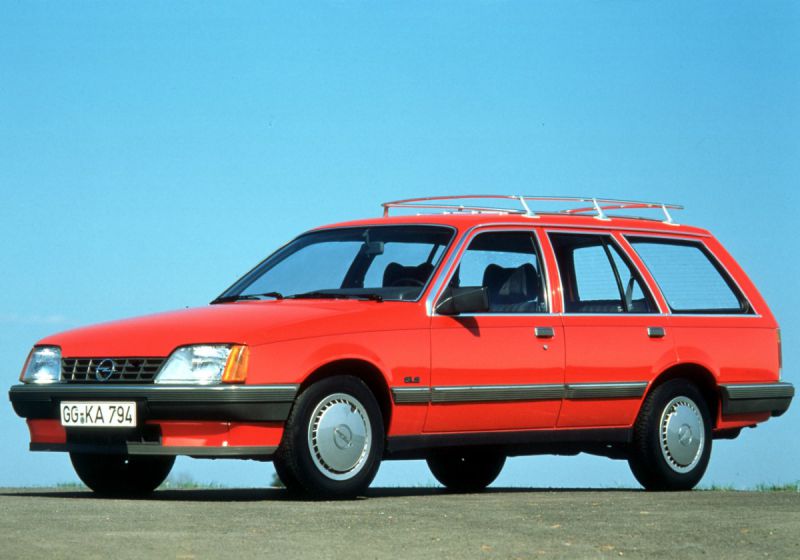
The Opel Rekord E Caravan (facelift 1982) represents a significant chapter in European automotive history, embodying the practical and robust mid-size family car ethos of the early to mid-1980s. Produced by the German automaker Opel, a long-standing subsidiary of General Motors, the Rekord series was a ubiquitous presence on European roads, serving as a reliable choice for families and businesses alike. The ‘E’ generation, launched in 1977, received a notable facelift in 1982, bringing subtle styling updates and mechanical refinements to keep it competitive in a rapidly evolving market. This particular variant, the 2.3 D (71 Hp) Automatic Caravan, highlights the growing demand for fuel-efficient diesel powertrains combined with the versatility of a station wagon body, a configuration highly prized for its utility in Europe.
While the Opel Rekord was never officially sold in the United States, its design and engineering principles mirrored those of its GM stablemates across the Atlantic, albeit tailored for European tastes and regulations. It competed fiercely in a segment defined by practicality, durability, and economical operation, offering a sensible alternative to more premium or performance-oriented vehicles. The facelifted Rekord E Caravan, with its diesel engine and automatic transmission, was particularly geared towards comfort and long-distance cruising, making it an ideal vehicle for the European continent’s diverse road networks.
Engine & Performance: The Diesel Advantage for the Opel Rekord E Caravan (facelift 1982)
Under the hood, the Opel Rekord E Caravan (facelift 1982) 2.3 D was powered by a 2.3-liter (2260 cm³) naturally aspirated inline four-cylinder diesel engine, designated with the code 23D. This robust powerplant delivered a modest but effective 71 horsepower at 4400 rpm, paired with a more substantial 99.57 lb.-ft. (135 Nm) of torque peaking at a low 2400 rpm. For its era, and especially for a diesel engine, this configuration emphasized reliability and fuel economy over outright speed.
The engine utilized a precombustion chamber injection system, a common technology for diesel engines of the 1980s, known for its smoother operation compared to direct injection systems of the time, albeit at a slight efficiency penalty. With a high compression ratio of 22:1 and a simple SOHC (Single Overhead Camshaft) valvetrain with two valves per cylinder, the 2.3 D engine was engineered for longevity and ease of maintenance, crucial attributes for a family car or fleet vehicle.
Mated to a 3-speed automatic transmission, the powertrain delivered power to the rear wheels. While the automatic gearbox provided a comfortable driving experience, it did impact performance figures. The Rekord E Caravan 2.3 D accelerated from 0 to 60 mph in approximately 23.8 seconds, with a top speed of around 91.96 mph (148 km/h). These figures clearly indicate that the vehicle was designed for steady, economical cruising rather than spirited driving. Its combined fuel consumption was an impressive 30.2 US mpg (7.8 L/100 km), showcasing the diesel’s inherent efficiency and making it a compelling choice during a period of fluctuating fuel prices.
Design & Features: Form Follows Function
The Opel Rekord E Caravan (facelift 1982) adhered to the functional design philosophy prevalent in European family cars of the early 1980s. As a station wagon (known as an “estate” in many European markets and “Caravan” by Opel), its primary design objective was to maximize interior space and cargo capacity. The facelift introduced minor cosmetic enhancements, typically including updated grille designs, revised headlamps, and tail light clusters, aimed at subtly modernizing its appearance without altering the fundamental structure.
Measuring 184.17 inches (4678 mm) in length, 67.72 inches (1720 mm) in width, and 58.07 inches (1475 mm) in height, the Rekord E Caravan offered generous dimensions for its segment. Its long wheelbase of 105.04 inches (2668 mm) contributed to a stable ride and a spacious cabin, comfortably accommodating five occupants. The availability of 3- or 5-door configurations for the station wagon body provided flexibility, though the 5-door variant was by far the most popular for family use, offering easier access to the rear seats and cargo area.
Inside, the Rekord E was characterized by a practical and durable interior. While not luxurious by modern standards, the cabin was designed for everyday use, with hard-wearing materials and straightforward ergonomics. Features common to the era included manual window winders, basic heating and ventilation systems, and a functional instrument cluster. Safety features were rudimentary compared to today’s vehicles, focusing on passive measures like seatbelts and a sturdy body structure. The true strength of the Caravan lay in its cavernous cargo area, easily accessible via a large tailgate, making it an ideal vehicle for transporting goods, luggage, or even serving as a light commercial vehicle.
Technical Specifications
| Category | Specification | US Equivalent / Notes |
|---|---|---|
| General Information | ||
| Brand | Opel | |
| Model | Rekord | |
| Generation | Rekord E Caravan (facelift 1982) | |
| Type (Engine) | 2.3 D (71 Hp) Automatic | |
| Start of production | 1982 year | |
| End of production | 1986 year | |
| Powertrain Architecture | Internal Combustion engine | |
| Body type | Station wagon (estate) | |
| Seats | 5 | |
| Doors | 3-5 | |
| Performance Specs | ||
| Fuel consumption (combined) | 7.8 l/100 km | 30.2 US mpg |
| Fuel Type | Diesel | |
| Acceleration 0 – 60 mph | 23.8 sec | |
| Maximum speed | 148 km/h | 91.96 mph |
| Weight-to-power ratio | 18 kg/Hp | 55.5 Hp/tonne |
| Weight-to-torque ratio | 9.5 kg/Nm | 105.5 Nm/tonne |
| Engine Specs | ||
| Power | 71 Hp @ 4400 rpm | |
| Power per liter | 31.4 Hp/l | |
| Torque | 135 Nm @ 2400 rpm | 99.57 lb.-ft. @ 2400 rpm |
| Engine Model/Code | 23D | |
| Engine displacement | 2260 cm³ | 137.91 cu. in. (2.3 Liters) |
| Number of cylinders | 4 | Inline |
| Cylinder Bore | 92 mm | 3.62 in. |
| Piston Stroke | 85 mm | 3.35 in. |
| Compression ratio | 22:1 | |
| Number of valves per cylinder | 2 | |
| Fuel injection system | Precombustion chamber injection | |
| Engine aspiration | Naturally aspirated engine | |
| Valvetrain | SOHC | |
| Engine oil capacity | 5.5 l | 5.81 US qt |
| Coolant | 11.5 l | 12.15 US qt |
| Space, Volume and Weights | ||
| Kerb Weight | 1280 kg | 2821.92 lbs. |
| Max. weight | 1900 kg | 4188.78 lbs. |
| Max load | 620 kg | 1366.87 lbs. |
| Fuel tank capacity | 70 l | 18.49 US gal |
| Permitted trailer load with brakes (12%) | 1000 kg | 2204.62 lbs. |
| Permitted trailer load without brakes | 535 kg | 1179.47 lbs. |
| Dimensions | ||
| Length | 4678 mm | 184.17 in. |
| Width | 1720 mm | 67.72 in. |
| Height | 1475 mm | 58.07 in. |
| Wheelbase | 2668 mm | 105.04 in. |
| Front track | 1435 mm | 56.5 in. |
| Rear (Back) track | 1432 mm | 56.38 in. |
| Ride height (ground clearance) | 140 mm | 5.51 in. |
| Minimum turning circle (diameter) | 10.8 m | 35.43 ft. |
| Drivetrain, Brakes and Suspension Specs | ||
| Drivetrain Architecture | The Internal combustion engine (ICE) drives the rear wheels of the vehicle. | Rear-wheel drive |
| Drive wheel | Rear wheel drive | |
| Number of gears and type of gearbox | 3 gears, automatic transmission | |
| Front brakes | Ventilated discs | |
| Rear brakes | Drum | |
Legacy & Market Impact of the Opel Rekord E Caravan (facelift 1982)
The Opel Rekord E Caravan (facelift 1982) held a significant position in the European automotive landscape during its production run. It was a staple offering in the highly competitive mid-size segment, particularly appealing to families, small businesses, and fleet operators who valued its blend of practicality, economy, and robust construction. Its reputation was built on reliability and ease of maintenance, qualities that made it a popular choice across various European nations.
In its primary markets, the Rekord E Caravan faced stiff competition from other European manufacturers. Key rivals included the Ford Sierra Wagon, the Volkswagen Passat Variant, the Peugeot 505 Break, and even more upmarket alternatives like the Volvo 240/740 wagons. While some competitors might have offered more advanced styling or sportier driving dynamics, the Rekord consistently delivered a solid, no-nonsense package that resonated with a broad customer base. The diesel variant, in particular, carved out its niche by offering superior fuel economy, a crucial factor during the oil crises of the 1970s and subsequent periods of rising fuel costs.
Historically, the Rekord E represents a transitional phase for Opel. While it retained a relatively traditional, angular design, the facelift and ongoing refinements hinted at the more aerodynamic and technologically advanced models that would follow, such as the Opel Omega (which replaced the Rekord in 1986). The Rekord’s enduring legacy is that of a dependable workhorse, a car that faithfully served millions of European families and businesses, proving that practical utility and economical operation could be packaged in an accessible and well-engineered vehicle. Today, surviving examples are cherished by enthusiasts for their classic 1980s aesthetic, mechanical simplicity, and a nostalgic connection to a bygone era of European motoring.