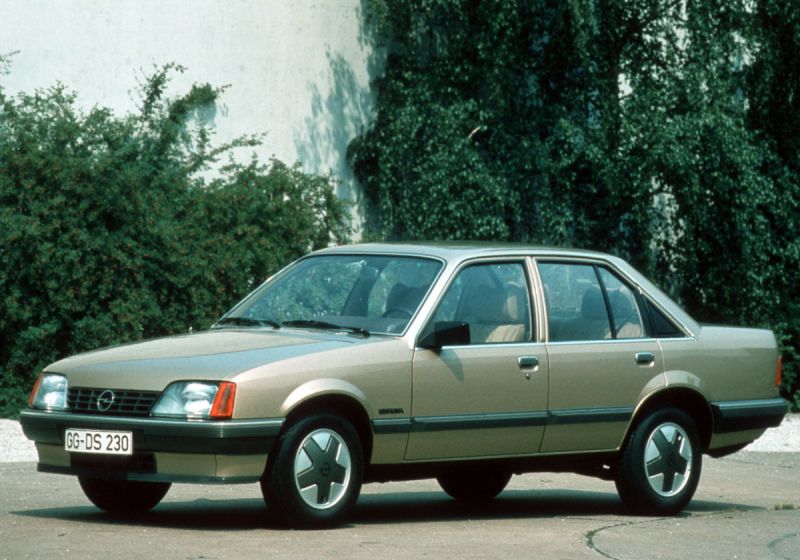
The Opel Rekord, a name synonymous with dependable and practical family transportation in Europe for decades, saw its fifth and final generation, the Rekord E, produced from 1977 to 1986. The focus of this analysis is the significant facelift introduced in September 1982, specifically the 1.8-liter variant producing 75 horsepower. This particular iteration of the Opel Rekord E (facelift 1982) represented a crucial mid-cycle refresh, aiming to modernize its aesthetics and engineering in a rapidly evolving automotive landscape. Positioned as a mid-size sedan, the Rekord E competed fiercely in the heart of the European family car market, offering a blend of robust engineering, ample space, and economical operation, characteristics highly valued by consumers across the continent.
While never officially sold in the United States, the Opel Rekord E was a cornerstone of General Motors’ European operations, showcasing the brand’s commitment to delivering reliable, rear-wheel-drive vehicles to a broad customer base. Its design and mechanical package reflected the prevailing trends of early 1980s European automotive engineering, prioritizing durability and cost-effectiveness over outright performance or cutting-edge technology. The 1982 facelift sought to keep the Rekord competitive against newer rivals, ensuring its continued relevance as a workhorse for families and businesses alike.
Engine and Performance of the Opel Rekord E (facelift 1982)
At the heart of the Opel Rekord E (facelift 1982) 1.8 (75 Hp) was Opel’s venerable 18N engine, a naturally aspirated, inline four-cylinder unit. This powerplant, with a displacement of 1796 cubic centimeters (109.6 cu. in.), was engineered for reliability and modest fuel consumption rather than exhilarating speed. It featured a Single Overhead Camshaft (SOHC) valvetrain with two valves per cylinder, a common and proven configuration for the era that balanced efficiency with manufacturing simplicity. Fuel delivery was handled by a carburetor system, a technology that was beginning its decline in favor of more precise fuel injection systems but remained prevalent in many mainstream models of the early 1980s.
The 18N engine generated a respectable 75 horsepower at 5400 rpm. Torque output stood at 99.57 lb.-ft. (135 Nm) delivered at a relatively low 3000 rpm, which contributed to the car’s tractable nature in everyday driving conditions. This power was channeled to the rear wheels via a robust 4-speed manual transmission, a configuration chosen for its durability and ease of maintenance. While not a powerhouse, the powertrain was well-suited to the car’s purpose as a family sedan.
In terms of performance, the Rekord E 1.8 offered adequate, though not sporty, acceleration. It could reach 60 mph from a standstill in an estimated 15.7 seconds, with a top speed of 99.42 mph (160 km/h). These figures were competitive for a non-performance oriented mid-size sedan of its time. Fuel economy was a notable strong suit, with a combined rating of 25.6 US mpg (9.2 l/100 km), thanks in part to its relatively low curb weight of 2458.15 lbs. (1115 kg) and the engine’s conservative tuning. This combination of performance and efficiency made the Rekord an attractive proposition for European buyers seeking an economical daily driver.
Design and Features
The Opel Rekord E (facelift 1982) retained the fundamental architecture of the original Rekord E but introduced several aesthetic and functional enhancements. The body style remained a traditional 4-door sedan, designed to accommodate five occupants comfortably. Its dimensions were substantial for a European mid-size car of the period, measuring 183.15 inches (4652 mm) in length, 67.95 inches (1726 mm) in width, and 55.91 inches (1420 mm) in height. The wheelbase of 105.04 inches (2668 mm) contributed to a stable ride and generous interior space.
The facelift itself brought subtle but effective changes to the Rekord E’s exterior. These typically involved revised front and rear fascias, including new grilles, headlights, and taillights, aimed at giving the car a more contemporary appearance. Aerodynamics, while not a primary design driver, were considered, resulting in a drag coefficient (Cd) of 0.36, which was a decent figure for a sedan of its era and contributed to its highway fuel efficiency. The design was characterized by clean lines, a relatively upright stance, and large glass areas, ensuring excellent visibility and a bright cabin.
Inside, the Rekord E prioritized practicality and durability. The cabin offered seating for