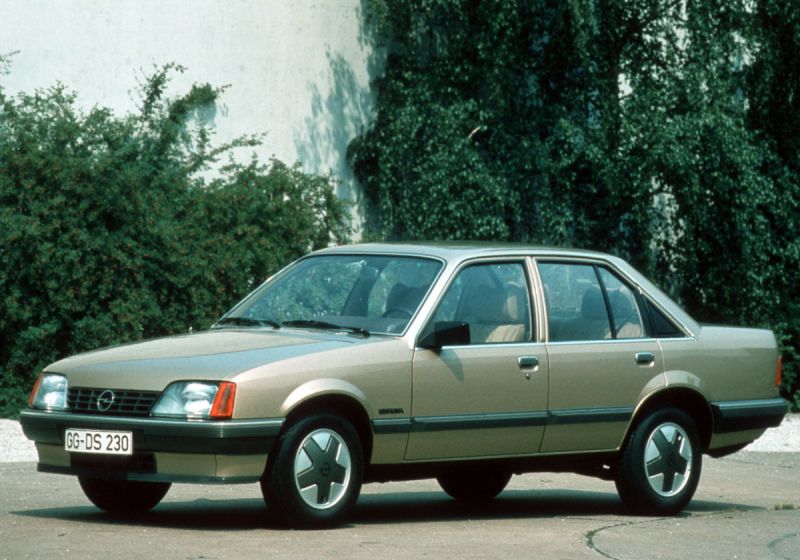
The Opel Rekord E (facelift 1982) 1.8i CAT (100 Hp): A European Mainstay
The Opel Rekord E (facelift 1982) 1.8i CAT (100 Hp) represents a significant chapter in European automotive history, embodying the practical, reliable, and family-oriented sedan prevalent in the 1980s. Manufactured by the German automaker Opel, a subsidiary of General Motors, the Rekord series had long been a cornerstone of the mid-size and executive car segments across Europe. The E generation, introduced in 1977 and facelifted in 1982, was a continuation of this legacy, offering a blend of spaciousness, straightforward engineering, and respectable performance for its class. The 1.8i CAT (100 Hp) variant, specifically produced between August 1985 and August 1986, marked a transitional period for the Rekord, integrating early emissions control technology with its well-established inline-four engine. While never officially sold in the United States, the Rekord E played a crucial role in providing accessible and dependable transportation for millions of European families and businesses, competing vigorously in a highly competitive market segment.
Engine and Performance of the Opel Rekord E (facelift 1982) 1.8i CAT (100 Hp)
At the heart of the Opel Rekord E (facelift 1982) 1.8i CAT (100 Hp) lies a robust and proven 1.8-liter (1796 cm3 or 109.6 cu. in.) inline-four cylinder engine, designated with the code C18NV. This naturally aspirated powerplant features a Single Overhead Camshaft (SOHC) valvetrain with two valves per cylinder, a common and reliable configuration for its era, prioritizing durability and ease of maintenance. The engine produced a respectable 100 horsepower at 5800 rpm, delivering a power-per-liter ratio of 55.7 Hp/l. Torque output stood at 140 Nm (103.26 lb.-ft.) at a relatively low 3000 rpm, providing a strong, accessible pull for daily driving and highway cruising.
A key distinguishing feature of this particular model was the “i CAT” designation, indicating a multi-port manifold fuel injection system coupled with a catalytic converter. This technology, while standard on most vehicles today, was a progressive step in the mid-1980s for European cars, signaling Opel’s commitment to meeting nascent emissions standards. Mated to a five-speed manual transmission, which drove the rear wheels, the Rekord E 1.8i CAT offered a traditional and engaging driving experience.
In terms of performance, the 1.8i CAT (100 Hp) model was capable of accelerating from 0 to 60 mph in a calculated 12.4 seconds (or 0 to 100 km/h in 13 seconds), reaching a maximum speed of 109.98 mph (177 km/h). These figures positioned it as a competent, if not overtly sporty, performer within its class. Fuel economy for the combined cycle was rated at 9 liters per 100 kilometers, which translates to approximately 26.1 US mpg, a reasonable figure for a mid-size sedan of its time, especially considering its weight-to-power ratio of 11.2 kg/Hp.
Design and Features
The Opel Rekord E (facelift 1982) retained the classic, somewhat conservative styling that characterized Opel vehicles of the period. As a four-door sedan, its design emphasized practicality, interior space, and a dignified presence. The facelift introduced subtle enhancements to the exterior, primarily focusing on updated front and rear fascias, giving it a more contemporary look for the mid-1980s without straying far from its established aesthetic. With a length of 183.15 inches (4652 mm), a width of 67.95 inches (1726 mm), and a height of 55.91 inches (1420 mm), the Rekord E was a substantial vehicle, offering ample room for five occupants. The wheelbase measured 105.04 inches (2668 mm), contributing to a stable ride and generous cabin space.
Inside, the Rekord E was known for its comfortable and functional interior. While not luxurious by modern standards, it provided durable cloth upholstery, clear instrumentation, and intuitive controls. The focus was on ergonomics and practicality, making it a suitable vehicle for long journeys or family duties. The trunk space was a generous 17.3 cubic feet (490 liters), accommodating significant luggage. Safety features, typical for the era, included a robust body structure and conventional seat belts. The car’s drivability was enhanced by a minimum turning circle of 35.43 feet (10.8 meters), making it relatively maneuverable for its size. The braking system comprised ventilated discs at the front and drum brakes at the rear, a common setup that provided adequate stopping power.
Technical Specifications: Opel Rekord E (facelift 1982) 1.8i CAT (100 Hp)
| Category | Specification | Value | US Equivalent |
|---|---|---|---|
| Brand | Opel | ||
| Model | Rekord | ||
| Generation | Rekord E (facelift 1982) | ||
| Type (Engine) | 1.8i CAT (100 Hp) | ||
| Production Start | August, 1985 | ||
| Production End | August, 1986 | ||
| Powertrain Architecture | Internal Combustion engine | ||
| Body type | Sedan | ||
| Seats | 5 | ||
| Doors | 4 | ||
| Performance Specs | |||
| Fuel consumption (combined) | 9 l/100 km | 26.1 US mpg | |
| Fuel Type | Petrol (Gasoline) | ||
| Acceleration 0-60 mph | 12.4 sec | ||
| Acceleration 0-100 km/h | 13 sec | ||
| Maximum speed | 177 km/h | 109.98 mph | |
| Weight-to-power ratio | 11.2 kg/Hp | 89.3 Hp/tonne | |
| Weight-to-torque ratio | 8 kg/Nm | 125 Nm/tonne | |
| Engine Specs | |||
| Power | 100 Hp @ 5800 rpm | ||
| Power per liter | 55.7 Hp/l | ||
| Torque | 140 Nm @ 3000 rpm | 103.26 lb.-ft. @ 3000 rpm | |
| Engine Model/Code | C18NV | ||
| Engine displacement | 1796 cm3 | 109.6 cu. in. | |
| Number of cylinders | 4 | ||
| Engine configuration | Inline | ||
| Cylinder Bore | 84.8 mm | 3.34 in. | |
| Piston Stroke | 79.5 mm | 3.13 in. | |
| Compression ratio | 8.9:1 | ||
| Valves per cylinder | 2 | ||
| Fuel injection system | Multi-port manifold injection | ||
| Engine aspiration | Naturally aspirated engine | ||
| Valvetrain | SOHC | ||
| Engine oil capacity | 3 l | 3.17 US qt | |
| Coolant capacity | 7.5 l | 7.93 US qt | |
| Space, Volume and Weights | |||
| Kerb Weight | 1120 kg | 2469.18 lbs. | |
| Max. weight | 1655 kg | 3648.65 lbs. | |
| Max load | 535 kg | 1179.47 lbs. | |
| Trunk (boot) space – minimum | 490 l | 17.3 cu. ft. | |
| Fuel tank capacity | 65 l | 17.17 US gal | |
| Dimensions | |||
| Length | 4652 mm | 183.15 in. | |
| Width | 1726 mm | 67.95 in. | |
| Height | 1420 mm | 55.91 in. | |
| Wheelbase | 2668 mm | 105.04 in. | |
| Front track | 1435 mm | 56.5 in. | |
| Rear (Back) track | 1412 mm | 55.59 in. | |
| Minimum turning circle | 10.8 m | 35.43 ft. | |
| Drivetrain, Brakes and Suspension Specs | |||
| Drivetrain Architecture | Internal combustion engine drives rear wheels | ||
| Drive wheel | Rear wheel drive | ||
| Number of gears and type | 5 gears, manual transmission | ||
| Front brakes | Ventilated discs | ||
| Rear brakes | Drum | ||
Legacy and Market Impact of the Opel Rekord E (facelift 1982)
The Opel Rekord E (facelift 1982) was a quintessential European family sedan, and its 1.8i CAT (100 Hp) variant, produced in its final years, exemplified its adaptability during a period of evolving automotive standards. Throughout its lifespan, the Rekord E was a strong contender in the competitive European D-segment, where it faced off against rivals such as the Ford Granada, Volkswagen Passat, and to some extent, the BMW 5 Series and Mercedes-Benz W123, albeit often at a more accessible price point. Its reputation was built on reliability, spaciousness, and straightforward mechanics, making it a popular choice for both private buyers and fleet operators.
The introduction of the catalytic converter in models like the 1.8i CAT in the mid-1980s marked a significant step for Opel and the European market as a whole. While emissions regulations were not as stringent as in the United States at the time, the increasing awareness of environmental impact led to the gradual adoption of cleaner engine technologies. The Rekord E, being a high-volume seller, played a part in normalizing these advancements, paving the way for more widespread adoption of catalytic converters in subsequent generations of European vehicles.
Despite its strong market presence, the Rekord E also represented the end of an era for Opel’s large sedan lineup. It was eventually replaced by the Opel Omega (Vauxhall Carlton in the UK) in 1986, a car that brought more modern styling, improved aerodynamics, and enhanced technology to the segment. However, the Rekord’s legacy endures as a symbol of practical, no-nonsense German engineering that served millions of customers with dependable transportation. Today, well-preserved examples of the Rekord E are appreciated by classic car enthusiasts in Europe for their robust construction and nostalgic appeal, serving as a reminder of a time when European sedans prioritized utility and longevity.