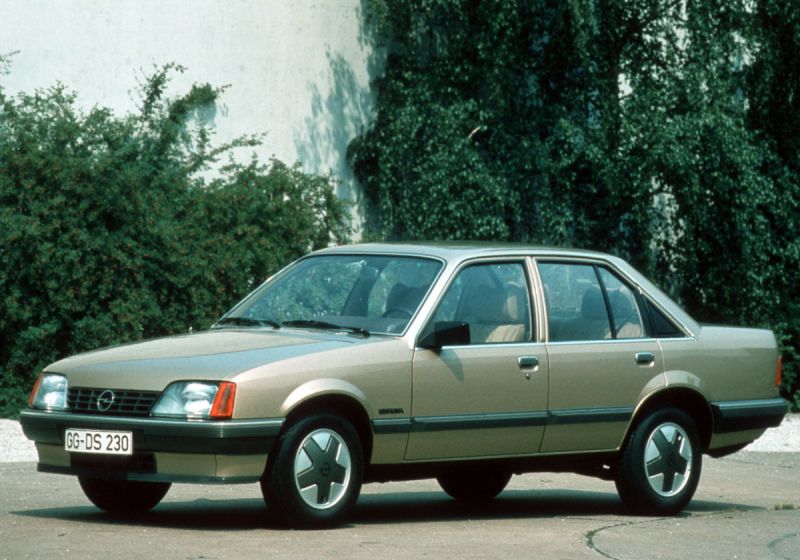
The Opel Rekord E (facelift 1982) 2.2 D (71 Hp): A Stalwart of European Motoring
The Opel Rekord, a name synonymous with dependable and practical motoring across Europe for decades, saw its final iteration in the ‘E’ generation. Specifically, the Opel Rekord E (facelift 1982) 2.2 D (71 Hp) represents a crucial phase in the model’s history, produced from August 1983 to September 1986. This particular variant, a four-door sedan equipped with a robust diesel engine, was not marketed in the United States but carved out a significant niche in its primary European markets, particularly Germany, as a reliable family car, a fleet vehicle, and a popular choice for taxi services.
The Rekord E, first introduced in 1977, received a significant facelift in 1982, bringing a more aerodynamic and contemporary aesthetic to the venerable nameplate. This update aimed to keep the Rekord competitive in a rapidly evolving automotive landscape. The 2.2 D model, arriving slightly later in the facelifted series, underscored Opel’s commitment to fuel efficiency and durability, characteristics highly valued by European consumers during the early to mid-1980s. It embodied the pragmatic engineering philosophy that defined Opel’s success, offering a spacious interior, a comfortable ride, and economical operation, making it a true workhorse for the continent. Its sturdy construction and straightforward mechanicals contributed to its reputation for longevity and low cost of ownership, factors that were paramount for buyers in that era.
Engine and Performance: The Heart of the Opel Rekord E (facelift 1982) 2.2 D (71 Hp)
At the core of the Opel Rekord E (facelift 1982) 2.2 D (71 Hp) lay its inline four-cylinder diesel engine, designated as the 23D model. With a displacement of 2.26 liters (2260 cm3 or 137.91 cubic inches), this naturally aspirated powerplant was engineered for longevity and economy rather than outright speed. It produced a modest but effective 71 horsepower at 4400 rpm, coupled with a respectable 135 Newton-meters (99.57 lb.-ft.) of torque delivered at a low 2400 rpm. This torque profile made the Rekord 2.2 D particularly well-suited for everyday driving, offering ample pulling power for its size and intended use, especially when navigating city traffic or cruising on the Autobahn.
Power was sent to the rear wheels via a five-speed manual transmission, a common and reliable setup for the era that further contributed to the vehicle’s fuel efficiency. Performance figures, while not exhilarating by modern standards, were entirely adequate for the time and segment. The Rekord 2.2 D could accelerate from 0 to 60 mph in approximately 19 seconds, eventually reaching a top speed of 99.42 mph (160 km/h). These numbers reflected its role as a practical, long-distance cruiser designed for comfortable highway travel and urban utility, prioritizing endurance and economy over blistering acceleration. Its robust powertrain architecture meant it was built