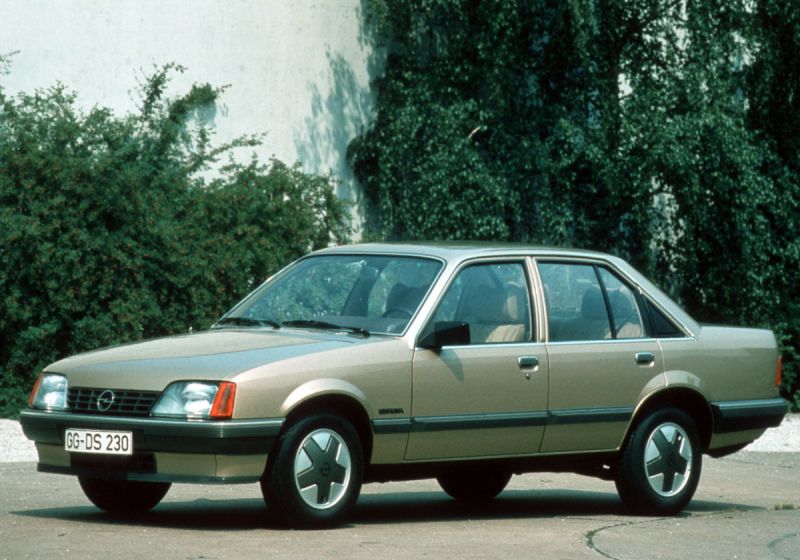
The Opel Rekord E (facelift 1982) 2.3 D (65 Hp) Automatic: A European Mainstay
The Opel Rekord E (facelift 1982) represents a crucial chapter in the history of German automotive manufacturing, serving as a pillar of the European mid-size to executive car segment for General Motors’ Opel division. Produced primarily for the European market, where it competed fiercely against domestic and international rivals, the Rekord E was renowned for its robust construction, practicality, and cost-effectiveness. The specific variant under review, the 2.3 D (65 Hp) Automatic, was introduced in September 1982 as part of the Rekord E’s significant facelift, aiming to modernize its aesthetics and refine its mechanical package. This model, a four-door sedan with seating for five, embodied the traditional European family car and fleet vehicle ethos of the early 1980s, prioritizing durability and fuel economy, especially in its diesel guise, over outright performance.
Evolution of the Opel Rekord E (facelift 1982)
The Opel Rekord lineage stretched back to 1953, establishing itself as a core product for Opel, bridging the gap between smaller models like the Kadett and larger, more luxurious offerings such as the Senator. The Rekord E generation, launched in 1977, was a significant evolution, featuring a more contemporary design and improved aerodynamics compared to its predecessors. The 1982 facelift, sometimes referred to as the Rekord E2, brought a refreshed front fascia with new headlights and grille, revised taillights, and updated interior trim, giving the car a more modern appearance in line with the evolving design trends of the decade. This particular 2.3 D automatic model, produced for a relatively short period from September 1982 to July 1983, was a testament to Opel’s commitment to offering efficient and practical diesel options in a market increasingly conscious of fuel consumption.
Engine and Performance of the Opel Rekord E (facelift 1982)
Under the hood, the Opel Rekord E (facelift 1982) 2.3 D featured a naturally aspirated, inline four-cylinder diesel engine, designated as the 23D. With a displacement of 2,260 cubic centimeters (approximately 2.3 liters or 137.91 cubic inches), this powerplant was engineered for longevity and economy rather than blistering speed. It produced a modest 65 horsepower at 4,200 revolutions per minute, a figure that, while conservative by today’s standards, was typical for a diesel sedan of its era. Torque output was 127 Newton-meters (93.67 lb.-ft.) available at a relatively low 2,500 rpm, providing adequate pulling power for daily driving and highway cruising.
The engine utilized a precombustion chamber injection system, a common technology for diesel engines of the period, known for its smoother operation compared to direct injection systems of the time, albeit at a slight efficiency penalty. The valvetrain was a simple Single Overhead Camshaft (SOHC) design with two valves per cylinder, emphasizing reliability and ease of maintenance. With a high compression ratio of 22:1, characteristic of diesel engines, the 2.3 D was designed to maximize fuel efficiency.
Power was transmitted to the rear wheels via a three-speed automatic transmission. This combination, while contributing to a relaxed driving experience, also impacted acceleration. The Rekord E 2.3 D Automatic took a leisurely 23.8 seconds to accelerate from 0 to 60 miles per hour, with a maximum speed of 93.21 mph (150 km/h). These figures clearly indicate that the vehicle was not designed for spirited performance but rather for comfortable, economical travel. Its combined fuel economy was a respectable 30.2 US miles per gallon (7.8 liters per 100 km), a significant selling point in an era still reeling from the energy crises of the 1970s. The substantial 17.17 US gallon (65 liter) fuel tank further enhanced its long-distance cruising capability.
Design and Features
The 1982 facelift brought a more contemporary look to the Rekord E. Its four-door sedan body style was a classic representation of a family car in the European market. Measuring 183.15 inches (4,652 mm) in length, 67.95 inches (1,726 mm) in width, and 55.91 inches (1,420 mm) in height, the Rekord E offered generous interior space for five occupants and a substantial trunk capacity of 17.3 cubic feet (490 liters). This made it a practical choice for families and an ideal candidate for taxi fleets across Europe.
The design was characterized by clean, functional lines, reflecting Opel’s pragmatic engineering philosophy. The drag coefficient (Cd) of 0.36 was a respectable figure for the early 1980s, contributing to both fuel efficiency and reduced wind noise at highway speeds. The vehicle rode on a 105.04-inch (2,668 mm) wheelbase, providing a stable and comfortable ride. The front track was 56.5 inches (1,435 mm), and the rear track was 55.59 inches (1,412 mm), contributing to balanced handling.
In terms of mechanicals, the Rekord E featured ventilated disc brakes at the front, offering effective stopping power, while the rear wheels were equipped with traditional drum brakes, a common and cost-effective solution for cars of its class and era. The drivetrain architecture, with its internal combustion engine driving the rear wheels, was a hallmark of traditional European sedans, contributing to a balanced weight distribution and a distinct driving feel. The minimum turning circle of 35.43 feet (10.8 meters) indicated decent maneuverability for its size. The curb weight of 2,799.87 lbs (1,270 kg) and a maximum permissible weight of 3,924.23 lbs (1,780 kg) underscored its solid build and load-carrying capability, including a permitted trailer load with brakes of 2,425.08 lbs (1,100 kg).
Technical Specifications
| Category | Specification | Value |
|---|---|---|
| Brand | Opel | |
| Model | Rekord | |
| Generation | Rekord E (facelift 1982) | |
| Type (Engine) | 2.3 D (65 Hp) Automatic | |
| Start of Production | September, 1982 | |
| End of Production | July, 1983 | |
| Powertrain Architecture | Internal Combustion engine | |
| Body type | Sedan | |
| Seats | 5 | |
| Doors | 4 | |
| Performance Specs | ||
| Fuel consumption (combined) | 30.2 US mpg (7.8 l/100 km) | |
| Fuel Type | Diesel | |
| Acceleration 0 – 60 mph | 23.8 sec | |
| Maximum speed | 93.21 mph (150 km/h) | |
| Weight-to-power ratio | 19.5 kg/Hp, 51.2 Hp/tonne | |
| Weight-to-torque ratio | 10 kg/Nm, 100 Nm/tonne | |
| Engine Specs | ||
| Power | 65 Hp @ 4200 rpm | |
| Power per liter | 28.8 Hp/l | |
| Torque | 93.67 lb.-ft. @ 2500 rpm (127 Nm @ 2500 rpm) | |
| Engine Model/Code | 23D | |
| Engine displacement | 2.3 liters (2260 cm³ / 137.91 cu. in.) | |
| Number of cylinders | 4 | |
| Engine configuration | Inline | |
| Cylinder Bore | 3.62 in. (92 mm) | |
| Piston Stroke | 3.35 in. (85 mm) | |
| Compression ratio | 22:1 | |
| Number of valves per cylinder | 2 | |
| Fuel injection system | Precombustion chamber injection | |
| Engine aspiration | Naturally aspirated engine | |
| Valvetrain | SOHC | |
| Engine oil capacity | 5.81 US qt (5.5 l) | |
| Coolant | 12.15 US qt (11.5 l) | |
| Space, Volume and Weights | ||
| Kerb Weight | 2799.87 lbs (1270 kg) | |
| Max. weight (Gross Vehicle Weight) | 3924.23 lbs (1780 kg) | |
| Max load | 1124.36 lbs (510 kg) | |
| Trunk (boot) space – minimum | 17.3 cu. ft. (490 l) | |
| Fuel tank capacity | 17.17 US gal (65 l) | |
| Permitted trailer load with brakes (12%) | 2425.08 lbs (1100 kg) | |
| Dimensions | ||
| Length | 183.15 in. (4652 mm) | |
| Width | 67.95 in. (1726 mm) | |
| Height | 55.91 in. (1420 mm) | |
| Wheelbase | 105.04 in. (2668 mm) | |
| Front track | 56.5 in. (1435 mm) | |
| Rear (Back) track | 55.59 in. (1412 mm) | |
| Ride height (ground clearance) | 5.51 in. (140 mm) | |
| Drag coefficient (Cd) | 0.36 | |
| Minimum turning circle (turning diameter) | 35.43 ft. (10.8 m) | |
| Drivetrain, Brakes and Suspension Specs | ||
| Drivetrain Architecture | The Internal combustion engine (ICE) drives the rear wheels of the vehicle. | |
| Drive wheel | Rear wheel drive | |
| Number of gears and type of gearbox | 3 gears, automatic transmission | |
| Front brakes | Ventilated discs | |
| Rear brakes | Drum | |
Legacy and Market Impact
The Opel Rekord E, particularly its diesel variants like the 2.3 D, carved out a significant niche in the European automotive landscape of the early to mid-1980s. It was not a vehicle designed to excite with performance or lavish with luxury, but rather to serve as a dependable, practical, and economical workhorse. Its reputation for robustness and reliability made it a popular choice for families, sales representatives, and, notably, as a ubiquitous taxi cab across Germany and other European nations. The diesel engine, while not powerful, offered excellent fuel efficiency and durability, crucial attributes during a period of fluctuating fuel prices.
In its primary market, the Rekord E competed against a diverse array of vehicles. Key rivals included the Ford Granada (later replaced by the Sierra), Volkswagen Passat, Peugeot 505, and to some extent, the more upmarket Mercedes-Benz W123 series (especially its diesel models) and BMW 5-Series. The Rekord positioned itself as a solid, value-oriented alternative to these competitors, offering ample space and proven engineering without the premium price tag of some of its rivals. Its traditional rear-wheel-drive layout, a characteristic shared with many European sedans of the time, contributed to predictable handling and good traction, especially when laden.
The Rekord E generation was significant as it marked the end of an era for Opel’s mid-size nameplate. It was the last model to bear the “Rekord” badge, being succeeded by the Opel Omega in 1986. The Omega, while maintaining some of the Rekord’s core values, ushered in a new design language and further technological advancements. The Opel Rekord E (facelift 1982) 2.3 D Automatic, therefore, stands as a testament to a particular time in automotive history: an era where diesel engines were gaining traction for their efficiency, automatic transmissions were becoming more common, and the traditional rear-wheel-drive sedan was still a dominant force before the widespread adoption of front-wheel drive in the segment. Today, these Rekords are remembered fondly by enthusiasts and former owners as durable, unassuming vehicles that reliably served the needs of millions across Europe.