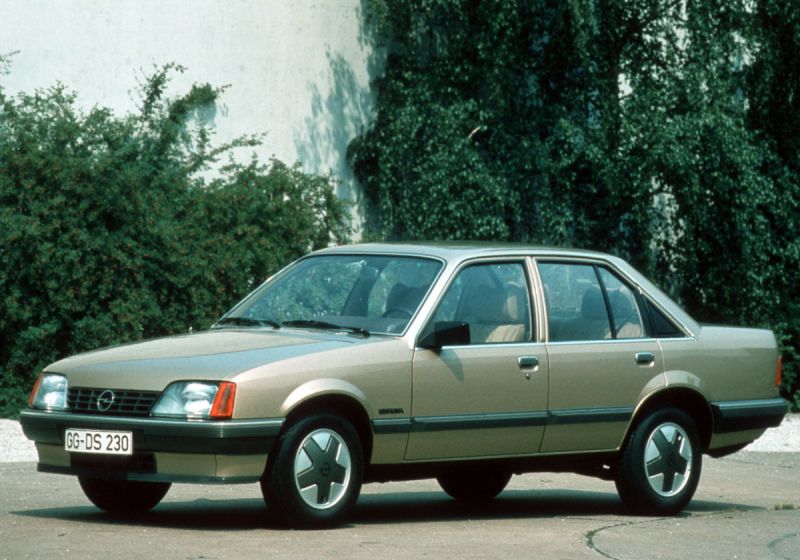
The Opel Rekord E (facelift 1982) 2.3 TD (86 Hp): A European Workhorse
The Opel Rekord E (facelift 1982) 2.3 TD (86 Hp) represents a significant chapter in European automotive history, embodying the practical, robust, and increasingly fuel-efficient philosophy prevalent in the mid-1980s. As a product of the German automaker Opel, a long-standing subsidiary of General Motors, the Rekord series served as a cornerstone of the brand’s lineup, particularly in the D-segment (mid-size) market. The E-generation, launched in 1977, received a crucial facelift in 1982, bringing updated styling and technological refinements to keep it competitive. This particular variant, produced from May 1984 to September 1986, was equipped with a 2.3-liter turbocharged diesel engine, a powertrain choice that underscored Opel’s commitment to economy and durability in a continent grappling with varying fuel prices and a growing appreciation for diesel’s efficiency. While never officially sold in the United States, the Rekord E played a vital role in transporting families and business professionals across Europe, cementing its reputation as a reliable and spacious sedan.
Engine and Performance: The 2.3 TD (86 Hp) Powertrain
At the heart of this particular Opel Rekord E (facelift 1982) was its 2.3 TD (Turbo Diesel) engine, designated by the code 23DT. This inline-four-cylinder unit boasted a displacement of 2,260 cubic centimeters (137.91 cubic inches), making it one of the larger diesel options available in its class during that era. The engine featured a Single Overhead Camshaft (SOHC) valvetrain with two valves per cylinder and utilized a precombustion chamber injection system, a common technology for early indirect injection diesels designed to reduce noise and harshness.
Crucially, the “TD” suffix indicated the presence of a turbocharger, a significant addition that boosted both power and torque compared to naturally aspirated diesel counterparts. The engine produced a respectable 86 horsepower at 4,200 revolutions per minute, a solid figure for a mid-1980s passenger car diesel. More importantly for daily driving, it generated a robust 139.4 lb.-ft. of torque at a low 2,200 rpm, providing ample pulling power and making the car feel responsive in city traffic and on the highway.
Mated to a 5-speed manual transmission, the 2.3 TD Rekord E was a capable performer for its segment and time. It could accelerate from 0 to 60 mph in a calculated 14.3 seconds, with a maximum speed of 104.39 mph. While these figures might seem modest by modern standards, they were competitive for a diesel sedan in the mid-1980s, prioritizing fuel economy and longevity over outright sprint times. The vehicle’s powertrain architecture featured a classic rear-wheel-drive layout, characteristic of many Opel models of the period, contributing to a balanced driving feel.
Fuel economy was a major selling point for the 2.3 TD. With a combined fuel consumption rating of 6.9 liters per 100 kilometers, which translates to an impressive 34.1 US miles per gallon, the Rekord E offered significant savings at the pump, particularly appealing in European markets where diesel fuel was often more affordable and widely available. Its 17.17 US gallon fuel tank capacity provided an excellent cruising range, making it a suitable choice for long-distance travel.
Design and Features: Enduring Practicality
The Opel Rekord E (facelift 1982) Aesthetic
The Opel Rekord E, particularly after its 1982 facelift, presented a clean, functional, and somewhat conservative design that resonated with its target audience. As a 4-door sedan, it emphasized practicality and space, offering comfortable seating for five occupants. The facelift introduced subtle but important changes, typically including revised front and rear styling elements such as new grilles, headlights, taillights, and bumpers, aiming to modernize its appearance and improve aerodynamics. The drag coefficient (Cd) of 0.36 was respectable for a sedan of its era, contributing to both fuel efficiency and reduced wind noise at speed.
In terms of dimensions, the Rekord E was a substantial vehicle for its time. It measured 183.15 inches in length, 67.95 inches in width, and 55.91 inches in height, with a generous wheelbase of 105.04 inches. These dimensions translated into a spacious interior, offering ample legroom and headroom for passengers. The trunk space was particularly impressive, providing a minimum of 17.3 cubic feet, making it highly practical for family vacations or professional use.
Chassis and Safety Features
The Rekord E’s chassis was engineered for comfort and predictability, typical of mid-size sedans of the period. It featured ventilated disc brakes at the front, offering effective stopping power, complemented by drum brakes at the rear. This combination was standard for its class and provided adequate braking performance for the vehicle’s weight and speed capabilities. The rear-wheel-drive architecture, while now less common in mainstream sedans, was a hallmark of Opel’s larger models, contributing to a robust feel and often preferred by drivers for its handling characteristics.
Safety features in the mid-1980s were rudimentary compared to today’s standards. While specific advanced safety systems were absent, the Rekord E benefited from a strong body structure and a traditional, durable build quality. The interior focused on ergonomic controls and clear instrumentation, prioritizing ease of use for the driver. The turning circle of 35.43 feet was quite good for a car of its size, aiding maneuverability in urban environments.
Technical Specifications: Opel Rekord E (facelift 1982) 2.3 TD (86 Hp)
The following table provides a comprehensive overview of the technical data for the Opel Rekord E (facelift 1982) 2.3 TD (86 Hp):
| Category | Specification |
|---|---|
| General Information | |
| Brand | Opel |
| Model | Rekord |
| Generation | Rekord E (facelift 1982) |
| Engine Type | 2.3 TD (86 Hp) |
| Production Start | May, 1984 |
| Production End | September, 1986 |
| Powertrain Architecture | Internal Combustion engine |
| Body Type | Sedan |
| Seats | 5 |
| Doors | 4 |
| Performance Specs | |
| Fuel Consumption (Combined) | 6.9 l/100 km (34.1 US mpg) |
| Fuel Type | Diesel |
| Acceleration 0 – 60 mph | 14.3 sec |
| Maximum Speed | 168 km/h (104.39 mph) |
| Weight-to-Power Ratio | 14.5 kg/Hp (69.1 Hp/tonne) |
| Weight-to-Torque Ratio | 6.6 kg/Nm (151.8 Nm/tonne) |
| Engine Specs | |
| Power | 86 Hp @ 4200 rpm |
| Power per liter | 38.1 Hp/l |
| Torque | 189 Nm @ 2200 rpm (139.4 lb.-ft. @ 2200 rpm) |
| Engine Model/Code | 23DT |
| Engine Displacement | 2260 cm3 (137.91 cu. in.) |
| Number of Cylinders | 4 |
| Engine Configuration | Inline |
| Cylinder Bore | 92 mm (3.62 in.) |
| Piston Stroke | 85 mm (3.35 in.) |
| Compression Ratio | 23:1 |
| Number of Valves per Cylinder | 2 |
| Fuel Injection System | Precombustion chamber injection |
| Engine Aspiration | Turbocharger |
| Valvetrain | SOHC |
| Engine Oil Capacity | 5.5 l (5.81 US qt) |
| Coolant Capacity | 11.5 l (12.15 US qt) |
| Space, Volume and Weights | |
| Kerb Weight | 1245 kg (2744.76 lbs) |
| Max. Weight (GVWR) | 1780 kg (3924.23 lbs) |
| Max Load | 535 kg (1179.47 lbs) |
| Trunk (Boot) Space – Minimum | 490 l (17.3 cu. ft.) |
| Fuel Tank Capacity | 65 l (17.17 US gal) |
| Dimensions | |
| Length | 4652 mm (183.15 in.) |
| Width | 1726 mm (67.95 in.) |
| Height | 1420 mm (55.91 in.) |
| Wheelbase | 2668 mm (105.04 in.) |
| Front Track | 1435 mm (56.5 in.) |
| Rear Track | 1412 mm (55.59 in.) |
| Ride Height (Ground Clearance) | 140 mm (5.51 in.) |
| Drag Coefficient (Cd) | 0.36 |
| Minimum Turning Circle | 10.8 m (35.43 ft.) |
| Drivetrain, Brakes and Suspension | |
| Drivetrain Architecture | Rear-wheel drive, Internal Combustion engine |
| Drive Wheel | Rear wheel drive |
| Number of Gears & Type | 5 gears, manual transmission |
| Front Brakes | Ventilated discs |
| Rear Brakes | Drum |
Legacy and Market Impact: The Enduring Charm of the Opel Rekord E (facelift 1982)
The Opel Rekord E (facelift 1982) 2.3 TD (86 Hp) carved out a significant niche in the highly competitive European automotive landscape of the 1980s. Its reputation was built on a foundation of reliability, spaciousness, and, particularly with the diesel variants, impressive fuel economy. In an era before the widespread dominance of front-wheel-drive platforms in the mid-size segment, the Rekord maintained its traditional rear-wheel-drive layout, offering a driving experience that was both predictable and robust.
Opel positioned the Rekord as a sensible, value-oriented choice for families and fleet operators. It competed fiercely with other European staples such as the Ford Granada (and its eventual replacement, the Scorpio), Volkswagen Passat, Audi 100, Peugeot 505, and even entry-level models from premium brands like Volvo’s 240/740 series. Against these rivals, the Rekord often distinguished itself with its straightforward engineering, ease of maintenance, and competitive pricing. The diesel variant, especially the turbocharged 2.3 TD, was particularly popular in markets like Germany, France, and the Benelux countries, where diesel fuel was a common and economical choice for high-mileage drivers. Its excellent fuel efficiency and durable engine made it a favored vehicle for taxis and company cars.
The Rekord E generation marked the end of an era for Opel’s long-running Rekord nameplate, which had been a constant presence since the 1950s. Its successor, the Opel Omega (Vauxhall Carlton in the UK), launched in 1986, brought a more modern, aerodynamic design and updated technology, including multi-valve engines and a more sophisticated chassis. However, the Rekord E’s legacy endures as a testament to Opel’s engineering prowess during a transitional period in automotive design and technology. It represented the pinnacle of traditional German mid-size car values: solid construction, practical utility, and a focus on long-term ownership.
Today, the Opel Rekord E (facelift 1982) 2.3 TD (86 Hp) is remembered as a sturdy classic, appreciated by enthusiasts for its straightforward mechanics and historical significance. It serves as a reminder of a time when diesel engines were primarily about economy and longevity, rather than high performance, and when a well-built, unpretentious sedan could be the backbone of a major automaker’s success across an entire continent. Its impact on the European market, though not directly felt in the US, was profound, shaping the automotive landscape for decades to come.