The Opel Rekord P1 (Olympia): A Beacon of Post-War European Motoring
The Opel Rekord P1 (Olympia) 1.5 (50 Hp), produced from 1957 to 1960, represents a pivotal chapter in European automotive history, particularly for the German manufacturer Opel. As a direct successor to the Opel Olympia Rekord, the P1 generation introduced a new level of styling and comfort, reflecting the growing prosperity and aspirations of post-war West Germany. While never officially sold in the United States, the Rekord P1 was a quintessential European family car, embodying the spirit of the economic miracle (Wirtschaftswunder) with its modern design and practical engineering. It was a mass-market vehicle designed to provide reliable, affordable transportation for families, contributing significantly to Opel’s strong market position across the continent. This particular variant, powered by a 1.5-liter engine generating 50 horsepower, was a popular choice, offering a balance of performance and fuel efficiency suitable for the era’s infrastructure and consumer demands.
The Evolution of Opel Rekord P1 (Olympia)
The Rekord nameplate, first introduced in 1953, quickly became synonymous with Opel’s mid-size offerings. The P1 generation, often referred to as the Olympia Rekord P1 or simply Rekord P1, marked a significant departure from its predecessors in terms of aesthetic and technological ambition. The “P1” designation itself referred to the panoramic windshield, a defining feature of its design, which was heavily influenced by contemporary American automotive styling. This was a deliberate strategy by Opel, a subsidiary of General Motors, to bring modern, attractive designs to the European market. The P1 was offered in various body styles, but the 4-door sedan, as detailed here, was the workhorse of the lineup, providing ample space for up to five occupants. Its production run from 1957 to 1960, though relatively short, saw considerable sales, cementing its place as a popular and recognizable vehicle on European roads.
Engine and Performance of the Opel Rekord P1 (Olympia) 1.5 (50 Hp)
At the heart of the 1957-1960 Opel Rekord P1 (Olympia) 1.5 (50 Hp) was a robust and proven 1.5-liter (1488 cm³ or 90.8 cu. in.) inline four-cylinder engine. This naturally aspirated gasoline (petrol) unit was configured with an overhead valve (OHV) valvetrain, a common and reliable design for the period. Fuel delivery was managed by a carburetor, a straightforward and effective system. The engine was longitudinally mounted at the front, driving the rear wheels, a conventional drivetrain architecture for sedans of that era.
This 1.5-liter engine produced a modest but entirely adequate 50 horsepower at 4300 revolutions per minute (rpm). Its power per liter stood at 33.6 horsepower per liter, a respectable figure for a non-performance oriented engine of the late 1950s. More importantly for everyday driving, the engine delivered a healthy 106 Newton-meters (78.18 lb.-ft.) of torque across a useful band from 1800 to 2400 rpm. This broad torque curve ensured good tractability and flexibility, making the Rekord P1 capable of handling urban traffic and longer journeys without constant gear changes.
Power was transmitted to the rear wheels via a 3-speed manual transmission, a standard offering for many European cars of the time. While modern vehicles often feature five or six gears, the three-speed manual was sufficient for the Rekord P1’s performance characteristics, emphasizing simplicity and durability. This powertrain allowed the Rekord P1 to achieve a maximum speed of 128 km/h (79.54 mph), which was competitive for a family sedan in its segment.
In terms of efficiency, the Opel Rekord P1 1.5 (50 Hp) delivered a combined fuel economy of approximately 8.5 liters per 100 kilometers, translating to an estimated 27.7 US miles per gallon. This fuel consumption was considered economical for the period, especially given the rising cost of fuel in post-war Europe. The vehicle’s kerb weight of 2050.3 lbs (930 kg) contributed to its relatively favorable weight-to-power ratio of 18.6 kg/Hp, ensuring that the 50 horsepower could move the car with reasonable authority. The engine’s simplicity, coupled with a 7.25:1 compression ratio, meant it could run reliably on the standard gasoline available at the time.
Design and Features: The Panoramic Pioneer
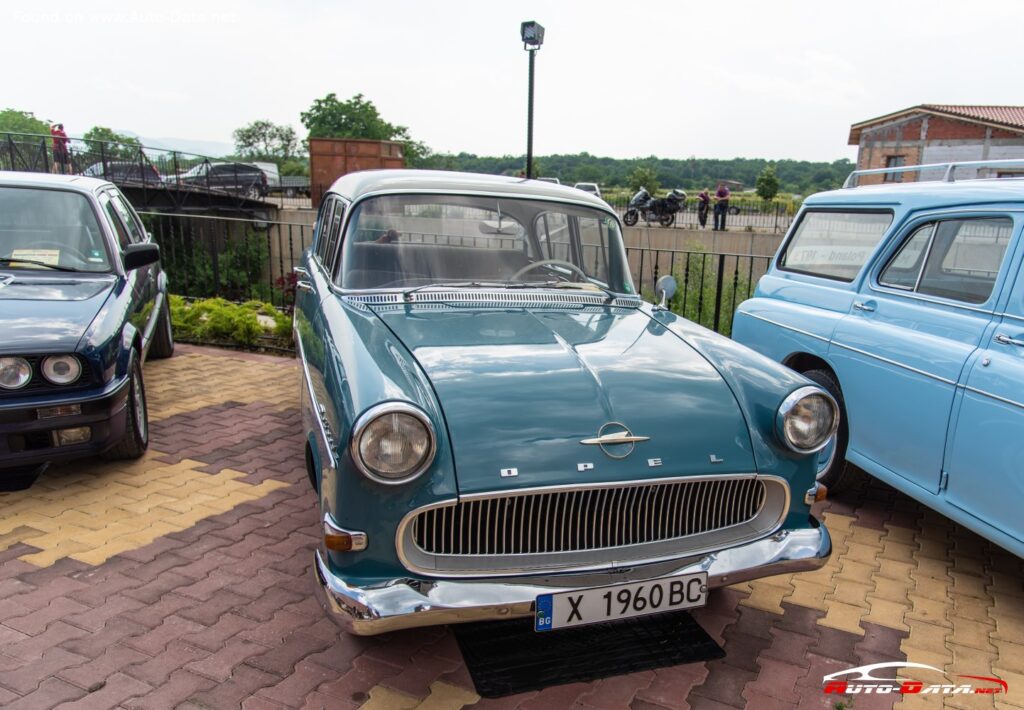
The Opel Rekord P1 (Olympia) was a visual standout in the late 1950s, largely due to its distinctive American-inspired styling. The most prominent feature, from which its “P1” designation was derived, was the expansive panoramic windshield, wrapping around the A-pillars to provide excellent visibility and a sense of openness within the cabin. This design element, popular in the US during the mid-century, brought a touch of transatlantic flair to European roads. The sedan body type was characterized by clean lines, modest tailfins, and often a fashionable two-tone paint scheme, further enhancing its modern appeal. Its dimensions, with a length of 174.53 inches (4433 mm), a width of 63.62 inches (1616 mm), and a height of 58.66 inches (1490 mm), made it a comfortably sized family car, neither too bulky for narrow European streets nor too small for family duties.
Inside, the Rekord P1 was designed for practicality and comfort. The 4-door, 5-seat configuration provided easy access and sufficient room for a family. While luxury features as we know them today were absent, the interior was well-appointed for its class, featuring durable upholstery and a straightforward dashboard layout. Instrumentation was clear and functional, prioritizing ease of use. The emphasis was on robust construction and longevity, characteristics highly valued by European consumers. The car featured a spacious trunk, making it suitable for family vacations and daily errands.
In terms of its chassis and running gear, the Rekord P1 employed a conventional setup for the era. The front suspension utilized independent coil springs, contributing to a relatively comfortable ride and improved handling compared to earlier beam-axle designs. The rear suspension, however, still relied on leaf springs, a durable and cost-effective solution for carrying passengers and cargo. Braking was handled by drum brakes on all four wheels, which provided adequate stopping power for the vehicle’s speed and weight. The steering system, a cone worm with recirculation balls, offered predictable control, though it lacked the power assistance found in more modern vehicles. The 13-inch wheels (4J x 13) were fitted with tires that provided a balance of grip and ride comfort. The overall design philosophy was to offer a stylish, reliable, and comfortable vehicle that was accessible to a broad segment of the European population, effectively bridging the gap between utilitarian post-war transport and the more aspirational vehicles that would follow.
Technical Specifications: Opel Rekord P1 (Olympia) 1.5 (50 Hp) (1957-1960)
| Category | Specification | US/Imperial Equivalent |
|---|---|---|
| General Information | ||
| Brand | Opel | |
| Model | Rekord P1 (Olympia) | |
| Generation | Rekord P1 (Olympia) | |
| Type (Engine) | 1.5 (50 Hp) | |
| Start of Production | 1957 year | |
| End of Production | 1960 year | |
| Powertrain Architecture | Internal Combustion engine | |
| Body type | Sedan | |
| Seats | 5 | |
| Doors | 4 | |
| Performance Specs | ||
| Fuel consumption (economy) – combined | 8.5 l/100 km | 27.7 US mpg |
| Fuel Type | Petrol (Gasoline) | |
| Maximum speed | 128 km/h | 79.54 mph |
| Weight-to-power ratio | 18.6 kg/Hp | 53.8 Hp/tonne |
| Weight-to-torque ratio | 8.8 kg/Nm | 114 Nm/tonne |
| Engine Specs | ||
| Power | 50 Hp @ 4300 rpm | |
| Power per liter | 33.6 Hp/l | |
| Torque | 106 Nm @ 1800-2400 rpm | 78.18 lb.-ft. @ 1800-2400 rpm |
| Engine layout | Front, Longitudinal | |
| Engine displacement | 1488 cm³ | 90.8 cu. in. |
| Number of cylinders | 4 | |
| Engine configuration | Inline | |
| Cylinder Bore | 80 mm | 3.15 in. |
| Piston Stroke | 74 mm | 2.91 in. |
| Compression ratio | 7.25:1 | |
| Number of valves per cylinder | 2 | |
| Fuel injection system | Carburetor | |
| Engine aspiration | Naturally aspirated engine | |
| Valvetrain | OHV | |
| Engine oil capacity | 3 l | 3.17 US qt |
| Engine oil specification | Not specified | |
| Coolant capacity | 8 l | 8.45 US qt |
| Space, Volume and Weights | ||
| Kerb Weight | 930 kg | 2050.3 lbs. |
| Max. weight | 1340 kg | 2954.19 lbs. |
| Max load | 410 kg | 903.9 lbs. |
| Fuel tank capacity | 40 l | 10.57 US gal |
| Dimensions | ||
| Length | 4433 mm | 174.53 in. |
| Width | 1616 mm | 63.62 in. |
| Height | 1490 mm | 58.66 in. |
| Wheelbase | 2541 mm | 100.04 in. |
| Front track | 1260 mm | 49.61 in. |
| Rear (Back) track | 1270 mm | 50 in. |
| Minimum turning circle (turning diameter) | 10.7 m | 35.1 ft. |
| Drivetrain, Brakes and Suspension Specs | ||
| Drivetrain Architecture | Internal combustion engine drives rear wheels | |
| Drive wheel | Rear wheel drive | |
| Number of gears and type of gearbox | 3 gears, manual transmission | |
| Front suspension | Independent coil spring | |
| Rear suspension | Leaf spring | |
| Front brakes | Drum | |
| Rear brakes | Drum | |
| Steering type | Cone worm with recirculation balls | |
| Wheel rims size | 4J x 13 | |
Legacy and Market Impact of the Opel Rekord P1 (Olympia)
The Opel Rekord P1 (Olympia) 1.5 (50 Hp) left an indelible mark on the European automotive landscape, particularly in Germany. It arrived at a time when the continent was experiencing rapid economic recovery and a burgeoning middle class was seeking modern, stylish, and dependable family transportation. The P1 perfectly fit this niche, offering a blend of contemporary American-inspired design and practical German engineering. Its “panoramic” styling was a bold statement that differentiated it from many of its more conservative European rivals, giving it a fresh and aspirational image.
In its primary markets, the Rekord P1 competed fiercely with other popular European sedans. Key rivals included the Ford Taunus 17M (P2), which also adopted a similar “Detroit-look” styling, and the Mercedes-Benz 180 “Ponton,” though the latter often occupied a slightly higher market segment. Volkswagen’s Beetle and Type 3 models were also competitors, albeit with a different engine layout and design philosophy. The Rekord P1 distinguished itself with its spacious interior, comfortable ride for the era, and robust mechanicals. Its 1.5-liter engine, while not exceptionally powerful, was known for its reliability and efficiency, crucial attributes for family cars.
The historical significance of the Rekord P1 cannot be overstated. It solidified Opel’s reputation as a leading manufacturer of accessible and stylish vehicles, demonstrating the brand’s ability to innovate and respond to market trends. It was a car that symbolized progress and modernity, moving beyond the austerity of the immediate post-war years. For many German families, the Rekord P1 was their first truly modern car, offering a level of comfort, speed, and aesthetic appeal previously unseen in their garages.
Although its production run was relatively short, the P1’s influence extended well into the subsequent Rekord generations, which continued to evolve Opel’s design language and technological advancements. Today, the Opel Rekord P1 is cherished by classic car enthusiasts in Europe for its distinctive styling, its role in post-war economic recovery, and its representation of a fascinating period in automotive design where European practicality met American flamboyance. It remains a testament to Opel’s engineering prowess and its understanding of the evolving needs of the European motorist. Its legacy is one of a stylish, dependable workhorse that helped mobilize a continent.