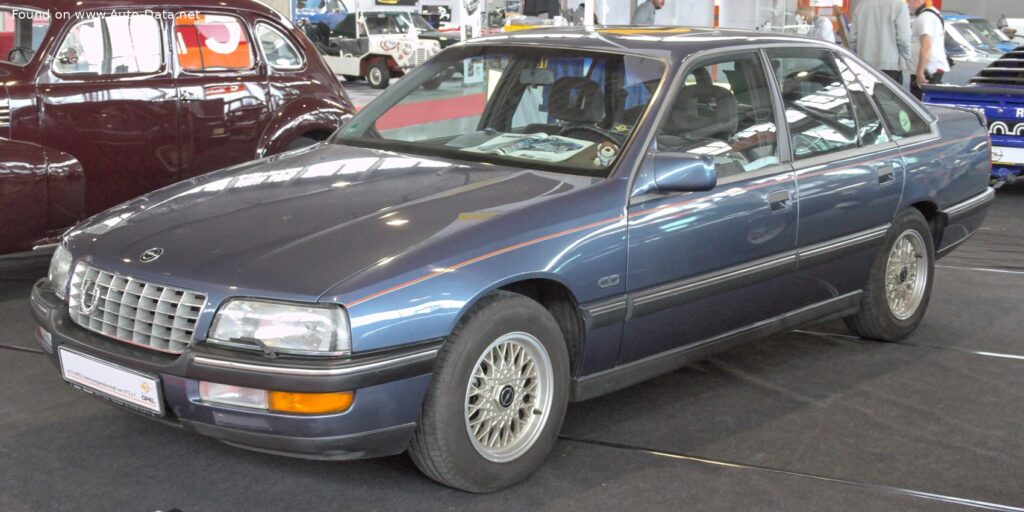
The Opel Senator B 2.6i (150 Hp): A Flagship of German Engineering
The Opel Senator B 2.6i (150 Hp) represents the second and final generation of Opel’s executive full-size sedan, a vehicle designed to compete with the likes of BMW and Mercedes-Benz in the competitive European luxury market. Produced by the German subsidiary of General Motors, the Senator B was a significant model for Opel, serving as its flagship offering from its introduction in 1987 until its discontinuation in 1993. The 2.6i variant, specifically produced from August 1990 to June 1993, offered a compelling blend of performance, comfort, and sophisticated engineering, positioning it as a strong contender in its segment for discerning European buyers. While never officially sold in the United States, the Senator B exemplified European automotive design and technical prowess of its era, embodying Opel’s aspirations for premium market penetration.
Built on the robust V-platform, shared with the Opel Omega, the Senator B was a four-door, five-seat sedan that emphasized rear-wheel-drive dynamics and a smooth, refined driving experience. Its primary market was Central and Western Europe, where it was appreciated for its spacious interior, comprehensive feature set, and solid construction. This article will delve into the technical specifications, design philosophies, and market impact of the Opel Senator B 2.6i (150 Hp), highlighting its role as a testament to German engineering during the late 20th century.
Engine and Performance of the Opel Senator B
At the heart of the Opel Senator B 2.6i (150 Hp) lies a naturally aspirated 2.6-liter (2594 cm3 or 158.3 cu. in.) inline-six gasoline engine, designated with the code C26NE. This robust powerplant was engineered for smooth power delivery and durability, characteristics highly valued in executive sedans. Featuring a Single Overhead Camshaft (SOHC) valvetrain with two valves per cylinder and a multi-port manifold fuel injection system, the engine produced a respectable 150 horsepower at 5600 rpm. Its power per liter stood at 57.8 horsepower, a solid figure for a non-turbocharged engine of its time.
Torque output was equally impressive, with 220 Newton-meters (162.26 lb.-ft.) available at a relatively low 3600 rpm. This broad torque band contributed to the Senator B’s flexible driving characteristics, allowing for effortless cruising and confident overtaking maneuvers. The engine’s maximum speed was rated at 6250 rpm, indicating a willingness to rev when called upon. Power was sent to the rear wheels via a standard five-speed manual transmission, a setup favored by enthusiasts for its direct engagement.
In terms of acceleration, the Senator B 2.6i could sprint from 0 to 62 mph (0-100 km/h) in 10.3 seconds, with a calculated 0-60 mph time of 9.8 seconds. Its top speed was an impressive 213 km/h (132.35 mph), making it a capable performer on the German Autobahn and other European highways. Despite its executive cruiser aspirations, the Senator B offered a spirited driving experience. The vehicle’s weight-to-power ratio was 9.7 kg/Hp (103.1 Hp/tonne), while its weight-to-torque ratio was 6.6 kg/Nm (151.2 Nm/tonne), indicating a well-balanced power-to-weight characteristic for its segment.
Fuel efficiency, while not the primary focus for a large executive sedan of this era, was competitive. The combined fuel consumption was rated at 9.4 liters per 100 kilometers, translating to approximately 25 US miles per gallon. Urban driving resulted in about 14.1 l/100 km (16.7 US mpg), while extra-urban cruising improved to 7.7 l/100 km (30.5 US mpg), showcasing its efficiency on longer journeys.
Design and Features
The Opel Senator B carried forward the design language established by its predecessor, yet adopted a more contemporary and aerodynamic aesthetic, evidenced by its drag coefficient (Cd) of 0.31. Its styling was understated and elegant, reflecting the conservative tastes often associated with executive sedans in Europe. The four-door sedan body type offered a classic profile, emphasizing spaciousness and comfort for all five occupants.
Dimensions were generous, with an overall length of 4845 mm (190.75 in.), a width of 1743 mm (68.62 in.), and a height of 1450 mm (57.09 in.). The substantial wheelbase of 2730 mm (107.48 in.) contributed significantly to the Senator B’s stable ride quality and expansive interior volume. Inside, the Senator B was designed with driver and passenger comfort in mind. The trunk space was ample, ranging from 530 liters (18.72 cu. ft.) with all seats in place, expandable to 870 liters (30.72 cu. ft.) when necessary, providing excellent practicality for luggage and cargo.
Key features for the Senator B 2.6i included a focus on safety and driving dynamics. It came equipped with ventilated disc brakes at the front and disc brakes at the rear, complemented by an Anti-lock Braking System (ABS), which was a significant safety feature for the early 1990s. Hydraulic power steering ensured ease of maneuverability, despite the car’s size. The suspension system utilized coil springs at both the front and rear, designed to provide a compliant yet controlled ride suitable for long-distance travel. The vehicle rode on 205/65 R15 tires mounted on 15-inch wheel rims, a common specification for executive cars of its era, balancing grip with ride comfort.
While specific interior amenities varied by trim level, the Senator B generally offered a well-appointed cabin with quality materials, comfortable seating, and a comprehensive instrument cluster. Features like electric windows, central locking, and advanced climate control systems were typical for its class, aiming to provide a refined and effortless driving experience.
Technical Specifications: Opel Senator B 2.6i (150 Hp)
| Category | Specification | Metric / US Equivalent |
|---|---|---|
General Information |
||
| Brand | Opel | |
| Model | Senator | |
| Generation | Senator B | |
| Type (Engine) | 2.6i (150 Hp) | |
| Start of Production | August, 1990 | |
| End of Production | June, 1993 | |
| Powertrain Architecture | Internal Combustion Engine | |
| Body Type | Sedan | |
| Seats | 5 | |
| Doors | 4 | |
Performance Specs |
||
| Fuel Consumption (Urban) | 14.1 l/100 km | 16.7 US mpg / 20 UK mpg |
| Fuel Consumption (Extra Urban) | 7.7 l/100 km | 30.5 US mpg / 36.7 UK mpg |
| Fuel Consumption (Combined) | 9.4 l/100 km | 25 US mpg / 30.1 UK mpg |
| Fuel Type | Petrol (Gasoline) | |
| Acceleration 0-62 mph (0-100 km/h) | 10.3 sec | |
| Acceleration 0-60 mph (Calculated) | 9.8 sec | |
| Maximum Speed | 213 km/h | 132.35 mph |
| Weight-to-Power Ratio | 9.7 kg/Hp | 103.1 Hp/tonne |
| Weight-to-Torque Ratio | 6.6 kg/Nm | 151.2 Nm/tonne |
Engine Specs |
||
| Power | 150 Hp @ 5600 rpm | |
| Power per Liter | 57.8 Hp/l | |
| Torque | 220 Nm @ 3600 rpm | 162.26 lb.-ft. @ 3600 rpm |
| Maximum Engine Speed | 6250 rpm | |
| Engine Layout | Front, Longitudinal | |
| Engine Model/Code | C26NE | |
| Engine Displacement | 2594 cm3 | 2.6 Liters / 158.3 cu. in. |
| Number of Cylinders | 6 | |
| Engine Configuration | Inline | |
| Cylinder Bore | 88.8 mm | 3.5 in. |
| Piston Stroke | 69.8 mm | 2.75 in. |
| Compression Ratio | 9.2:1 | |
| Valves per Cylinder | 2 | |
| Fuel Injection System | Multi-port manifold injection | |
| Engine Aspiration | Naturally aspirated | |
| Valvetrain | SOHC | |
| Engine Oil Capacity | 5.5 l | 5.81 US qt / 4.84 UK qt |
| Coolant Capacity | 10.5 l | 11.1 US qt / 9.24 UK qt |
Space, Volume and Weights |
||
| Kerb Weight | 1455 kg | 3207.73 lbs. |
| Max. Weight | 2005 kg | 4420.27 lbs. |
| Max Load | 550 kg | 1212.54 lbs. |
| Trunk (Boot) Space – Minimum | 530 l | 18.72 cu. ft. |
| Trunk (Boot) Space – Maximum | 870 l | 30.72 cu. ft. |
| Fuel Tank Capacity | 75 l | 19.81 US gal / 16.5 UK gal |
Dimensions |
||
| Length | 4845 mm | 190.75 in. |
| Width | 1743 mm | 68.62 in. |
| Height | 1450 mm | 57.09 in. |
| Wheelbase | 2730 mm | 107.48 in. |
| Front Track | 1462 mm | 57.56 in. |
| Rear (Back) Track | 1480 mm | 58.27 in. |
| Ride Height (Ground Clearance) | 140 mm | 5.51 in. |
| Drag Coefficient (Cd) | 0.31 | |
| Minimum Turning Circle (Turning Diameter) | 10.95 m | 35.93 ft. |
Drivetrain, Brakes and Suspension Specs |
||
| Drivetrain Architecture | Internal combustion engine (ICE) drives the rear wheels. | |
| Drive Wheel | Rear wheel drive | |
| Number of Gears and Type of Gearbox | 5 gears, manual transmission | |
| Front Suspension | Coil spring | |
| Rear Suspension | Coil spring | |
| Front Brakes | Ventilated discs | |
| Rear Brakes | Disc | |
| Assisting Systems | ABS (Anti-lock braking system) | |
| Power Steering | Hydraulic Steering | |
| Tires Size | 205/65 R15 | |
| Wheel Rims Size | 15 | |
Legacy and Market Impact of the Opel Senator B
The Opel Senator B, particularly the 2.6i variant, carved out a distinct niche in the European executive car market during its production run. Positioned as Opel’s flagship, it aimed to offer a compelling alternative to established premium brands like BMW, Mercedes-Benz, and Audi. While it might not have always matched the brand prestige of its German rivals, the Senator B offered exceptional value, robust engineering, and a focus on practicality and comfort that resonated with a specific segment of buyers.
Its primary competitors included the BMW 5 Series (E34), Mercedes-Benz E-Class (W124), and the Audi 100/A6 (C4). The Senator B distinguished itself with its strong inline-six engines, comfortable ride, and conservative yet elegant styling. For many, it represented a more understated luxury, providing executive-level transportation without the overt status symbolism of its more expensive counterparts. The 2.6i engine, in particular, offered a sweet spot in the lineup, providing a good balance of performance and running costs for the era.
The Senator B’s reputation was built on its reliability and solid build quality, attributes that were highly valued by consumers. It was often chosen by business professionals and families who needed a spacious, comfortable, and dependable vehicle for long-distance travel. The rear-wheel-drive architecture, shared with the Omega, provided a traditional driving feel that many enthusiasts appreciated, contrasting with some front-wheel-drive competitors.
Despite its merits, the Senator B was ultimately discontinued in 1993, marking the end of Opel’s direct foray into the full-size luxury sedan segment. Its demise reflected a shift in market dynamics and possibly a strategic decision by General Motors to focus Opel on more mainstream segments, leaving the premium space to brands like Cadillac or Saab within the GM portfolio, or allowing consumers to gravitate towards the more established German luxury marques.
Today, the Opel Senator B 2.6i (150 Hp) is remembered as a capable and dignified executive sedan that offered a substantial amount of car for the money. It stands as a testament to Opel’s engineering capabilities and its ambition to compete at the highest levels of the European automotive industry. While it may not have achieved the iconic status of some of its rivals, it remains a respected and somewhat understated classic, appreciated by enthusiasts for its smooth performance, comfortable ride, and enduring quality. Its legacy is one of a well-engineered, practical, and refined vehicle that capably served its purpose as Opel’s flagship in a highly competitive market.