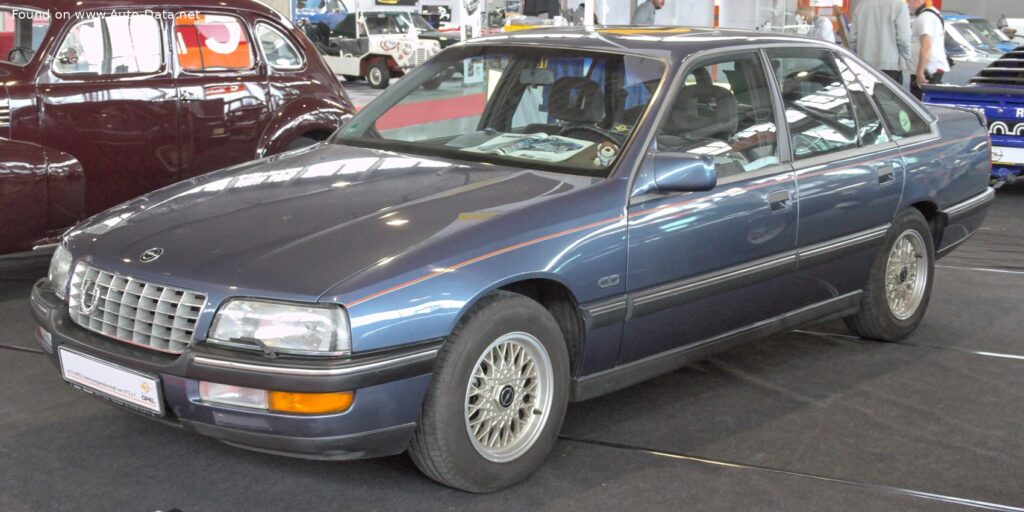
The Opel Senator B 3.0i 24V (204 Hp) Automatic: Opel’s Executive Standard
The Opel Senator B 3.0i 24V (204 Hp) Automatic represents the pinnacle of Opel’s executive sedan offerings during its production run from October 1989 to May 1993. As the second and final generation of the Senator nameplate, this model served as the flagship for the German automaker, a division of General Motors Europe. Positioned in the highly competitive European executive segment, the Senator B was designed to challenge established rivals with its blend of sophisticated engineering, luxurious appointments, and a compelling inline-six powertrain. While never officially sold in the United States, the Opel Senator B played a crucial role in Opel’s strategy to showcase its engineering prowess and offer a credible alternative to premium German marques like BMW and Mercedes-Benz within its primary European markets. This particular variant, equipped with the potent 3.0-liter 24-valve engine and an automatic transmission, epitomized the Senator’s ambition as a comfortable, powerful, and refined long-distance cruiser.
Engine and Performance: The Heart of the Opel Senator B 3.0i 24V
At the core of the Opel Senator B 3.0i 24V lies a highly regarded 3.0-liter (2969 cm3 or 181.18 cu. in.) C30SE inline-six gasoline engine. This powerplant was a significant evolution for Opel, featuring a Double Overhead Camshaft (DOHC) valvetrain with four valves per cylinder, totaling 24 valves. This advanced cylinder head design, coupled with multi-port manifold injection and natural aspiration, allowed the engine to produce a robust 204 horsepower at 6000 rpm. This output translated to an impressive power-per-liter figure of 68.7 Hp/l, a testament to its efficient design for the late 1980s and early 1990s.
Torque delivery was equally impressive, with 199.14 lb.-ft. (270 Nm) peaking at a relatively accessible 3600 rpm. This broad torque curve ensured strong, effortless acceleration, making the Senator B an excellent choice for highway cruising and confident overtaking maneuvers. Mated to a smooth-shifting 4-speed automatic transmission, the powertrain directed its power to the rear wheels, a configuration favored by executive sedans for its balanced handling characteristics.
Performance figures reflected the engine’s capability, with the Opel Senator B 3.0i 24V accelerating from 0 to 60 mph in a brisk 8.4 seconds (0-100 km/h in 8.8 seconds). Its top speed reached an impressive 146.02 mph (235 km/h), firmly placing it among the faster executive cars of its era. Despite its performance, Opel also paid attention to drivability and refinement, ensuring the inline-six delivered its power with a characteristic smoothness. Fuel economy, while not a primary selling point for an executive sedan of this caliber, was reasonable for its time, with a combined rating of 26.1 US mpg (9 l/100 km). The vehicle’s weight-to-power ratio stood at 7.3 kg/Hp (136.5 Hp/tonne), highlighting its solid performance credentials relative to its curb weight range of 3295.91 to 3461.26 lbs.
Design and Features: Executive Comfort and Aerodynamic Form
The Opel Senator B retained the classic executive sedan proportions of its predecessor but adopted a more contemporary and aerodynamic design language, achieving a commendable drag coefficient (Cd) of 0.31. Its four-door, five-seat sedan body type exuded a sense of understated elegance, characterized by clean lines, a relatively low roofline, and a purposeful stance. Measuring 190.75 inches (4845 mm) in length, 69.41 inches (1763 mm) in width, and 57.09 inches (1450 mm) in height, the Senator B offered a substantial road presence. The generous 107.48-inch (2730 mm) wheelbase contributed significantly to both passenger comfort and stable high-speed handling.
Inside, the Senator B was designed to provide a comfortable and spacious environment for its occupants. While specific luxury features are not detailed in the raw data, as a flagship executive sedan of its era, it would have offered amenities expected in its class, such as power-adjustable seating, climate control, advanced audio systems, and high-quality upholstery materials. The trunk space was particularly impressive, offering a minimum of 18.72 cu. ft. (530 liters) and expanding to a cavernous 32.84 cu. ft. (930 liters) with the rear seats folded, providing ample room for luggage or larger items.
Underneath its refined exterior, the Senator B featured a robust chassis designed for both comfort and dynamic capability. The front suspension utilized an independent MacPherson strut setup with coil springs and an anti-roll bar, providing precise steering and good body control. The rear featured an independent coil spring system with a transverse stabilizer and trailing arms, a sophisticated arrangement that contributed to the car’s smooth ride and confident handling. Braking power was supplied by ventilated discs at the front and solid discs at the rear, complemented by an Anti-lock Braking System (ABS), which was a significant safety feature for its time. Steering was managed by a hydraulic power steering system, offering a direct and communicative feel. The car rode on 205/65 R15 tires, mounted on 6J x 15 or 7J x 15 wheel rims, balancing grip with ride comfort.
Technical Specifications
| Feature | Specification |
|---|---|
| Brand | Opel |
| Model | Senator |
| Generation | Senator B |
| Type (Engine) | 3.0i 24V (204 Hp) Automatic |
| Start of Production | October, 1989 |
| End of Production | May, 1993 |
| Powertrain Architecture | Internal Combustion Engine |
| Body Type | Sedan |
| Seats | 5 |
| Doors | 4 |
| Fuel Consumption (Urban) | 14.5 l/100 km (16.2 US mpg) |
| Fuel Consumption (Extra Urban) | 7.4 l/100 km (31.8 US mpg) |
| Fuel Consumption (Combined) | 9 l/100 km (26.1 US mpg) |
| Fuel Type | Petrol (Gasoline) |
| Acceleration 0-60 mph | 8.4 sec |
| Maximum Speed | 146.02 mph (235 km/h) |
| Weight-to-Power Ratio | 7.3 kg/Hp (136.5 Hp/tonne) |
| Weight-to-Torque Ratio | 5.5 kg/Nm (180.6 Nm/tonne) |
| Power | 204 Hp @ 6000 rpm |
| Power per Liter | 68.7 Hp/l |
| Torque | 199.14 lb.-ft. (270 Nm) @ 3600 rpm |
| Maximum Engine Speed | 6600 rpm |
| Engine Layout | Front, Longitudinal |
| Engine Model/Code | C30SE |
| Engine Displacement | 3.0 Liters (2969 cm3, 181.18 cu. in.) |
| Number of Cylinders | 6 |
| Engine Configuration | Inline |
| Cylinder Bore | 3.74 in. (95 mm) |
| Piston Stroke | 2.75 in. (69.8 mm) |
| Compression Ratio | 10:1 |
| Number of Valves per Cylinder | 4 |
| Fuel Injection System | Multi-port manifold injection |
| Engine Aspiration | Naturally aspirated engine |
| Valvetrain | DOHC |
| Engine Oil Capacity | 5.81 US qt (5.5 l) |
| Coolant Capacity | 10.36 US qt (9.8 l) |
| Kerb Weight | 3295.91 – 3461.26 lbs. (1495-1570 kg) |
| Max. Weight | 4486.41 – 4552.55 lbs. (2035-2065 kg) |
| Max Load | 1091.29 – 1190.5 lbs. (495-540 kg) |
| Trunk (boot) Space (Minimum) | 18.72 cu. ft. (530 l) |
| Trunk (boot) Space (Maximum) | 32.84 cu. ft. (930 l) |
| Fuel Tank Capacity | 19.81 US gal (75 l) |
| Max. Roof Load | 220.46 lbs. (100 kg) |
| Permitted Trailer Load with Brakes (12%) | 3747.86 lbs. (1700 kg) |
| Permitted Towbar Download | 165.35 lbs. (75 kg) |
| Length | 190.75 in. (4845 mm) |
| Width | 69.41 in. (1763 mm) |
| Height | 57.09 in. (1450 mm) |
| Wheelbase | 107.48 in. (2730 mm) |
| Front Track | 57.09 in. (1450 mm) |
| Rear Track | 57.8 in. (1468 mm) |
| Ride Height (Ground Clearance) | 5.51 in. (140 mm) |
| Drag Coefficient (Cd) | 0.31 |
| Minimum Turning Circle | 35.93 ft. (10.95 m) |
| Drivetrain Architecture | Rear Wheel Drive, Internal Combustion Engine |
| Drive Wheel | Rear wheel drive |
| Number of Gears and Gearbox Type | 4 gears, automatic transmission |
| Front Suspension | Independent, MacPherson with coil spring and anti-roll bar |
| Rear Suspension | Independent coil spring, Transverse stabilizer, Trailing arm |
| Front Brakes | Ventilated discs |
| Rear Brakes | Disc |
| Assisting Systems | ABS (Anti-lock braking system) |
| Steering Type | Cone worm with recirculation balls |
| Power Steering | Hydraulic Steering |
| Tires Size | 205/65 R15 |
| Wheel Rims Size | 6J x 15; 7J x 15 |
Legacy and Market Impact of the Opel Senator B
The Opel Senator B, particularly in its potent 3.0i 24V Automatic guise, holds a significant place in Opel’s history as its last true large executive sedan. As the flagship model for Opel and Vauxhall (its British counterpart), the Senator B was designed to compete directly with segment stalwarts such as the BMW 5-Series (E34), Mercedes-Benz E-Class (W124), and the Audi 100/A6 (C4). While it may not have achieved the same prestige or sales volume as its German premium rivals, it offered a compelling value proposition, providing similar levels of performance, comfort, and sophistication at a more accessible price point for European consumers.
Its reputation was built on its refined inline-six engines, comfortable ride quality, and robust construction. The 24-valve C30SE engine was particularly celebrated for its smoothness, power, and durability, becoming a favorite among enthusiasts. The Senator B was often lauded for its strong highway manners, making it an ideal choice for long-distance European travel. It also served as a popular choice for taxi fleets and police forces in some European countries, a testament to its reliability and spaciousness.
The Senator B’s discontinuation in 1993 marked a strategic shift for Opel. The market for large, rear-wheel-drive executive sedans was becoming increasingly challenging, with premium brands dominating the upper echelons and a growing demand for more efficient, front-wheel-drive alternatives. Opel pivoted its focus to the Omega B, which, while still a large sedan, was positioned slightly differently and eventually saw its top-tier role taken over by other models within the General Motors portfolio in Europe.
Today, the Opel Senator B 3.0i 24V is regarded as a classic European executive car, appreciated by enthusiasts for its understated design, powerful and smooth engine, and its status as the last of a lineage. It represents an era when Opel aimed to compete directly at the top of the mainstream European market, showcasing the brand’s engineering capabilities and commitment to producing high-quality, comfortable, and capable automobiles. Its legacy is one of quiet competence and a testament to Opel’s ambition in the executive segment, a chapter that concluded with the Senator B, leaving behind a car that continues to impress with its timeless qualities.