The Opel Senator B 3.0i CAT (156 Hp): A European Executive Flagship
The Opel Senator B, specifically the 3.0i CAT (156 Hp) variant produced between September 1987 and September 1990, represented Opel’s ambitious foray into the full-size executive sedan segment in Europe. As the flagship model for General Motors’ German subsidiary, the Senator B was designed to offer a compelling blend of comfort, robust engineering, and sophisticated features, aiming to compete with established luxury marques without carrying the same premium price tag. While never officially sold in the United States under the Opel badge, the Senator B’s mechanical underpinnings and design philosophy reflect a period of significant automotive development, particularly in the European market where it carved out a niche for itself as a spacious, capable, and somewhat understated alternative to its more overtly luxurious rivals. This generation, the “B” series, built upon the foundation of its predecessor, the Senator A, by introducing more modern styling, improved aerodynamics, and enhanced powertrain options, culminating in a vehicle that was both contemporary for its time and indicative of Opel’s engineering prowess.
Engine & Performance: Powering the Opel Senator B
At the heart of the Opel Senator B 3.0i CAT lies a longitudinally mounted, naturally aspirated 3.0-liter (2969 cm³, or 181.18 cu. in.) inline-six gasoline engine, designated with the code C30LE. This robust powerplant was a hallmark of Opel’s engineering, known for its smooth operation and dependable performance. It delivered a respectable 156 horsepower at 5400 rpm, translating to a power-per-liter output of 52.5 Hp/l. Torque figures stood at 230 Nm (169.64 lb.-ft.), available across a broad range from 3800 to 4400 rpm, ensuring flexible power delivery suitable for an executive cruiser.
A notable feature for its era was the inclusion of a Catalytic Converter (CAT), indicated in the model name, signifying Opel’s commitment to reducing emissions even in the late 1980s, a period when such technology was becoming increasingly prevalent in Europe. The engine utilized a multi-port manifold injection system for precise fuel delivery and featured a CIH (Cam-in-Head) valvetrain with two valves per cylinder. With a compression ratio of 8.6:1, it was optimized for regular unleaded petrol (gasoline).
Performance-wise, the Senator B 3.0i CAT was capable of accelerating from 0 to 60 mph in a brisk 9.5 seconds, and it could reach a top speed of 133.59 mph (215 km/h). These figures were competitive for a large sedan of its time, providing ample performance for both highway cruising and urban driving. Power was sent to the rear wheels via a 5-speed manual transmission, offering an engaging driving experience for those who preferred more direct control over their vehicle. The drivetrain architecture, with its front-longitudinal engine and rear-wheel drive, contributed to a balanced weight distribution and classic sedan driving dynamics, appealing to traditionalists.
Design & Features of the Opel Senator B
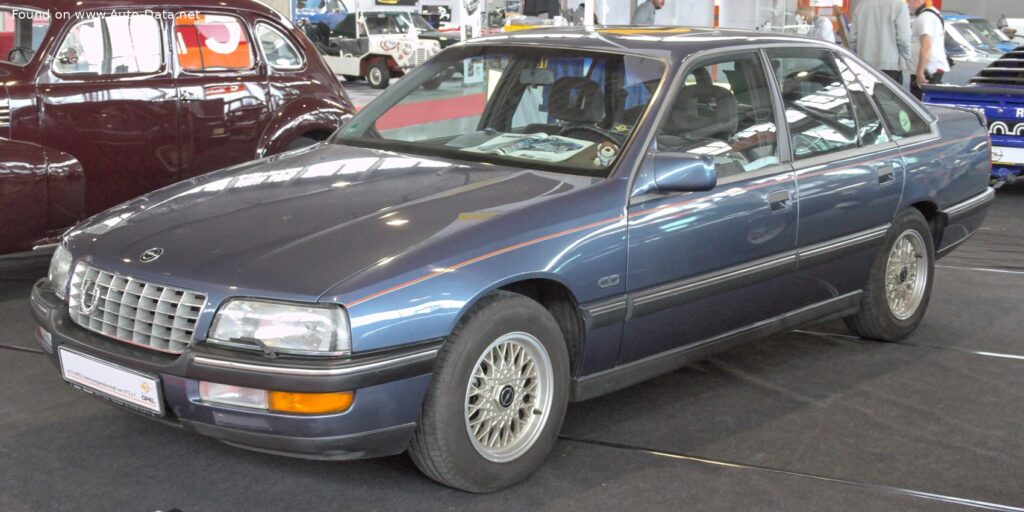
The design of the Opel Senator B was a clear evolution from its predecessor, adopting a more contemporary and aerodynamic aesthetic that was in line with late 1980s automotive trends. Its four-door sedan body, measuring 190.75 inches (4845 mm) in length and 69.41 inches (1763 mm) in width, exuded a sense of understated elegance. The height stood at 57.17 inches (1452 mm), and a wheelbase of 107.48 inches (2730 mm) contributed to a spacious cabin and a stable ride. The car’s drag coefficient (Cd) of 0.30 was quite commendable for its time, aiding in fuel efficiency and reducing wind noise at higher speeds.
Inside, the Senator B offered seating for five occupants, with a focus on comfort and practicality. The trunk space was generous, ranging from 18.72 cu. ft. (530 liters) to an impressive 32.84 cu. ft. (930 liters) with the rear seats folded, making it highly versatile for an executive sedan. The interior appointments, while not overtly lavish compared to some German rivals, were well-appointed and durable, reflecting Opel’s reputation for robust build quality.
From a technological standpoint, the Senator B incorporated several features that were considered advanced for a mainstream executive car in the late 1980s. These included a hydraulic power steering system, making maneuvering the large sedan manageable. The suspension system comprised an independent McPherson strut setup with coil springs and an anti-roll bar at the front, paired with an independent coil spring, transverse stabilizer, and trailing arm arrangement at the rear. This sophisticated suspension design provided a comfortable ride while maintaining good handling characteristics. Braking was handled by ventilated discs at the front and solid discs at the rear, augmented by an Anti-lock Braking System (ABS), a crucial safety feature that was still a premium offering during this period. The car rode on 205/65 R15 tires mounted on 6J x 15-inch wheel rims, providing a good balance of grip and ride comfort.
Technical Specifications for the Opel Senator B 3.0i CAT (156 Hp)
| Category | Specification |
|---|---|
| General Information | |
| Brand | Opel |
| Model | Senator B |
| Type (Engine) | 3.0i CAT (156 Hp) |
| Production Start | September, 1987 |
| Production End | September, 1990 |
| Body Type | Sedan |
| Seats | 5 |
| Doors | 4 |
| Performance Specs | |
| Fuel Type | Petrol (Gasoline) |
| Fuel Consumption (Urban) | 15.5 l/100 km (15.2 US mpg) |
| Fuel Consumption (Extra Urban) | 7.8 l/100 km (30.2 US mpg) |
| Fuel Consumption (Combined) | 10.9 l/100 km (21.6 US mpg) |
| Acceleration 0-60 mph | 9.5 seconds |
| Maximum Speed | 133.59 mph (215 km/h) |
| Weight-to-Power Ratio | 9.2 kg/Hp (108.7 Hp/tonne) |
| Weight-to-Torque Ratio | 6.2 kg/Nm (160.3 Nm/tonne) |
| Engine Specs | |
| Power | 156 Hp @ 5400 rpm |
| Power per Liter | 52.5 Hp/l |
| Torque | 230 Nm (169.64 lb.-ft.) @ 3800-4400 rpm |
| Maximum Engine Speed | 6400 rpm |
| Engine Layout | Front, Longitudinal |
| Engine Model/Code | C30LE |
| Engine Displacement | 2969 cm³ (181.18 cu. in.) |
| Number of Cylinders | 6 |
| Engine Configuration | Inline |
| Cylinder Bore | 95 mm (3.74 in.) |
| Piston Stroke | 69.8 mm (2.75 in.) |
| Compression Ratio | 8.6:1 |
| Valves per Cylinder | 2 |
| Fuel Injection System | Multi-port manifold injection |
| Engine Aspiration | Naturally aspirated |
| Valvetrain | CIH |
| Engine Oil Capacity | 5.5 l (5.81 US qt) |
| Space, Volume and Weights | |
| Kerb Weight | 1435 kg (3163.63 lbs.) |
| Max. Weight | 1995 kg (4398.22 lbs.) |
| Max Load | 560 kg (1234.59 lbs.) |
| Trunk (Boot) Space (Min) | 530 l (18.72 cu. ft.) |
| Trunk (Boot) Space (Max) | 930 l (32.84 cu. ft.) |
| Fuel Tank Capacity | 75 l (19.81 US gal) |
| Max. Roof Load | 100 kg (220.46 lbs.) |
| Permitted Trailer Load (with brakes) | 1700 kg (3747.86 lbs.) |
| Permitted Trailer Load (without brakes) | 720 kg (1587.33 lbs.) |
| Permitted Towbar Download | 75 kg (165.35 lbs.) |
| Dimensions | |
| Length | 4845 mm (190.75 in.) |
| Width | 1763 mm (69.41 in.) |
| Height | 1452 mm (57.17 in.) |
| Wheelbase | 2730 mm (107.48 in.) |
| Front Track | 1450 mm (57.09 in.) |
| Rear Track | 1468 mm (57.80 in.) |
| Ride Height (Ground Clearance) | 140 mm (5.51 in.) |
| Drag Coefficient (Cd) | 0.30 |
| Minimum Turning Circle | 10.95 m (35.93 ft.) |
| Drivetrain, Brakes and Suspension Specs | |
| Drivetrain Architecture | Rear wheel drive |
| Number of Gears | 5 gears, manual transmission |
| Front Suspension | Independent, McPherson with coil spring and anti-roll bar |
| Rear Suspension | Independent coil spring, Transverse stabilizer, Trailing arm |
| Front Brakes | Ventilated discs |
| Rear Brakes | Disc |
| Assisting Systems | ABS (Anti-lock braking system) |
| Steering Type | Cone worm with recirculation balls |
| Power Steering | Hydraulic Steering |
| Tire Size | 205/65 R15 |
| Wheel Rims Size | 6J x 15 |
Legacy & Market Impact of the Opel Senator B
The Opel Senator B, and particularly the 3.0i CAT variant, held a significant position in the European automotive landscape during its production run. As Opel’s largest and most luxurious sedan, it was tasked with challenging established players in the executive segment, primarily from its domestic rivals like the BMW 5-Series (E34 generation) and the Mercedes-Benz E-Class (W124 generation), as well as the Ford Scorpio/Granada. While it may not have achieved the same aspirational status as its German premium counterparts, the Senator B carved out a reputation for being a highly competent, comfortable, and reliable vehicle that offered exceptional value.
Its competitive edge often lay in its robust, well-proven mechanicals, spacious interior, and more accessible pricing compared to similarly equipped BMWs or Mercedes-Benzes. For buyers seeking a large, comfortable, rear-wheel-drive sedan for long-distance cruising without the badge premium, the Senator B was an attractive option. Its inline-six engine, particularly the 3.0-liter unit, was praised for its durability and smooth power delivery, aligning with the expectations of executive car buyers. The inclusion of features like ABS and a catalytic converter underscored its modernity and compliance with evolving safety and environmental standards.
The Senator B’s legacy is that of a quintessential European executive car from the late 1980s. It represented a period when Opel was striving to elevate its brand image and compete more directly with premium manufacturers. While it eventually faded from the market, replaced by models that adapted to changing market demands and tastes, the Opel Senator B remains a classic example of German engineering focused on practicality, comfort, and understated performance. Today, these vehicles are appreciated by enthusiasts for their classic rear-wheel-drive dynamics, robust construction, and as a tangible piece of General Motors Europe’s history, showcasing a time when flagship sedans were built with a distinctive blend of luxury and everyday usability.