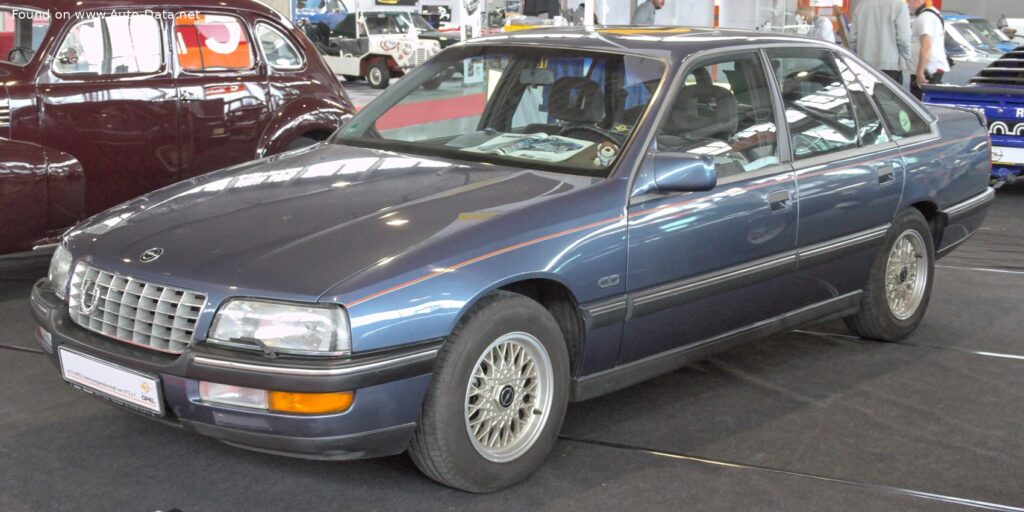
The Opel Senator B 3.0i CAT (177 Hp) Automatic: A European Executive Sedan
The Opel Senator B 3.0i CAT (177 Hp) Automatic represents the second and final generation of Opel’s flagship executive sedan, produced from January 1988 to May 1993. As Opel’s entry into the competitive full-size luxury segment, the Senator B was designed to offer discerning European customers a comfortable, refined, and well-equipped rear-wheel-drive vehicle, positioned above the slightly smaller Opel Omega. While never officially sold in the United States, the Senator B played a crucial role in Opel’s brand image and market strategy across Europe, serving as a testament to German engineering and comfort in its era. It aimed to provide a more accessible yet sophisticated alternative to established luxury brands, focusing on robust mechanics, spacious interiors, and a smooth driving experience.
Based on the Opel Omega A platform, the Senator B shared much of its underpinnings with its more mainstream sibling but distinguished itself with a longer wheelbase, more luxurious appointments, and a focus on higher-tier powertrains. The 3.0i CAT variant, equipped with a catalytic converter (CAT) for reduced emissions, was a significant offering, blending respectable performance with increasing environmental consciousness of the late 1980s and early 1990s. This particular model, with its 177 horsepower engine and smooth automatic transmission, was aimed at executives and private buyers who valued comfort, effortless cruising, and a degree of understated prestige.
Engineering and Design of the Opel Senator B
Powertrain and Performance
At the heart of the Opel Senator B 3.0i CAT (177 Hp) Automatic was Opel’s venerable C30NE inline-six engine, a naturally aspirated 3.0-liter (2969 cm³) unit. This robust powerplant was a hallmark of Opel’s engineering, known for its smooth operation and reliability. It delivered a respectable 177 horsepower at 5800 rpm and 177.01 lb.-ft. of torque at 4200 rpm, providing ample power for comfortable highway cruising and confident overtaking.
The engine featured a multi-port manifold injection system and a CIH (Cam-in-head) valvetrain with two valves per cylinder, a design choice that contributed to its low-end torque and durability. With a compression ratio of 9.2:1, it ran efficiently on petrol (gasoline) fuel. The inclusion of a catalytic converter (CAT) was a forward-thinking move for its time, demonstrating Opel’s commitment to meeting evolving emission standards in its primary European markets.
Power was transferred to the rear wheels via a 4-speed automatic transmission, emphasizing the car’s role as a comfortable cruiser rather than an outright sports sedan. This combination allowed the Senator B 3.0i CAT to accelerate from 0 to 60 mph in a respectable 9.8 seconds, with a top speed of 133.59 mph. While not blistering performance by today’s standards, these figures were competitive for an executive sedan of its era, especially one focused on refinement. The car’s weight-to-power ratio stood at 8.2 kg/Hp (121.6 Hp/tonne), reflecting its solid construction and executive segment positioning.
Fuel economy for the 3.0i CAT automatic was rated at a combined 26.1 US mpg, with urban consumption around 15.5 US mpg and extra-urban figures reaching 31.8 US mpg. These numbers were typical for a large-displacement inline-six engine paired with an automatic transmission in the late 1980s and early 1990s, balancing performance with reasonable efficiency for its size and era.
Design, Comfort, and Features
The Senator B’s design was characterized by its clean, aerodynamic lines, a departure from the more angular styling of its predecessor. With a drag coefficient (Cd) of just 0.30, it was notably sleek for a large sedan of its time, contributing to both fuel efficiency and reduced wind noise at speed. The vehicle measured 190.75 inches in length, 69.41 inches in width, and 57.09 inches in height, with a substantial 107.48-inch wheelbase, providing a commanding road presence and a spacious interior.
As a 4-door, 5-seat sedan, the Senator B prioritized passenger comfort and cargo capacity. The trunk offered a generous 18.72 cubic feet of space, expandable to 32.84 cubic feet with the rear seats folded (though often a pass-through was more common in executive sedans of this type). The interior was designed with high-quality materials and thoughtful ergonomics, typical of German executive cars. Features often included power windows, central locking, and advanced climate control systems for the time, ensuring a premium cabin experience.
Underneath, the Senator B featured an independent suspension setup, with McPherson struts and an anti-roll bar at the front, and an independent coil spring system with a transverse stabilizer and trailing arms at the rear. This sophisticated arrangement, coupled with hydraulic power steering, provided a compliant ride quality that absorbed road imperfections effectively, making it an excellent long-distance cruiser. Braking was handled by ventilated discs at the front and solid discs at the rear, augmented by an Anti-lock Braking System (ABS), a significant safety feature for its era that enhanced control during emergency stops. The car rode on 205/65 R15 tires, providing a good balance of grip and ride comfort.
Technical Specifications
| Category | Specification |
|---|---|
| Brand | Opel |
| Model | Senator B 3.0i CAT (177 Hp) Automatic |
| Generation | Senator B |
| Production Start | January, 1988 |
| Production End | May, 1993 |
| Body Type | Sedan |
| Seats | 5 |
| Doors | 4 |
| Performance | |
| Fuel Consumption (Urban) | 15.5 US mpg |
| Fuel Consumption (Extra Urban) | 31.8 US mpg |
| Fuel Consumption (Combined) | 26.1 US mpg |
| Fuel Type | Petrol (Gasoline) |
| Acceleration 0-60 mph | 9.8 sec |
| Maximum Speed | 133.59 mph |
| Weight-to-Power Ratio | 8.2 kg/Hp |
| Engine Specs | |
| Power | 177 Hp @ 5800 rpm |
| Torque | 177.01 lb.-ft. @ 4200 rpm |
| Maximum Engine Speed | 6300 rpm |
| Engine Layout | Front, Longitudinal |
| Engine Model/Code | C30NE |
| Engine Displacement | 3.0 L (181.18 cu. in.) |
| Number of Cylinders | 6 |
| Engine Configuration | Inline |
| Cylinder Bore | 3.74 in. |
| Piston Stroke | 2.75 in. |
| Compression Ratio | 9.2:1 |
| Valves per Cylinder | 2 |
| Fuel Injection System | Multi-port manifold injection |
| Engine Aspiration | Naturally aspirated |
| Valvetrain | CIH |
| Engine Oil Capacity | 5.81 US qt |
| Coolant Capacity | 10.67 US qt |
| Dimensions & Weights | |
| Kerb Weight | 3207.73 – 3373.07 lbs. |
| Max. Weight | 4420.27 – 4486.41 lbs. |
| Max Load | 1113.33 – 1212.54 lbs. |
| Trunk (Boot) Space (Min) | 18.72 cu. ft. |
| Trunk (Boot) Space (Max) | 32.84 cu. ft. |
| Fuel Tank Capacity | 19.81 US gal |
| Length | 190.75 in. |
| Width | 69.41 in. |
| Height | 57.09 in. |
| Wheelbase | 107.48 in. |
| Front Track | 57.09 in. |
| Rear Track | 57.8 in. |
| Ground Clearance | 5.51 in. |
| Drag Coefficient (Cd) | 0.30 |
| Minimum Turning Circle | 35.93 ft. |
| Drivetrain, Brakes & Suspension | |
| Drivetrain Architecture | Rear-wheel drive |
| Drive Wheel | Rear wheel drive |
| Gearbox Type | 4-speed automatic |
| Front Suspension | Independent, McPherson with coil spring and anti-roll bar |
| Rear Suspension | Independent coil spring, Transverse stabilizer, Trailing arm |
| Front Brakes | Ventilated discs |
| Rear Brakes | Disc |
| Assisting Systems | ABS (Anti-lock braking system) |
| Steering Type | Cone worm with recirculation balls |
| Power Steering | Hydraulic Steering |
| Tires Size | 205/65 R15 |
| Wheel Rims Size | 6J x 15; 7J x 15 |
Legacy and Market Impact of the Opel Senator B
The Opel Senator B, particularly in its 3.0i CAT (177 Hp) Automatic guise, cemented Opel’s reputation as a purveyor of robust, comfortable, and understated executive sedans in Europe. While it never achieved the same iconic status or sales volumes as its German premium rivals like the BMW 5-Series (E34) or the Mercedes-Benz E-Class (W124), it carved out a niche for itself as a value-oriented alternative, offering comparable space, comfort, and reliability without the higher price tag or perceived ostentation.
In its primary markets, the Senator B competed directly with the Ford Scorpio/Granada, another large European sedan, and indirectly with the Audi 100/A6 (C3/C4). Its appeal lay in its smooth, powerful inline-six engines, refined ride quality, and a spacious, well-appointed interior that made it popular among business executives, taxi operators in some regions, and families seeking a comfortable long-distance touring car. The rear-wheel-drive architecture also gave it a traditional driving feel favored by many enthusiasts.
The Senator B’s mechanical durability and relatively straightforward engineering contributed to its longevity on European roads. Its C30NE engine, in particular, was praised for its robustness and ease of maintenance. The inclusion of modern features like ABS and a catalytic converter showcased Opel’s commitment to safety and environmental responsibility, keeping it competitive during a period of rapid automotive evolution.
Ultimately, the Senator B’s production ceased in 1993, marking the end of an era for Opel’s dedicated executive flagship. The market for large, rear-wheel-drive sedans was shifting, and Opel decided to focus its upper-segment efforts on the Omega, which grew in size and luxury in its subsequent generations. Despite its discontinuation, the Opel Senator B remains a classic example of German engineering from the late 20th century, appreciated by collectors and enthusiasts for its comfortable ride, solid build quality, and a touch of understated European executive charm. It stands as a testament to Opel’s ambition to compete at the higher echelons of the automotive market, offering a compelling blend of performance, luxury, and practicality that was well-suited to its time and place.