
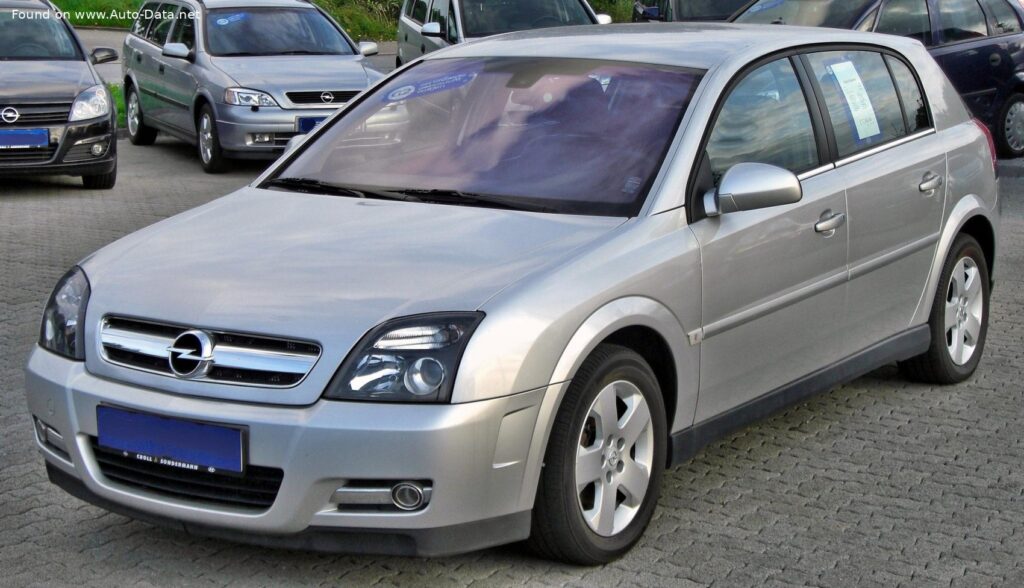
The Opel Signum 1.9 CDTI (120 Hp): An Executive Hatchback Experiment
The Opel Signum 1.9 CDTI (120 Hp) represents a unique and ambitious venture by the German automaker Opel into a niche segment of the European market. Produced from May 2004 to 2005, this particular variant of the Signum was part of the model’s sole generation, which ran from 2003 to 2008. Positioned above Opel’s conventional mid-size offering, the Vectra, the Signum aimed to blend the spaciousness and versatility of a large hatchback with the comfort and executive appeal typically found in more premium sedans or wagons. It was a vehicle designed primarily for the European market, where its unique blend of attributes sought to attract buyers looking for something beyond the traditional three-box sedan or estate car.
The Signum’s powertrain architecture was based on an internal combustion engine driving the front wheels, a conventional setup for its class. Its distinctive body type, often described as a large five-door hatchback or a “long-wheelbase liftback,” was central to its appeal, offering exceptional rear passenger legroom and flexible cargo solutions. The 1.9 CDTI engine, a testament to Europe’s strong preference for efficient diesel powerplants, provided a balanced combination of performance and remarkable fuel economy, making it a practical choice for long-distance cruising and daily commuting alike.
Engine and Performance of the Opel Signum
Powertrain and Dynamics
Under the hood, the Opel Signum 1.9 CDTI (120 Hp) featured a robust and efficient 1.9-liter (1910 cm3 or 116.56 cu. in.) inline four-cylinder diesel engine, designated with the model code Z19DT. This powerplant was a product of a joint venture between General Motors and Fiat, renowned for its strong torque delivery and reliability. It utilized a common rail fuel injection system, combined with a turbocharger and intercooler, to optimize combustion and boost power output.
The engine produced a respectable 120 horsepower at 3250 revolutions per minute, delivering a power-per-liter ratio of 62.8 horsepower per liter. More significantly for a diesel, it generated a robust 280 Newton-meters (206.52 lb.-ft.) of torque at a low 2000 rpm. This ample torque at lower engine speeds translated into confident acceleration and strong pulling power, particularly beneficial for highway overtaking or when carrying a full load. Power was sent to the front wheels via a smooth-shifting 6-speed manual transmission, offering drivers precise control and contributing to the vehicle’s overall efficiency.
In terms of raw performance, the Signum 1.9 CDTI could accelerate from 0 to 60 mph in a respectable 11.6 seconds, with a top speed of 118.68 mph (191 km/h). While not a sports car, these figures were perfectly adequate for its intended role as a comfortable and capable long-distance cruiser. The vehicle’s weight-to-power ratio stood at 12.9 kg per horsepower (77.7 Hp per tonne), and its weight-to-torque ratio was 5.5 kg per Newton-meter (181.2 Nm per tonne), indicating a well-matched engine and chassis for its segment.
A standout feature of this diesel variant was its impressive fuel economy. The Signum 1.9 CDTI achieved an estimated 30.5 US miles per gallon in urban driving, an even more impressive 47 US miles per gallon on the highway, and a combined average of 39.2 US miles per gallon. These figures, coupled with CO2 emissions of 162 grams per kilometer, highlighted its efficiency and environmental consciousness for its era, aligning with European market demands for economical and cleaner diesel powertrains. The fuel tank capacity of 16.11 US gallons provided an excellent driving range.
Design and Features of the Opel Signum
Innovative Body and Interior
The Opel Signum’s most defining characteristic was its distinctive body type. While technically a five-door hatchback, its extended wheelbase and focus on rear passenger comfort gave it a unique identity. Measuring 182.52 inches in length, 70.79 inches in width, and 57.48 inches in height, the Signum was a substantial vehicle for its class. Its generous 111.42-inch wheelbase, shared with the long-wheelbase Vectra estate, was instrumental in providing exceptional legroom for rear occupants, a key selling point. The drag coefficient (Cd) of 0.33 was commendable for a vehicle of its size and shape, contributing to both fuel efficiency and reduced wind noise at higher speeds.
The interior of the Signum was designed with versatility and passenger comfort in mind. The rear seating area, in particular, was highly configurable, often featuring Opel’s “FlexSpace” system. This allowed the two outer rear seats to slide, recline, and even be replaced by individual “lounge” seats, offering a level of flexibility uncommon in a car of this type. While the minimum trunk space of 12.89 cubic feet might seem modest, folding the rear seats expanded this significantly to a cavernous 49.79 cubic feet, making it highly practical for various cargo needs.
Standard features for the Signum 1.9 CDTI included front-wheel drive, a 6-speed manual transmission, and a suspension setup featuring coil springs at both the front and rear, tuned for a comfortable ride. Braking duties were handled by ventilated discs at the front and solid discs at the rear, complemented by an Anti-lock Braking System (ABS) for enhanced safety and control during emergency stops. The hydraulic rack and pinion steering system provided direct feedback and ease of maneuverability. The vehicle was fitted with 215/55 R16 tires on 6.5J x 16 wheel rims.
Technical Specifications: Opel Signum 1.9 CDTI (120 Hp)
| Category | Specification | US Equivalent |
|---|---|---|
| General Information | ||
| Brand | Opel | |
| Model | Signum | |
| Generation | Signum | |
| Type (Engine) | 1.9 CDTI (120 Hp) | |
| Start of production | May, 2004 | |
| End of production | 2005 | |
| Powertrain Architecture | Internal Combustion engine | |
| Body type | Hatchback | |
| Seats | 5 | |
| Doors | 5 | |
| Performance Specs | ||
| Fuel consumption (economy) – urban | 7.7 l/100 km | 30.5 US mpg |
| Fuel consumption (economy) – extra urban | 5 l/100 km | 47 US mpg |
| Fuel consumption (economy) – combined | 6 l/100 km | 39.2 US mpg |
| CO2 emissions | 162 g/km | |
| Fuel Type | Diesel | |
| Acceleration 0 – 60 mph | 11.6 sec | |
| Maximum speed | 191 km/h | 118.68 mph |
| Weight-to-power ratio | 12.9 kg/Hp | |
| Weight-to-torque ratio | 5.5 kg/Nm | |
| Engine Specs | ||
| Power | 120 Hp @ 3250 rpm. | |
| Power per liter | 62.8 Hp/l | |
| Torque | 280 Nm @ 2000 rpm. | 206.52 lb.-ft. @ 2000 rpm. |
| Engine layout | Front, Transverse | |
| Engine Model/Code | Z19DT | |
| Engine displacement | 1910 cm3 | 116.56 cu. in. |
| Number of cylinders | 4 | |
| Engine configuration | Inline | |
| Cylinder Bore | 82 mm | 3.23 in. |
| Piston Stroke | 90.4 mm | 3.56 in. |
| Compression ratio | 17.5:1 | |
| Number of valves per cylinder | 2 | |
| Fuel injection system | Diesel Commonrail | |
| Engine aspiration | Turbocharger, Intercooler | |
| Valvetrain | DOHC | |
| Engine oil capacity | 4.3 l | 4.54 US qt |
| Coolant capacity | 7 l | 7.4 US qt |
| Space, Volume and Weights | ||
| Kerb Weight | 1545 kg | 3406.14 lbs. |
| Max. weight | 2130 kg | 4695.85 lbs. |
| Max load | 585 kg | 1289.7 lbs. |
| Trunk (boot) space – minimum | 365 l | 12.89 cu. ft. |
| Trunk (boot) space – maximum | 1410 l | 49.79 cu. ft. |
| Fuel tank capacity | 61 l | 16.11 US gal |
| Dimensions | ||
| Length | 4636 mm | 182.52 in. |
| Width | 1798 mm | 70.79 in. |
| Height | 1460 mm | 57.48 in. |
| Wheelbase | 2830 mm | 111.42 in. |
| Front track | 1524 mm | 60 in. |
| Rear (Back) track | 1525 mm | 60.04 in. |
| Drag coefficient (Cd) | 0.33 | |
| Drivetrain, Brakes and Suspension Specs | ||
| Drivetrain Architecture | Internal combustion engine drives front wheels | |
| Drive wheel | Front wheel drive | |
| Number of gears and type of gearbox | 6 gears, manual transmission | |
| Front suspension | Coil spring | |
| Rear suspension | Coil spring | |
| Front brakes | Ventilated discs | |
| Rear brakes | Disc | |
| Assisting systems | ABS (Anti-lock braking system) | |
| Steering type | Steering rack and pinion | |
| Power steering | Hydraulic Steering | |
| Tires size | 215/55 R16 | |
| Wheel rims size | 6.5J x 16 | |
Legacy and Market Impact of the Opel Signum
The Opel Signum, particularly the 1.9 CDTI (120 Hp) variant, holds a unique place in Opel’s history as a car that dared to be different. Launched in 2003, the Signum was an attempt by Opel to create a new segment: a premium, executive-level five-door hatchback with superior rear passenger comfort and versatility. It was primarily targeted at fleet buyers and families in Europe who desired more space and comfort than a conventional sedan, but perhaps found a traditional station wagon too utilitarian.
In its primary European market, the Signum faced a challenging competitive landscape. While it didn’t have direct rivals in its exact “executive hatchback” niche, it competed indirectly with established mid-size sedans and wagons such as the Ford Mondeo, Volkswagen Passat, Renault Laguna, Peugeot 407, and Citroën C5. It also aimed to draw customers who might otherwise consider entry-level premium offerings from Audi, BMW, or Mercedes-Benz, particularly their compact executive wagons, by offering comparable space and features at a more accessible price point.
The Signum garnered praise for its exceptionally spacious and flexible interior, especially the rear seating area, which was often lauded for its legroom and innovative features like the FlexSpace system. Its ride quality was generally well-regarded, offering a comfortable and composed experience, suitable for long journeys. The 1.9 CDTI engine, as highlighted, was a strong performer in terms of efficiency and torque, making it a popular choice in diesel-dominated European markets.
However, the Signum’s unconventional styling and its unique market positioning ultimately limited its commercial success. Its design, while distinctive, was not universally loved, and many buyers struggled to categorize it, preferring more traditional body styles. Opel’s brand image, at the time, was not perceived as premium enough to fully support its executive aspirations, and it struggled to command the higher prices associated with its segment-bending features.
Despite its relatively short production run (the Signum was discontinued in 2008 without a direct successor), the Opel Signum 1.9 CDTI remains an interesting case study in automotive innovation. It showcased Opel’s willingness to experiment with new concepts and address evolving consumer needs for versatility and comfort. It can be seen as a precursor to today’s popular crossover and multi-purpose vehicle (MPV) segments, which prioritize flexible interiors and comfortable passenger accommodation over traditional body style classifications. While not a sales phenomenon, the Signum left a legacy as a comfortable, efficient, and remarkably spacious vehicle that was ahead of its time in anticipating the demand for versatile family and executive transport.
