
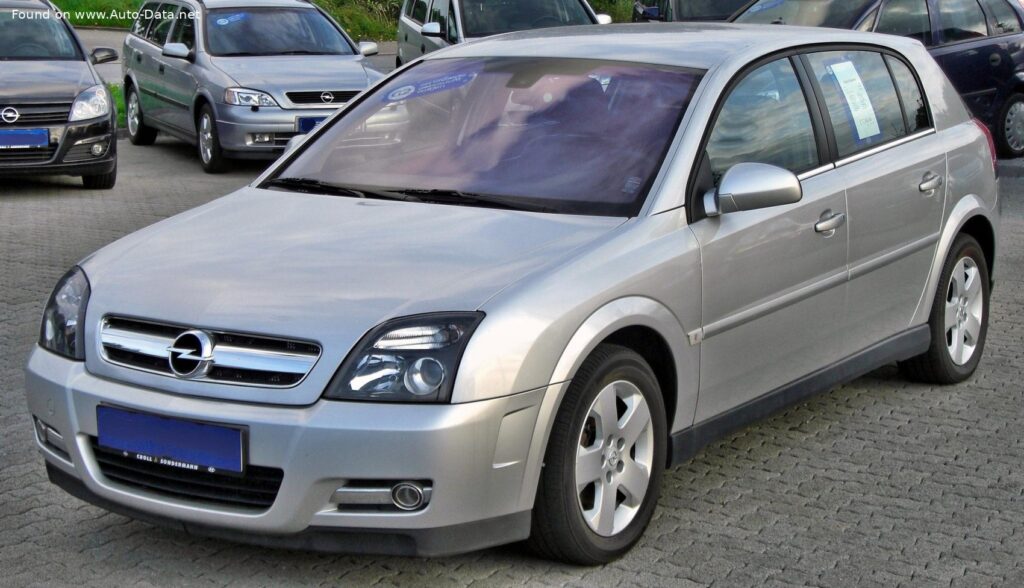
The Opel Signum 2.0 DTI ECOTEC (100 Hp): A European Executive Hatchback
The Opel Signum, introduced in May 2003, represented an ambitious and somewhat unconventional venture by General Motors’ European subsidiary, Opel. Designed primarily for the European market, the Signum was not offered in the United States, placing it firmly within the context of European automotive trends and consumer preferences. Positioned as a premium large family car, it aimed to bridge the gap between traditional sedans and station wagons, offering enhanced versatility and space in a distinctive “extended hatchback” body style. The Opel Signum 2.0 DTI ECOTEC (100 Hp) variant, specifically, highlighted Opel’s commitment to diesel power and efficiency, a cornerstone of the European automotive landscape during the early 2000s. This model sought to combine practicality with a refined driving experience, targeting a demographic that valued generous interior room and economical long-distance travel.
Engineering and Performance: The Opel Signum 2.0 DTI ECOTEC
Powertrain and Dynamics of the Opel Signum
At the heart of this particular Signum model was the 2.0-liter DTI ECOTEC internal combustion engine, a four-cylinder inline diesel unit engineered for a balance of efficiency and usable torque. With an engine displacement of 1,994 cubic centimeters (121.68 cubic inches), this powerplant delivered a respectable 100 horsepower at 4,000 revolutions per minute. More critically for a diesel engine, it produced a robust 169.64 lb.-ft. of torque, available at a low 1,500 rpm. This low-end torque was instrumental in providing responsive acceleration and comfortable cruising, particularly beneficial for highway driving and navigating urban environments.
The engine, designated Y20DTH, featured a modern common rail diesel fuel injection system, which allowed for precise fuel delivery and improved combustion, contributing to both power output and fuel economy. Further enhancing its performance and efficiency was a turbocharger coupled with an intercooler, ensuring a denser air charge for more effective combustion across the engine’s operating range. The valvetrain utilized a Double Overhead Camshaft (DOHC) configuration with four valves per cylinder, optimizing airflow and engine breathing. With a compression ratio of 18.5:1, typical for a diesel of its era, the engine was designed for robust and reliable operation.
Power was transmitted to the front wheels via a 5-speed manual transmission, a common and efficient choice for vehicles in this segment. This drivetrain architecture, coupled with the engine’s characteristics, allowed the Opel Signum to achieve a 0 to 60 mph acceleration time of 13.3 seconds, with a maximum speed of 114.95 mph. While not a performance leader, these figures were perfectly adequate for its intended purpose as a comfortable and economical family or business vehicle. Fuel efficiency was a key selling point, with a combined cycle rating of approximately 39.9 US mpg (5.9 liters per 100 km), showcasing the ECOTEC philosophy of optimizing fuel consumption.
Design and Features: The Versatile Opel Signum Hatchback
Innovative Body Style and Interior Space
The Opel Signum adopted a distinctive 5-door hatchback body type, though its elongated form often led to it being described as an “executive hatchback” or a “luxury wagon” in some markets. Measuring 182.52 inches in length, 70.79 inches in width, and 57.72 inches in height, the Signum was a substantial vehicle. A defining characteristic was its extended wheelbase of 111.42 inches, which was unusually long for a hatchback and contributed significantly to its interior volume, particularly benefiting rear passenger legroom. This focus on rear passenger comfort was a deliberate design choice, aiming to cater to the needs of business travelers or families requiring more spacious accommodations than a conventional sedan.
The interior was configured for five occupants, with a strong emphasis on versatility. While exact details of specific interior features for this trim are not provided, Opel typically equipped its Signum models with high levels of comfort and convenience features for the time, including climate control, power windows, and a comprehensive infotainment system. The trunk space was highly adaptable, offering a minimum of 12.89 cubic feet (365 liters) with all seats in place, which could expand to a generous 49.79 cubic feet (1410 liters) with the rear seats folded down. This flexibility underscored its practicality and ability to handle varying cargo needs, from daily errands to longer trips.
From a safety perspective, the Signum featured standard anti-lock braking system (ABS), ventilated discs at the front and disc brakes at the rear, providing confident stopping power. Its front suspension utilized coil springs, as did the rear, aiming for a comfortable and stable ride quality. The steering system was a hydraulic rack and pinion setup, offering direct feedback to the driver. The vehicle rode on 215/55 R16 tires mounted on 6.5J x 16-inch wheel rims, a common specification for vehicles of its size and class, balancing grip and ride comfort. The drag coefficient (Cd) of 0.33 was commendable for a vehicle of its shape and size, contributing to its highway fuel efficiency and reduced wind noise.
Technical Specifications
| Category | Specification |
|---|---|
| Brand | Opel |
| Model | Signum |
| Generation | Signum |
| Engine Type | 2.0 DTI ECOTEC (100 Hp) |
| Start of Production | May, 2003 |
| End of Production | November, 2004 |
| Powertrain Architecture | Internal Combustion engine, Front Wheel Drive |
| Body Type | Hatchback |
| Seats | 5 |
| Doors | 5 |
| Performance Specs | |
| Fuel Consumption (Urban) | 7.9 l/100 km (29.8 US mpg) |
| Fuel Consumption (Extra Urban) | 4.8 l/100 km (49 US mpg) |
| Fuel Consumption (Combined) | 5.9 l/100 km (39.9 US mpg) |
| Fuel Type | Diesel |
| Acceleration 0-60 mph | 13.3 sec |
| Maximum Speed | 185 km/h (114.95 mph) |
| Weight-to-power ratio | 16 kg/Hp, 62.7 Hp/tonne |
| Weight-to-torque ratio | 6.9 kg/Nm, 144.2 Nm/tonne |
| Engine Specs | |
| Power | 100 Hp @ 4000 rpm |
| Power per liter | 50.2 Hp/l |
| Torque | 230 Nm (169.64 lb.-ft.) @ 1500 rpm |
| Engine Layout | Front, Transverse |
| Engine Model/Code | Y20DTH |
| Engine Displacement | 1994 cm3 (121.68 cu. in.) |
| Number of Cylinders | 4 |
| Engine Configuration | Inline |
| Cylinder Bore | 84 mm (3.31 in.) |
| Piston Stroke | 90 mm (3.54 in.) |
| Compression Ratio | 18.5:1 |
| Number of Valves per Cylinder | 4 |
| Fuel Injection System | Diesel Commonrail |
| Engine Aspiration | Turbocharger, Intercooler |
| Valvetrain | DOHC |
| Engine Oil Capacity | 5.5 l (5.81 US qt) |
| Coolant Capacity | 7.3 l (7.71 US qt) |
| Space, Volume and Weights | |
| Kerb Weight | 1595 kg (3516.37 lbs) |
| Max. Weight | 2110 kg (4651.75 lbs) |
| Max Load | 515 kg (1135.38 lbs) |
| Trunk Space (Minimum) | 365 l (12.89 cu. ft.) |
| Trunk Space (Maximum) | 1410 l (49.79 cu. ft.) |
| Fuel Tank Capacity | 60 l (15.85 US gal) |
| Dimensions | |
| Length | 4636 mm (182.52 in.) |
| Width | 1798 mm (70.79 in.) |
| Height | 1466 mm (57.72 in.) |
| Wheelbase | 2830 mm (111.42 in.) |
| Front Track | 1524 mm (60 in.) |
| Rear Track | 1512 mm (59.53 in.) |
| Drag Coefficient (Cd) | 0.33 |
| Drivetrain, Brakes and Suspension Specs | |
| Drive Wheel | Front wheel drive |
| Number of Gears and Type of Gearbox | 5 gears, manual transmission |
| Front Suspension | Coil spring |
| Rear Suspension | Coil spring |
| Front Brakes | Ventilated discs |
| Rear Brakes | Disc |
| Assisting Systems | ABS (Anti-lock braking system) |
| Steering Type | Steering rack and pinion |
| Power Steering | Hydraulic Steering |
| Tires Size | 215/55 R16 |
| Wheel Rims Size | 6.5J x 16 |
Legacy and Market Impact of the Opel Signum
The Opel Signum carved out a rather unique, if somewhat niche, position in the competitive European automotive landscape. Launched at a time when traditional sedans and wagons dominated the D-segment, the Signum attempted to create a new sub-segment, offering a more flexible and spacious alternative. Its primary competitors included established players like the Volkswagen Passat, Ford Mondeo, and Renault Laguna, as well as more avant-garde offerings such as the Renault Vel Satis and Citroën C5, which also experimented with distinct body styles and comfort-oriented designs.
The Signum was largely praised for its exceptional rear passenger room, courtesy of its extended wheelbase, and its innovative FlexSpace seating system (though not explicitly detailed for this specific trim, it was a hallmark of the Signum line), which allowed for individual adjustment and even removal of rear seats for maximum versatility. Its ride comfort and overall refinement were also generally well-regarded, making it a suitable long-distance cruiser. The 2.0 DTI ECOTEC variant, in particular, underscored its appeal to economy-minded drivers who still desired a substantial and comfortable vehicle.
However, the Signum’s distinctive styling and unconventional “hatchback” designation for a vehicle of its size proved to be a double-edged sword. While some appreciated its uniqueness, others found its aesthetics polarizing, and it struggled to gain widespread acceptance against more conventionally styled rivals. It didn’t quite achieve the premium cachet of executive sedans, nor the outright practicality of traditional station wagons, leaving it in a somewhat ambiguous market position. Consequently, sales volumes, while respectable, never reached the levels of its more mainstream competitors.
Despite its mixed commercial success, the Opel Signum remains an interesting chapter in Opel’s history. It demonstrated Opel’s willingness to innovate and challenge conventional segment definitions. For those who prioritized interior space, versatility, and diesel efficiency in a comfortable package, the Signum, especially in its 2.0 DTI ECOTEC guise, offered a compelling, if unconventional, proposition. Its legacy is one of an innovative attempt to redefine the executive car, leaving behind a vehicle that, while not a blockbuster, certainly contributed to the diverse tapestry of European automotive design and engineering in the early 2000s.
