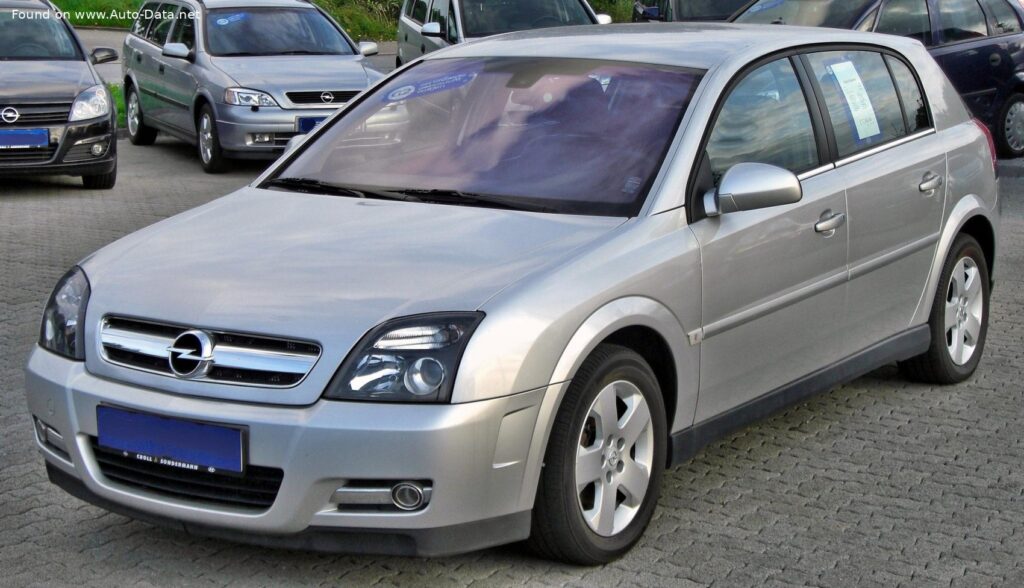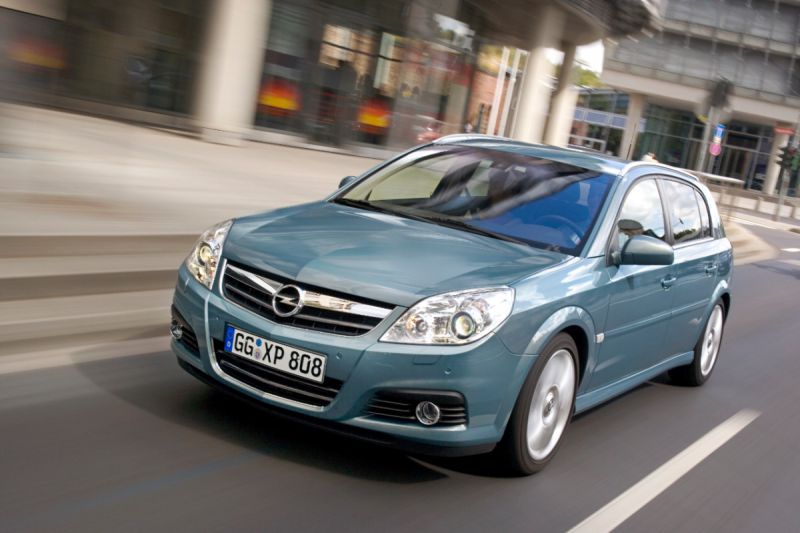
Introduction to the Opel Signum (facelift 2005)
The Opel Signum (facelift 2005) represents a distinctive and somewhat unconventional offering from the German automaker Opel, designed primarily for the European market. Launched in 2003 and receiving a significant refresh in July 2005, the Signum was Opel’s attempt to carve out a niche in the competitive D-segment (mid-size car category) by blending elements of a traditional sedan, a wagon, and a multi-purpose vehicle (MPV). Unlike its more conventional sibling, the Vectra, with which it shared a platform, the Signum aimed to provide enhanced rear passenger comfort and exceptional cargo versatility, positioning itself as a more executive-oriented and spacious five-door liftback. This facelifted generation, produced from 2005 until 2008, brought updated styling, improved interior materials, and refined powertrains, including the efficient 1.9 CDTI diesel engine, to better compete in a market increasingly demanding flexibility and fuel economy.
Engine and Performance: The 1.9 CDTI Powertrain
Under the hood, the Opel Signum (facelift 2005) 1.9 CDTI (100 Hp) variant featured a robust and widely utilized diesel engine, known for its balance of efficiency and usable torque. This particular iteration was equipped with a 1.9-liter (1910 cm3 or 116.56 cu. in.) inline four-cylinder engine, designated by the code Z19DTL. Employing a common rail direct injection fuel system, coupled with a turbocharger and intercooler, this powertrain delivered a respectable 100 horsepower at 3500 rpm. Its strength, however, lay in its torque output, peaking at 260 Newton-meters (191.77 lb.-ft.) from a low 1700 rpm. This characteristic ensured strong pulling power, making it well-suited for both city driving and highway cruising, where its low-end grunt minimized the need for frequent gear changes.
Power was sent to the front wheels via a smooth and precise 6-speed manual transmission, a choice that underscored the vehicle’s emphasis on driver engagement and fuel efficiency. While the 0-60 mph acceleration time of 13.3 seconds might not suggest a performance car, it was entirely adequate for its segment and intended use, allowing for confident merging onto highways. The top speed reached 111.85 mph (180 km/h). Crucially for European buyers, the 1.9 CDTI engine offered impressive fuel economy, with a combined rating of 39.9 US mpg (5.9 l/100 km), and an even more impressive 48 US mpg (4.9 l/100 km) on the extra-urban cycle. This efficiency, combined with CO2 emissions of 159 g/km, made it an economically attractive option during its production run, especially in markets where diesel fuel was prevalent and favored for its lower running costs. The engine also featured a particulate filter, highlighting Opel’s commitment to meeting evolving emissions standards of the era.
Design and Features: A Focus on Versatility
Opel Signum (facelift 2005) Body Style and Interior Innovation
The Opel Signum was categorized as a 5-door hatchback, though its elongated profile and generous wheelbase of 111.42 inches (2830 mm) often led it to be described as a large liftback or even a “luxury hatchback.” Its exterior dimensions—a length of 183.11 inches (4651 mm), a width of 70.79 inches (1798 mm), and a height of 57.48 inches (1460 mm)—contributed to a substantial road presence. The facelift in 2005 brought subtle but effective styling updates, including revised front fascias, headlights, and taillights, aligning its aesthetics more closely with the contemporary Opel design language. The drag coefficient of 0.32 was quite respectable for a vehicle of its size and shape, contributing to both fuel efficiency and reduced wind noise.
Where the Signum truly distinguished itself was in its interior design and remarkable versatility. It was specifically engineered to maximize rear passenger comfort, offering significantly more legroom than many rivals in its class. The rear seating area featured individual seats that could slide forward and backward, recline, and even fold flat, providing an MPV-like level of adaptability. This “FlexSpace” system allowed for a highly configurable cargo area, ranging from a minimum of 12.89 cubic feet (365 liters) to a cavernous 49.79 cubic feet (1410 liters) with the rear seats folded down. This emphasis on passenger space and cargo flexibility was a core tenet of the Signum’s design philosophy.
Standard features for the 2005 facelift model included a comprehensive safety suite, featuring Anti-lock Braking System (ABS), and a robust chassis setup with coil spring suspension both front and rear. Braking power was provided by ventilated discs at the front and solid discs at the rear, ensuring confident stopping performance. The steering system was a hydraulic rack and pinion setup, offering direct feedback and ease of maneuverability. The vehicle rode on 215/55 R16 tires mounted on 6.5J x 16-inch wheel rims, providing a good balance of ride comfort and handling stability. The curb weight of 3406.14 lbs (1545 kg) reflected its solid construction and generous dimensions.
Technical Specifications: Opel Signum (facelift 2005) 1.9 CDTI (100 Hp)
| Category | Specification | US Equivalent (where applicable) |
|---|---|---|
| General Information | ||
| Brand | Opel | |
| Model | Signum (facelift 2005) | |
| Type (Engine) | 1.9 CDTI (100 Hp) | |
| Production Start | July, 2005 | |
| Production End | June, 2008 | |
| Body Type | Hatchback | |
| Seats | 5 | |
| Doors | 5 | |
| Performance Specifications | ||
| Fuel Consumption (Urban) | 7.6 l/100 km | 30.9 US mpg |
| Fuel Consumption (Extra Urban) | 4.9 l/100 km | 48 US mpg |
| Fuel Consumption (Combined) | 5.9 l/100 km | 39.9 US mpg |
| CO2 Emissions | 159 g/km | |
| Fuel Type | Diesel | |
| Acceleration 0 – 60 mph | 13.3 sec | |
| Maximum Speed | 180 km/h | 111.85 mph |
| Weight-to-Power Ratio | 15.5 kg/Hp | |
| Weight-to-Torque Ratio | 5.9 kg/Nm | |
| Engine Specifications | ||
| Power | 100 Hp @ 3500 rpm | |
| Torque | 260 Nm @ 1700 rpm | 191.77 lb.-ft. @ 1700 rpm |
| Engine Layout | Front, Transverse | |
| Engine Model/Code | Z19DTL | |
| Engine Displacement | 1910 cm3 | 1.9 Liters (116.56 cu. in.) |
| Number of Cylinders | 4 | |
| Engine Configuration | Inline | |
| Cylinder Bore | 82 mm | 3.23 in. |
| Piston Stroke | 90.4 mm | 3.56 in. |
| Compression Ratio | 17.5:1 | |
| Valves per Cylinder | 2 | |
| Fuel Injection System | Diesel Commonrail | |
| Engine Aspiration | Turbocharger, Intercooler | |
| Valvetrain | DOHC | |
| Engine Oil Capacity | 4.3 l | 4.54 US qt |
| Coolant Capacity | 7 l | 7.4 US qt |
| Engine Systems | Particulate filter | |
| Space, Volume and Weights | ||
| Kerb Weight | 1545 kg | 3406.14 lbs. |
| Max. Weight | 2130 kg | 4695.85 lbs. |
| Max Load | 585 kg | 1289.7 lbs. |
| Trunk (Boot) Space – Minimum | 365 l | 12.89 cu. ft. |
| Trunk (Boot) Space – Maximum | 1410 l | 49.79 cu. ft. |
| Fuel Tank Capacity | 60 l | 15.85 US gal |
| Dimensions | ||
| Length | 4651 mm | 183.11 in. |
| Width | 1798 mm | 70.79 in. |
| Height | 1460 mm | 57.48 in. |
| Wheelbase | 2830 mm | 111.42 in. |
| Front Track | 1524 mm | 60 in. |
| Rear Track | 1525 mm | 60.04 in. |
| Drag Coefficient (Cd) | 0.32 | |
| Drivetrain, Brakes and Suspension | ||
| Drivetrain Architecture | Internal Combustion engine drives front wheels | |
| Drive Wheel | Front Wheel Drive | |
| Gearbox Type | 6-speed Manual Transmission | |
| Front Suspension | Coil spring | |
| Rear Suspension | Coil spring | |
| Front Brakes | Ventilated discs | |
| Rear Brakes | Disc | |
| Assisting Systems | ABS (Anti-lock braking system) | |
| Steering Type | Steering rack and pinion | |
| Power Steering | Hydraulic Steering | |
| Tire Size | 215/55 R16 | |
| Wheel Rims Size | 6.5J x 16 | |
Legacy and Market Impact
The Opel Signum, particularly the Opel Signum (facelift 2005), holds a unique place in Opel’s modern history. It was an ambitious project, attempting to bridge the gap between various vehicle segments and offer a more premium, versatile experience than its platform-mate, the Vectra. Its primary competitors in the European D-segment included popular models such as the Volkswagen Passat, Ford Mondeo, Renault Laguna, Peugeot 407, and the Skoda Superb. While these rivals often offered more conventional sedan or wagon body styles, the Signum stood out with its focus on rear passenger comfort and the highly adaptable FlexSpace interior.
Despite its innovative approach to interior packaging and comfort, the Signum never achieved the widespread sales success Opel had hoped for. Its unique body style, which was neither a traditional sedan nor a full-blown wagon or MPV, proved to be a challenging sell to a market accustomed to more defined categories. Many potential buyers found its aesthetics somewhat polarizing, and its positioning as a slightly more upscale offering was often overshadowed by established premium brands or more value-oriented competitors. However, for those who appreciated its distinctive qualities, the Signum was praised for its comfortable ride, decent handling, and exceptional interior flexibility. The 1.9 CDTI engine, as seen in this 100 Hp variant, was a strong point, providing reliable performance and excellent fuel economy, which was a significant advantage in the European context.
The Signum’s legacy is one of a bold experiment. It demonstrated Opel’s willingness to innovate and push boundaries in terms of vehicle architecture and interior functionality. While it was ultimately discontinued in 2008 without a direct successor, many of its innovative interior features, particularly the emphasis on modularity and rear passenger comfort, can be seen as precursors to design elements found in later Opel models and other European cars that prioritized practicality and intelligent space utilization. The Opel Signum remains a testament to a period when automakers explored diverse solutions to meet evolving consumer needs, even if those solutions didn’t always translate into massive commercial triumphs. It represents a fascinating chapter in the evolution of the European mid-size car, offering a unique blend of comfort, efficiency, and adaptability that is still appreciated by a dedicated cohort of owners.