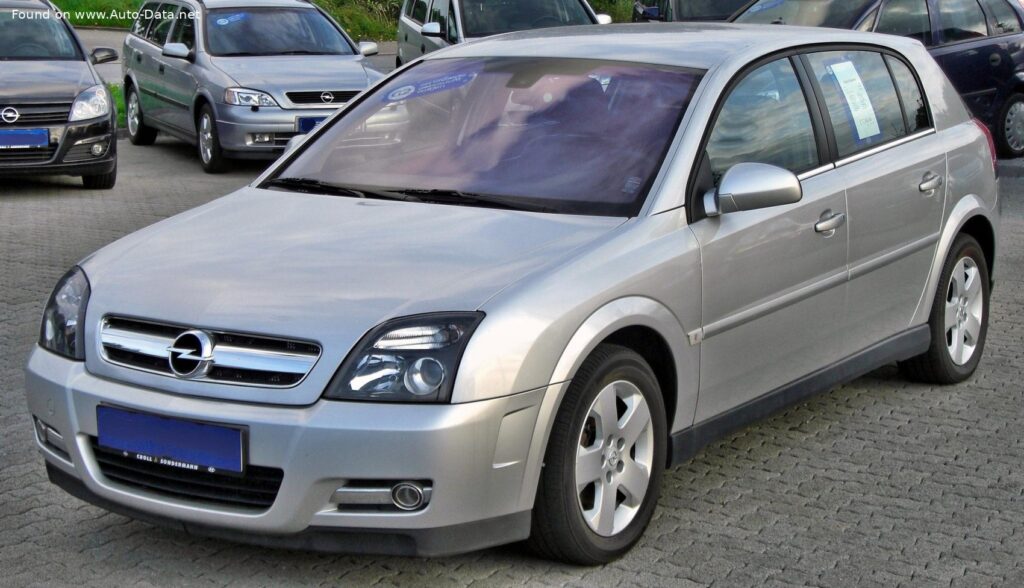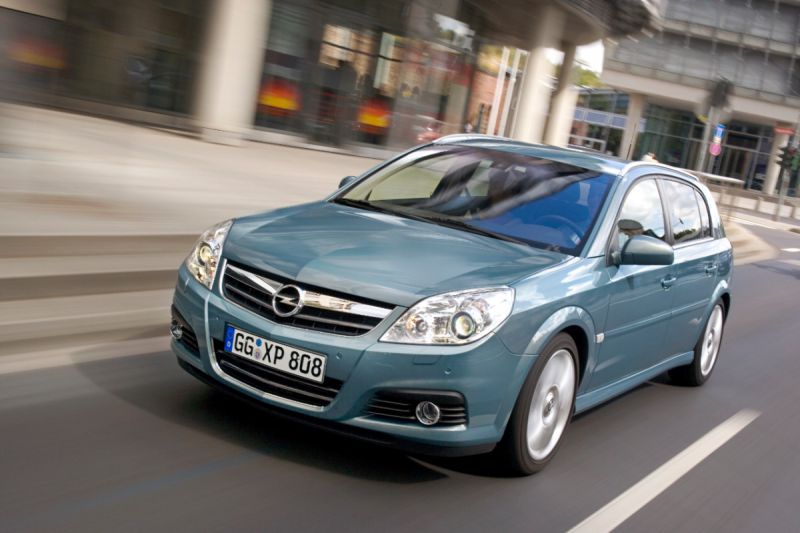
Opel Signum (facelift 2005) 1.9 CDTI (150 Hp) Automatic: A European Executive Hatchback
The Opel Signum (facelift 2005) 1.9 CDTI (150 Hp) Automatic represents a distinctive and ambitious offering from the German automaker, Opel. Primarily targeting the European market, where it was produced from 2005 until June 2008, the Signum carved out a unique niche within the D-segment (mid-size car class). Rather than conforming to traditional sedan or wagon formats, the Signum was conceived as an executive hatchback, emphasizing interior versatility, passenger comfort, and a premium feel. It was built upon the extended platform of the third-generation Opel Vectra, sharing much of its mechanical underpinnings but distinguishing itself with a focus on rear-seat legroom and modular cargo solutions. This particular variant, equipped with the robust 1.9-liter CDTI diesel engine and a smooth automatic transmission, offered a compelling blend of performance, efficiency, and practicality tailored for long-distance European touring.
The Evolution and Market Positioning of the Opel Signum (facelift 2005)
The original Opel Signum was introduced in 2003, and the 2005 facelift brought a series of refinements to its exterior styling, interior appointments, and powertrain options. These updates were designed to keep the model competitive and align its aesthetics with Opel’s contemporary design language, seen in models like the Astra H and the updated Vectra C. The facelifted Signum featured a redesigned grille, updated headlights, and subtle tweaks to the bumpers, giving it a more modern and cohesive appearance.
Opel’s vision for the Signum was to create a vehicle that offered the spaciousness and flexibility of an MPV (Multi-Purpose Vehicle) without sacrificing the driving dynamics and executive appeal of a traditional sedan. Its extended wheelbase, significantly longer than the standard Vectra sedan, was a cornerstone of this strategy, allowing for exceptional rear passenger comfort. While it never achieved the sales volumes of its more conventional D-segment rivals, the Signum was lauded by those who appreciated its innovative approach to interior packaging and its strong performance-to-efficiency ratio, especially in its diesel configurations. It was a testament to Opel’s willingness to experiment and challenge conventional automotive segments, though its unique proposition sometimes made it difficult for consumers to categorize.
Engine and Performance: The 1.9 CDTI Powertrain
At the heart of this particular Opel Signum variant lies the highly regarded 1.9-liter CDTI (Common Rail Diesel Turbo Injection) engine, designated with the internal code Z19DTH. This inline four-cylinder powerplant, with a displacement of 1910 cm3 (116.56 cu. in.), was a product of the GM-Fiat Powertrain joint venture and was widely used across various Opel and Fiat Group vehicles, earning a reputation for its blend of power and economy.
The engine delivers a respectable 150 horsepower at 4000 rpm, which, combined with a substantial 320 Nm (236.02 lb.-ft.) of torque available at a low 2000 rpm, provides the Signum with robust acceleration and effortless cruising capabilities. The strong torque output, a hallmark of modern diesel engines, ensures responsive performance, especially in mid-range acceleration and highway overtaking maneuvers. Power delivery is smooth and linear, thanks to the sophisticated Diesel Commonrail fuel injection system, a turbocharger, and an intercooler, which optimize combustion and boost efficiency. The engine also features a DOHC (Double Overhead Cam) valvetrain with four valves per cylinder, contributing to its efficient breathing and power output.
Mated to this potent diesel engine is a 6-speed automatic transmission, which expertly manages power delivery to the front wheels. This combination allows the Signum to accelerate from 0 to 60 mph in a credible 10.2 seconds and reach a maximum speed of 127.38 mph. While not a sports car, these figures are more than adequate for a family-oriented executive car designed for comfortable long-distance travel.
Perhaps one of the most compelling aspects of the 1.9 CDTI powertrain is its impressive fuel efficiency. Despite its size and automatic transmission, the Signum achieves an estimated 24 US mpg in urban driving conditions and an excellent 41.3 US mpg on the extra-urban cycle. These figures highlight the inherent efficiency of modern diesel technology, making it an economical choice for European drivers facing high fuel prices and a preference for diesel powertrains. The 61-liter (16.11 US gallon) fuel tank further enhances its long-distance touring credentials, offering an extended range between fill-ups.
Design and Features: Form Meets Function in the Opel Signum
The design philosophy of the Opel Signum (facelift 2005) was centered around maximizing interior space and flexibility within a relatively sleek, albeit unconventional, 5-door hatchback body. Measuring 183.11 inches in length, 70.79 inches in width, and 57.48 inches in height, with a substantial 111.42-inch wheelbase, the Signum presented a distinctive silhouette on European roads. Its proportions, particularly the extended wheelbase, were key to its promise of superior rear passenger comfort.
The exterior styling, refreshed for 2005, featured Opel’s then-current design language, characterized by a prominent grille, clear-lens headlights, and an overall aerodynamic profile, evidenced by a drag coefficient (Cd) of 0.32. While some found its aesthetic polarizing, it certainly stood out from the crowd of conventional sedans and wagons.
Inside, the Signum truly differentiated itself. The rear passenger compartment was the focal point of its design, offering the “FlexSpace” seating system. This allowed the two outer rear seats to slide forward and backward by up to 5.1 inches, recline, and even be folded flat or removed entirely, providing unparalleled legroom or cargo flexibility. A central “Travel Assistant” console, optional on some trims, could be fitted between the rear seats, offering features like a cooler, cup holders, and a multi-function storage unit, akin to airline business class amenities. The trunk space was also highly versatile, ranging from 12.89 cu. ft. with all seats in place to a cavernous 49.79 cu. ft. with the rear seats folded down, making it highly practical for a variety of uses, from daily commuting to family vacations.
Standard features for the era included essential safety systems such as ABS (Anti-lock Braking System), ensuring stable braking performance. The hydraulic power steering, utilizing a rack and pinion system, provided direct and communicative feedback to the driver. The suspension system, featuring coil springs at both the front and rear, was tuned for a comfortable ride, absorbing road imperfections typical of European roads while maintaining composed handling. Braking was handled by ventilated discs at the front and solid discs at the rear, providing ample stopping power. The vehicle rode on 215/55 R16 tires mounted on 6.5J x 16-inch wheel rims, offering a good balance of comfort, grip, and durability.
Technical Specifications: Opel Signum (facelift 2005) 1.9 CDTI (150 Hp) Automatic
| Specification | Value |
|---|---|
| Brand | Opel |
| Model | Signum |
| Generation | Signum (facelift 2005) |
| Type (Engine) | 1.9 CDTI (150 Hp) Automatic |
| Start of production | 2005 year |
| End of production | June, 2008 year |
| Powertrain Architecture | Internal Combustion engine |
| Body type | Hatchback |
| Seats | 5 |
| Doors | 5 |
| Fuel consumption (economy) – urban | 9.8 l/100 km (24 US mpg) |
| Fuel consumption (economy) – extra urban | 5.7 l/100 km (41.3 US mpg) |
| Fuel Type | Diesel |
| Acceleration 0 – 60 mph | 10.2 sec |
| Maximum speed | 205 km/h (127.38 mph) |
| Weight-to-power ratio | 10.4 kg/Hp, 95.8 Hp/tonne |
| Weight-to-torque ratio | 4.9 kg/Nm, 204.5 Nm/tonne |
| Power | 150 Hp @ 4000 rpm. |
| Power per liter | 78.5 Hp/l |
| Torque | 320 Nm @ 2000 rpm. (236.02 lb.-ft. @ 2000 rpm.) |
| Engine layout | Front, Transverse |
| Engine Model/Code | Z19DTH |
| Engine displacement | 1910 cm3 (116.56 cu. in.) |
| Number of cylinders | 4 |
| Engine configuration | Inline |
| Cylinder Bore | 82 mm (3.23 in.) |
| Piston Stroke | 90.4 mm (3.56 in.) |
| Compression ratio | 17.5:1 |
| Number of valves per cylinder | 4 |
| Fuel injection system | Diesel Commonrail |
| Engine aspiration | Turbocharger, Intercooler |
| Valvetrain | DOHC |
| Engine oil capacity | 4.3 l (4.54 US qt) |
| Coolant | 7 l (7.4 US qt) |
| Kerb Weight | 1565 kg (3450.23 lbs.) |
| Max. weight | 2130 kg (4695.85 lbs.) |
| Max load | 565 kg (1245.61 lbs.) |
| Trunk (boot) space – minimum | 365 l (12.89 cu. ft.) |
| Trunk (boot) space – maximum | 1410 l (49.79 cu. ft.) |
| Fuel tank capacity | 61 l (16.11 US gal) |
| Length | 4651 mm (183.11 in.) |
| Width | 1798 mm (70.79 in.) |
| Height | 1460 mm (57.48 in.) |
| Wheelbase | 2830 mm (111.42 in.) |
| Front track | 1524 mm (60 in.) |
| Rear (Back) track | 1525 mm (60.04 in.) |
| Drag coefficient (Cd) | 0.32 |
| Drivetrain Architecture | Front wheel drive. Internal Combustion engine. |
| Drive wheel | Front wheel drive |
| Number of gears and type of gearbox | 6 gears, automatic transmission |
| Front suspension | Coil spring |
| Rear suspension | Coil spring |
| Front brakes | Ventilated discs |
| Rear brakes | Disc |
| Assisting systems | ABS (Anti-lock braking system) |
| Steering type | Steering rack and pinion |
| Power steering | Hydraulic Steering |
| Tires size | 215/55 R16 |
| Wheel rims size | 6.5J x 16 |
Legacy and Market Impact of the Opel Signum (facelift 2005)
The Opel Signum (facelift 2005) holds a unique, albeit somewhat challenging, place in Opel’s modern history. It was a vehicle born out of a desire to innovate and offer something genuinely different in the highly competitive European D-segment. Its reputation was largely defined by its core strengths: exceptional interior versatility, particularly for rear passengers, and the efficiency and power of its diesel powertrains. The 1.9 CDTI (150 Hp) Automatic variant, in particular, was praised for its smooth performance and impressive fuel economy, making it an ideal choice for business travelers and families undertaking long journeys across the continent.
However, the Signum’s unconventional body style and market positioning proved to be its greatest hurdles. It struggled to define itself clearly between traditional sedans, wagons, and emerging MPVs or SUVs. Many consumers perceived it as an expensive derivative of the more common Vectra, and its unique hatchback profile, while offering practical benefits, did not resonate universally with buyers accustomed to more conventional shapes. This led to modest sales figures compared to its more mainstream rivals.
In its primary European market, the Opel Signum faced stiff competition from established players like the Ford Mondeo, Volkswagen Passat, Renault Laguna, and Peugeot 407. These competitors often offered more traditional body styles (sedan, wagon) that were more familiar and, arguably, more appealing to a broader customer base. Some of its more direct conceptual rivals, also attempting to blend segments, included the Renault Vel Satis and even certain compact executive wagons.
From a historical perspective, the Signum represents an important moment for Opel (and by extension, General Motors Europe). It demonstrated a willingness to push boundaries in interior packaging and ergonomic design, anticipating a later trend towards more flexible and lifestyle-oriented vehicles. While it wasn’t a commercial blockbuster, its engineering and design innovations, especially in optimizing passenger space and comfort, were commendable. It showcased Opel’s capability in developing sophisticated diesel engines and advanced automatic transmissions, which were crucial for success in the European market during that era.
The Opel Signum was never officially sold in the United States. This decision was largely due to several factors: Opel’s limited brand presence in the U.S. at the time (with GM primarily marketing its domestic brands), the American market’s strong preference for traditional sedans and increasingly SUVs over niche European hatchbacks, and a general skepticism towards diesel passenger cars in the U.S. market, which only began to shift years later. The Signum, therefore, remains a fascinating example of European automotive design and market strategy, a car that perhaps arrived a bit ahead of its time for its segment. Its legacy is one of thoughtful design and engineering, even if its commercial success was constrained by its unique identity.