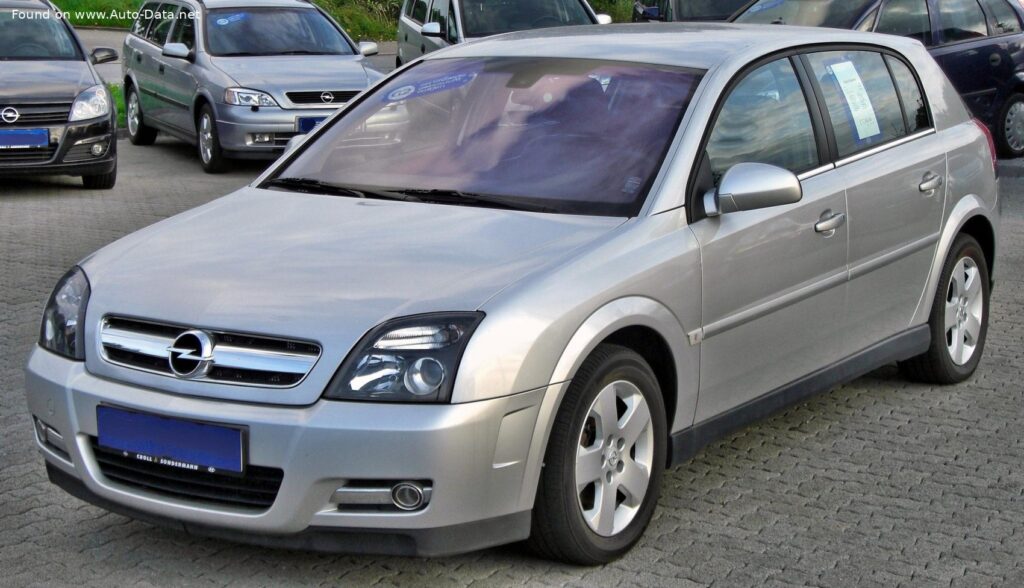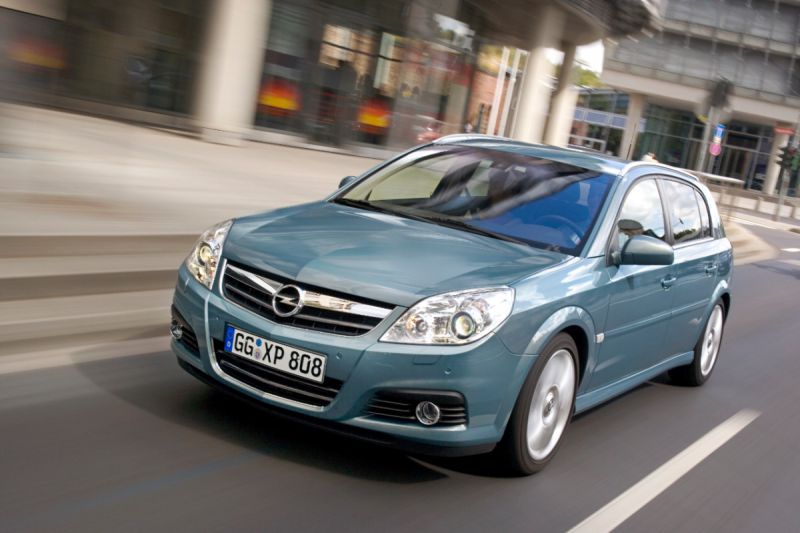
The Opel Signum (facelift 2005) 2.0i 16V Turbo ECOTEC (175 Hp) represents a distinctive chapter in Opel’s strategy to capture a niche in the European executive car market during the mid-2000s. Launched in 2005 as a refreshed version of the original Signum, this model was an ambitious attempt to blend the practicality of a hatchback with the spaciousness and comfort typically found in larger, more premium sedans or wagons. Primarily aimed at the European market, where Opel is a well-established brand, the Signum was never officially sold in the United States under the Opel badge, making it a unique sight for American enthusiasts. It shared its underpinnings with the contemporary Opel Vectra C, but distinguished itself with a longer wheelbase and a highly adaptable interior designed for enhanced passenger comfort and versatility. This specific variant, featuring the 2.0-liter 16V Turbo ECOTEC engine, offered a compelling balance of performance and efficiency for its segment.
Overview of the Opel Signum (facelift 2005)
The Opel Signum was conceived as a “premium-class car” that defied conventional body classifications. While technically a five-door hatchback, its extended wheelbase and emphasis on rear-seat passenger comfort positioned it more as a “large family car” or a “multi-variant” vehicle. The facelift in 2005 brought a series of aesthetic and technical updates to keep the model competitive. These revisions typically included refreshed front and rear styling, with updated grilles, headlights, taillights, and bumpers, aligning its appearance with Opel’s contemporary design language seen on other models like the Astra and Vectra. Inside, improvements often focused on material quality, trim options, and enhanced infotainment systems, although specific details for interior changes are not provided in the raw data. The Signum’s production run for this facelifted generation extended from 2005 until June 2008, showcasing Opel’s commitment to this unique market proposition for a few years.
Engine & Performance
At the heart of the Opel Signum (facelift 2005) 2.0i 16V Turbo ECOTEC (175 Hp) lies a robust and efficient 2.0-liter (1998 cm3 or 121.93 cubic inches) inline four-cylinder engine, designated by the code Z20NET. This powerplant features a DOHC (Double Overhead Camshaft) valvetrain with four valves per cylinder, optimizing airflow and combustion efficiency. The “ECOTEC” designation highlights Opel’s focus on combining economy, ecology, and technology in its engine designs. A key characteristic of this engine is its turbocharger with an intercooler, which significantly boosts power output and torque across a broad RPM range. The engine generates a respectable 175 horsepower at 5500 rpm and a substantial 195.45 lb-ft of torque at a low 2500 rpm. This low-end torque delivery contributes to responsive acceleration and flexible driving dynamics.
Mated to a precise 6-speed manual transmission, the power is delivered to the front wheels, providing a conventional and reliable drivetrain architecture. The performance figures for this variant are competitive for its class: it accelerates from 0 to 60 mph in an estimated 8.9 seconds and can reach a maximum speed of 136.7 mph (220 km/h). Despite its performance capabilities, the Signum also aimed for reasonable fuel economy. The combined fuel consumption is rated at 25.6 US mpg (9.2 l/100 km), with urban driving yielding 18 US mpg (13.1 l/100 km) and extra-urban cruising achieving 34.1 US mpg (6.9 l/100 km). These figures, considering the vehicle’s size and turbocharged engine, demonstrate a balanced approach to power and efficiency.
Design & Features
The design of the Opel Signum (facelift 2005) was a departure from traditional segment norms. While classified as a hatchback, its dimensions—a length of 183.11 inches (4651 mm) and a generous wheelbase of 111.42 inches (2830 mm)—gave it a distinctive silhouette that was longer than many conventional sedans in its class. This extended wheelbase was specifically engineered to maximize rear passenger space, a core tenet of the Signum’s design philosophy. The vehicle’s width stands at 70.79 inches (1798 mm) and its height at 57.48 inches (1460 mm), contributing to a stable and substantial road presence. The drag coefficient (Cd) of 0.32 indicates a reasonably aerodynamic shape for its time.
Inside, the Signum was designed for versatility and comfort, particularly for the rear passengers. While the raw data simply states “5 seats,” the Signum was famously equipped with Opel’s “FlexSpace” system, which allowed the two individual rear seats to slide, recline, and even fold down, offering exceptional legroom or increased cargo capacity as needed. The trunk space reflects this adaptability, ranging from a minimum of 12.89 cubic feet (365 liters) to a maximum of 49.79 cubic feet (1410 liters) with the rear seats folded. Standard features included power steering with a hydraulic rack and pinion system, providing direct and communicative feedback. For safety, the vehicle was equipped with ABS (Anti-lock Braking System), a crucial active safety feature. Braking was handled by ventilated discs at the front and disc brakes at the rear. The car rode on 215/55 R16 tires mounted on 6.5J x 16-inch wheel rims, providing a comfortable and stable ride quality, supported by coil spring suspension at both the front and rear.
Technical Specifications
| Category | Specification |
|---|---|
| Brand | Opel |
| Model | Signum |
| Generation | Signum (facelift 2005) |
| Type (Engine) | 2.0i 16V Turbo ECOTEC (175 Hp) |
| Start of Production | 2005 year |
| End of Production | June, 2008 year |
| Powertrain Architecture | Internal Combustion engine |
| Body Type | Hatchback |
| Seats | 5 |
| Doors | 5 |
| Fuel Consumption (Urban) | 13.1 l/100 km (18 US mpg) |
| Fuel Consumption (Extra Urban) | 6.9 l/100 km (34.1 US mpg) |
| Fuel Consumption (Combined) | 9.2 l/100 km (25.6 US mpg) |
| Fuel Type | Petrol (Gasoline) |
| Acceleration 0 – 60 mph | 8.9 sec |
| Maximum Speed | 220 km/h (136.7 mph) |
| Power | 175 Hp @ 5500 rpm |
| Torque | 265 Nm (195.45 lb.-ft.) @ 2500 rpm |
| Engine Layout | Front, Transverse |
| Engine Model/Code | Z20NET |
| Engine Displacement | 1998 cm3 (121.93 cu. in.) |
| Number of Cylinders | 4 |
| Engine Configuration | Inline |
| Cylinder Bore | 86 mm (3.39 in.) |
| Piston Stroke | 86 mm (3.39 in.) |
| Compression Ratio | 9.5:1 |
| Valves per Cylinder | 4 |
| Fuel Injection System | Multi-port manifold injection |
| Engine Aspiration | Turbocharger, Intercooler |
| Valvetrain | DOHC |
| Engine Oil Capacity | 6 l (6.34 US qt) |
| Coolant Capacity | 7.5 l (7.93 US qt) |
| Kerb Weight | 1560 kg (3439.21 lbs.) |
| Max. Weight | 2075 kg (4574.59 lbs.) |
| Max Load | 515 kg (1135.38 lbs.) |
| Trunk Space (Minimum) | 365 l (12.89 cu. ft.) |
| Trunk Space (Maximum) | 1410 l (49.79 cu. ft.) |
| Fuel Tank Capacity | 60 l (15.85 US gal) |
| Length | 4651 mm (183.11 in.) |
| Width | 1798 mm (70.79 in.) |
| Height | 1460 mm (57.48 in.) |
| Wheelbase | 2830 mm (111.42 in.) |
| Front Track | 1535 mm (60.43 in.) |
| Rear Track | 1525 mm (60.04 in.) |
| Drag Coefficient (Cd) | 0.32 |
| Drive Wheel | Front wheel drive |
| Gearbox | 6 gears, manual transmission |
| Front Suspension | Coil spring |
| Rear Suspension | Coil spring |
| Front Brakes | Ventilated discs |
| Rear Brakes | Disc |
| Assisting Systems | ABS (Anti-lock braking system) |
| Steering Type | Steering rack and pinion |
| Power Steering | Hydraulic Steering |
| Tires Size | 215/55 R16 |
| Wheel Rims Size | 6.5J x 16 |
Legacy & Market Impact
The Opel Signum (facelift 2005) holds a unique, albeit somewhat challenging, place in Opel’s history and the broader European automotive landscape. Its primary market impact stemmed from its innovative approach to interior space and flexibility, particularly the emphasis on rear passenger comfort, which set it apart from many direct competitors. Opel aimed to create a vehicle that could serve as both a comfortable executive transport and a versatile family car, bridging the gap between traditional sedans/wagons and the emerging MPV (Multi-Purpose Vehicle) segment.
In Europe, the Signum faced competition from a diverse range of vehicles. Traditional D-segment (mid-size) rivals included the Ford Mondeo, Volkswagen Passat, and Renault Laguna, while more unconventional competitors like the Renault Vel Satis and Citroën C5 also vied for buyers seeking distinctive designs and comfort. The Signum was often praised by reviewers for its excellent ride comfort, quiet cabin, and the sheer amount of legroom available to rear passengers, especially with the FlexSpace seating system. The 2.0 Turbo ECOTEC engine, as featured in this facelifted model, was particularly well-regarded for its smooth power delivery and decent fuel economy, offering a strong alternative to the popular diesel engines in the European market.
However, the Signum’s unconventional styling and ambiguous market positioning proved to be its greatest challenge. Many potential buyers found its “extended hatchback” design neither fully a sedan nor a wagon, struggling to place it within established categories. This ambiguity, coupled with a perception that it didn’t quite achieve the premium aura of true executive cars from brands like BMW or Mercedes-Benz, limited its sales success. Despite Opel’s efforts with the 2005 facelift to refresh its appeal, the Signum never reached its envisioned sales targets and was ultimately discontinued in 2008, making way for the Insignia, which adopted a more conventional sedan and wagon approach. Nevertheless, the Opel Signum remains a testament to Opel’s willingness to experiment with innovative body styles and interior configurations, leaving behind a legacy as an intriguing, if commercially challenging, pioneer in automotive design.