As an international automotive expert, I present a detailed analysis of the Opel Signum (facelift 2005) 2.8i V6 24V Turbo (230 Hp), a distinctive model from the European market.
The Opel Signum (facelift 2005): A Unique European Executive Hatchback
The Opel Signum, particularly in its facelifted 2005 iteration with the potent 2.8i V6 24V Turbo (230 Hp) engine, represented a bold and somewhat unconventional approach by Opel within the European D-segment. Launched in July 2005 and produced until October 2006, this specific generation aimed to bridge the gap between traditional executive sedans, practical station wagons, and the emerging trend of multi-purpose vehicles (MPVs). Based on the extended platform of the Opel Vectra C, the Signum was conceived as a premium-segment hatchback, offering enhanced rear passenger space and unparalleled interior versatility, distinguishing it from its more conventional siblings.
While never officially imported to the United States, the Opel Signum played a significant role in Opel’s European strategy, showcasing the brand’s engineering capabilities and its willingness to experiment with new body styles. It targeted buyers seeking executive-level comfort and features combined with exceptional practicality, all wrapped in a sleek, five-door hatchback body. This particular variant, powered by the turbocharged V6, stood at the pinnacle of the Signum lineup, offering a compelling blend of performance and refinement.
Engineering and Performance: The 2.8L V6 Turbo Heart
At the core of the Opel Signum (facelift 2005) 2.8i V6 24V Turbo lies a sophisticated powertrain designed for spirited driving and confident highway cruising. The engine, internally coded as Z28NEL, is a 2.8-liter (2792 cubic centimeters or 170.38 cubic inches) V6 unit, featuring 24 valves (four per cylinder) and multi-port manifold injection. What truly set this engine apart in its class was the inclusion of a turbocharger and intercooler, a setup more commonly associated with higher-performance vehicles. This forced induction system allowed the relatively compact V6 to produce a formidable 230 horsepower at 5500 revolutions per minute (rpm), translating to an impressive power-per-liter figure of 82.4 horsepower per liter.
Equally important for real-world driving was the robust torque output. The 2.8i V6 Turbo delivered 330 Newton-meters (Nm), equivalent to 243.4 pound-feet (lb.-ft.), available across a broad rev range, thanks to the turbocharger. This ensured strong acceleration from low speeds and effortless overtaking capabilities. Power was channeled to the front wheels via a precise 6-speed manual transmission, offering an engaging driving experience. This combination allowed the Signum to accelerate from 0 to 60 miles per hour in a brisk 7.2 seconds and achieve a top speed of 151 miles per hour (243 km/h).
Despite its performance orientation, Opel also paid attention to efficiency for its time. The fuel consumption figures, while not groundbreaking by today’s standards, were respectable for a turbocharged V6 executive car: approximately 15 US miles per gallon in urban driving and an impressive 30.9 US miles per gallon on the highway. With a 15.85 US gallon fuel tank, the Signum offered a decent cruising range. The vehicle’s weight-to-power ratio of 6.9 kilograms per horsepower (or 145.6 Hp per tonne) underscored its dynamic potential, positioning it competitively against other European executive cars.
Design Philosophy and Interior Versatility
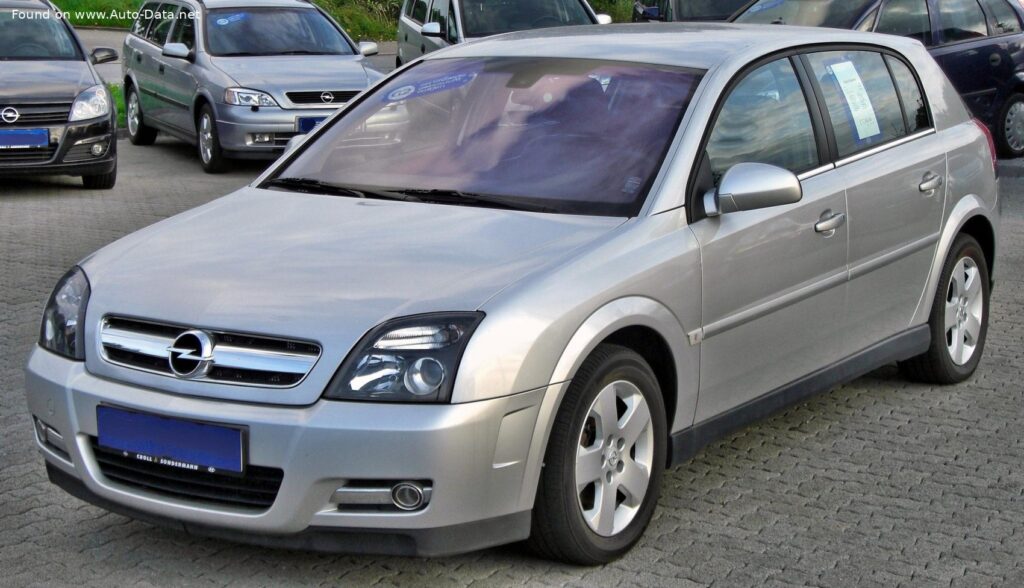
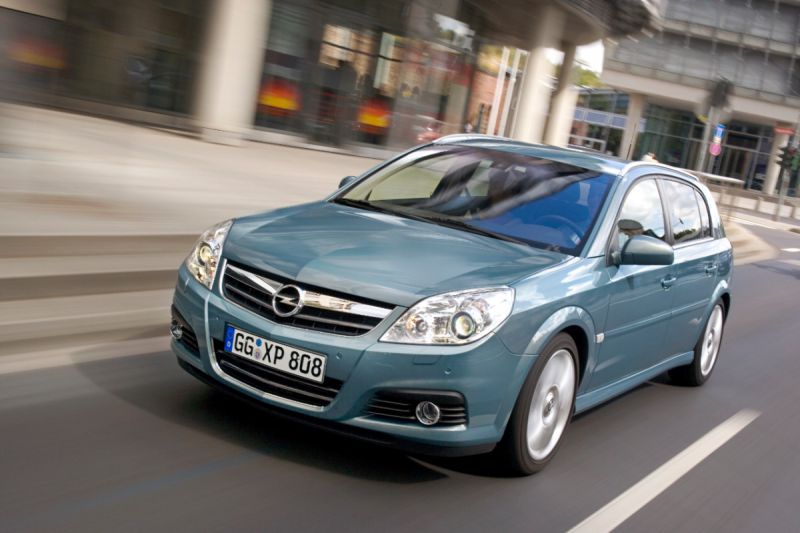
The Opel Signum’s body type is officially classified as a 5-door hatchback, but its design ethos went beyond this simple categorization. The 2005 facelift brought refreshed aesthetics, including a revised front fascia with a more prominent grille, updated headlights, and redesigned bumpers, aligning its look with the contemporary Opel design language. Its overall length of 183.11 inches (4651 mm) and width of 70.79 inches (1798 mm) gave it a substantial road presence.
However, the true innovation of the Signum lay in its interior. Built on an extended wheelbase of 111.42 inches (2830 mm) – significantly longer than the standard Vectra sedan – the Signum prioritized rear passenger comfort and cargo flexibility. It featured five seats, but the rear bench was uniquely designed with individual, adjustable seats that could slide fore and aft, recline, and even fold flat, offering unparalleled adaptability. This “FlexSpace” system, as Opel called it, allowed owners to prioritize legroom, cargo volume, or a combination of both. Minimum trunk space started at a respectable 12.89 cubic feet (365 liters), expanding to a cavernous 49.79 cubic feet (1410 liters) with the rear seats folded, making it exceptionally practical for its class.
From a chassis perspective, the Signum featured independent coil spring suspension at both the front and rear, tuned to provide a comfortable yet composed ride characteristic of an executive vehicle. Disc brakes on all four wheels, complemented by an Anti-lock Braking System (ABS), ensured confident stopping power. Standard 225/50 R17 tires on 17-inch wheel rims provided a good balance of grip and ride quality. The drag coefficient of 0.32 Cd was commendable for a vehicle of its size and shape, contributing to both fuel efficiency and reduced wind noise at higher speeds.
Technical Specifications of the Opel Signum (facelift 2005) 2.8i V6 24V Turbo (230 Hp)
| Category | Specification | US Equivalent / Notes |
|---|---|---|
| General Information | ||
| Brand | Opel | |
| Model | Signum | |
| Generation | Signum (facelift 2005) | |
| Type (Engine) | 2.8i V6 24V Turbo (230 Hp) | |
| Production Start | July, 2005 | |
| Production End | October, 2006 | |
| Powertrain Architecture | Internal Combustion Engine | |
| Body Type | Hatchback | |
| Seats | 5 | |
| Doors | 5 | |
| Performance Specifications | ||
| Fuel Consumption (Urban) | 15.7 l/100 km | 15 US mpg |
| Fuel Consumption (Extra Urban) | 7.6 l/100 km | 30.9 US mpg |
| Fuel Type | Petrol (Gasoline) | |
| Acceleration 0 – 60 mph | 7.2 seconds | |
| Acceleration 0 – 100 km/h | 7.6 seconds | |
| Maximum Speed | 243 km/h | 150.99 mph |
| Weight-to-Power Ratio | 6.9 kg/Hp | 145.6 Hp/tonne |
| Weight-to-Torque Ratio | 4.8 kg/Nm | 208.9 Nm/tonne |
| Engine Specifications | ||
| Power | 230 Hp @ 5500 rpm | |
| Power per Liter | 82.4 Hp/l | |
| Torque | 330 Nm | 243.4 lb.-ft. |
| Engine Layout | Front, Transverse | |
| Engine Model/Code | Z28NEL | |
| Engine Displacement | 2792 cm3 | 2.8 Liters (170.38 cu. in.) |
| Number of Cylinders | 6 | |
| Engine Configuration | V-engine | |
| Cylinder Bore | 89 mm | 3.5 inches |
| Piston Stroke | 74.8 mm | 2.94 inches |
| Compression Ratio | 9.5:1 | |
| Valves per Cylinder | 4 | |
| Fuel Injection System | Multi-port manifold injection | |
| Engine Aspiration | Turbocharger, Intercooler | |
| Engine Oil Capacity | 6 l | 6.34 US qt |
| Coolant Capacity | 7.5 l | 7.93 US qt |
| Dimensions, Volume, and Weights | ||
| Kerb Weight | 1580 kg | 3483.3 lbs. |
| Maximum Weight | 2175 kg | 4795.05 lbs. |
| Maximum Load | 595 kg | 1311.75 lbs. |
| Trunk (Boot) Space – Minimum | 365 l | 12.89 cu. ft. |
| Trunk (Boot) Space – Maximum | 1410 l | 49.79 cu. ft. |
| Fuel Tank Capacity | 60 l | 15.85 US gal |
| Length | 4651 mm | 183.11 inches |
| Width | 1798 mm | 70.79 inches |
| Height | 1466 mm | 57.72 inches |
| Wheelbase | 2830 mm | 111.42 inches |
| Front Track | 1536 mm | 60.47 inches |
| Rear (Back) Track | 1525 mm | 60.04 inches |
| Drag Coefficient (Cd) | 0.32 | |
| Drivetrain, Brakes, and Suspension | ||
| Drivetrain Architecture | Front-wheel drive (ICE drives front wheels) | |
| Drive Wheel | Front wheel drive | |
| Gearbox Type | 6 gears, manual transmission | |
| Front Suspension | Independent coil spring | |
| Rear Suspension | Independent coil spring | |
| Front Brakes | Disc | |
| Rear Brakes | Disc | |
| Assisting Systems | ABS (Anti-lock braking system) | |
| Tires Size | 225/50 R17 | |
| Wheel Rims Size | 17 inches |
Legacy and Market Positioning in Europe
The Opel Signum, particularly the potent 2.8i V6 Turbo variant, holds a unique place in Opel’s modern history. It was an ambitious attempt to create a new niche in the highly competitive European D-segment, offering a blend of executive comfort, performance, and unmatched interior flexibility. Its primary competitors in the European market included established players like the Ford Mondeo, Volkswagen Passat, Renault Laguna, and Peugeot 407, all of which offered more conventional sedan or wagon body styles. The Signum aimed to differentiate itself by appealing to buyers who found traditional sedans too restrictive and wagons too utilitarian, yet desired more space and versatility than a typical hatchback.
Despite its innovative concept and the strong performance of the 2.8L V6 Turbo engine, the Signum’s market impact was somewhat mixed. While praised by many automotive journalists for its comfortable ride, refined powertrain, and clever interior packaging, it struggled to achieve significant sales volumes. Its unconventional body style, which blended elements of a hatchback, a wagon, and even a slight MPV profile, may have been too niche for the broader market. Consumers often preferred the more straightforward offerings of its rivals or opted for true SUVs and MPVs as they gained popularity.
Nevertheless, the Opel Signum represented a forward-thinking approach to automotive design and functionality. It showcased Opel’s engineering prowess, particularly with the introduction of advanced engines like the 2.8L V6 Turbo, which later found its way into other performance-oriented Opel models. Today, the Signum is remembered as an interesting and often undervalued executive car that dared to be different. It remains a testament to Opel’s innovation during the mid-2000s, offering a compelling package for those who appreciated its unique blend of performance, luxury, and versatility.