The Opel Signum (facelift 2005): A European Executive Hatchback with V6 Diesel Power
The Opel Signum (facelift 2005) represents a unique and ambitious offering from General Motors’ European division, Opel, in the competitive D-segment of the mid-2000s. Positioned above the conventional Vectra, the Signum was conceived as an “executive express” or a “recreational vehicle” (RV) for the European market, blending the practicality of a hatchback with the spaciousness and comfort typically associated with larger sedans and wagons. This particular iteration, featuring the potent 3.0 V6 CDTI engine, was produced from July 2005 until June 2008, serving as the pinnacle of the Signum lineup in terms of performance and refinement. While never officially sold in the United States, the Signum showcased Opel’s innovative approach to interior packaging and powertrain technology, tailored specifically for European consumers who valued fuel efficiency, robust torque, and long-distance comfort.
Engine and Performance: The 3.0 V6 CDTI Powerplant in the Opel Signum (facelift 2005)
At the heart of this particular Opel Signum (facelift 2005) variant lies the formidable 3.0-liter V6 CDTI (Common Rail Diesel Injection) engine, designated by the code Z30DT. This sophisticated powertrain was a testament to the growing popularity and technological advancement of diesel engines in Europe during this era. Delivering a robust 184 horsepower at 4000 rpm, the engine provided ample motivation for the executive hatchback. More impressively, it generated a substantial 272.9 lb.-ft. of torque at a low 1900 rpm, ensuring strong acceleration and effortless cruising, particularly on the autobahns and highways where the Signum was intended to excel.
The V6 configuration, coupled with a DOHC (Double Overhead Camshaft) valvetrain and four valves per cylinder, ensured smooth power delivery and efficiency. Fueling the engine was a direct common rail diesel injection system, combined with a turbocharger and intercooler, which optimized combustion and boosted performance while maintaining impressive fuel economy for a vehicle of its size and power. Power was channeled to the front wheels via a precise 6-speed manual transmission, offering drivers an engaging and controlled driving experience. This setup allowed the Signum 3.0 V6 CDTI to accelerate from 0 to 60 mph in a respectable 8.7 seconds and achieve a top speed of 139.19 mph.
Despite its performance capabilities, the focus on efficiency was paramount. The vehicle boasted a combined fuel economy of 33.6 US mpg, an excellent figure for a V6-powered car in its segment. Urban driving yielded approximately 23.8 US mpg, while extra-urban conditions saw consumption drop to an impressive 44.4 US mpg. Furthermore, the engine was equipped with a particulate filter, a crucial feature for meeting stricter European emissions standards and demonstrating Opel’s commitment to cleaner diesel technology.
Design and Features: Innovative Versatility of the Opel Signum
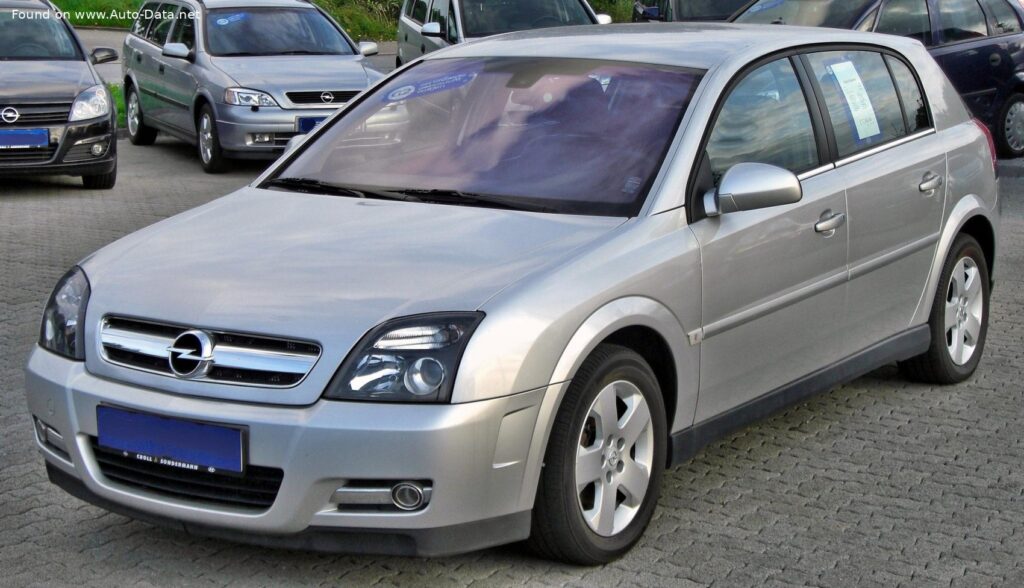
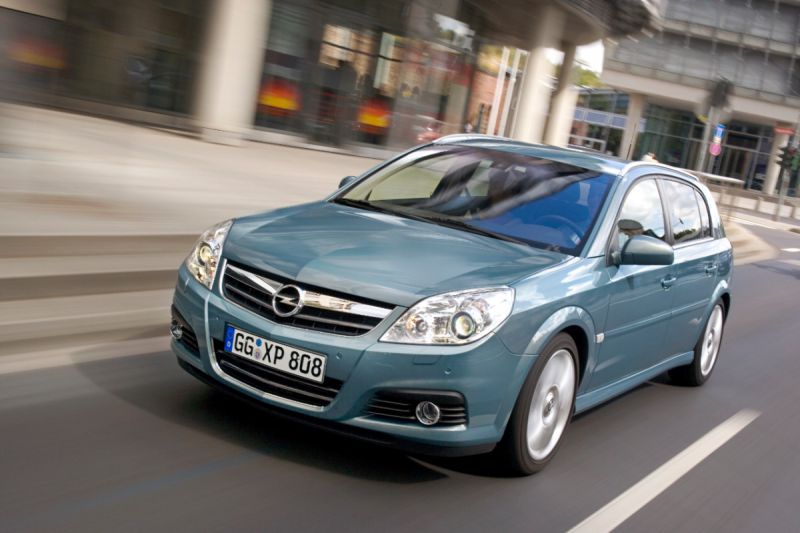
The Opel Signum (facelift 2005) adopted a distinctive 5-door hatchback body type, setting it apart from more traditional sedan and wagon rivals. The facelift introduced updated styling cues, including a revised front fascia with a more prominent grille and headlights, aligning its appearance with Opel’s contemporary design language. Measuring 183.11 inches in length, 70.79 inches in width, and 57.48 inches in height, with a generous 111.42-inch wheelbase, the Signum offered significant interior volume. The drag coefficient of 0.32 Cd was quite respectable for its class, contributing to both fuel efficiency and reduced wind noise at speed.
Where the Signum truly differentiated itself was its interior flexibility, particularly the “FlexSpace” rear seating concept. Instead of a conventional three-person bench, the Signum featured two individual rear seats that could slide, recline, and fold independently, much like the front seats. A third, smaller seat could be unfolded from the center console, or the console itself could be equipped with features like a cooler or entertainment system. This unique arrangement maximized passenger comfort and allowed for exceptional versatility in cargo management. The trunk space ranged from 12.89 cubic feet with all seats in place, expanding to a cavernous 49.79 cubic feet when the rear seats were folded, making it highly practical for various needs.
Underneath, the Signum utilized a proven chassis with coil spring suspension at both the front and rear, tuned for a balance of comfort and stable handling. Braking was handled by ventilated discs at the front and solid discs at the rear, complemented by an Anti-lock Braking System (ABS) for enhanced safety. Hydraulic rack and pinion steering provided direct feedback and ease of maneuverability. The vehicle rode on 215/55 R16 tires mounted on 6.5J x 16-inch wheel rims, offering a comfortable ride and adequate grip. With a curb weight of 3681.72 lbs., the Signum felt substantial and secure on the road.
Technical Specifications for the Opel Signum (facelift 2005) 3.0 V6 CDTI (184 Hp)
| Category | Specification |
|---|---|
| General Information | |
| Brand | Opel |
| Model | Signum (facelift 2005) |
| Type (Engine) | 3.0 V6 CDTI (184 Hp) |
| Start of Production | July, 2005 |
| End of Production | June, 2008 |
| Powertrain Architecture | Internal Combustion Engine |
| Body type | Hatchback |
| Seats | 5 |
| Doors | 5 |
| Performance Specs | |
| Fuel Consumption (Urban) | 23.8 US mpg |
| Fuel Consumption (Extra Urban) | 44.4 US mpg |
| Fuel Consumption (Combined) | 33.6 US mpg |
| Fuel Type | Diesel |
| Acceleration 0 – 60 mph | 8.7 sec |
| Maximum Speed | 139.19 mph |
| Weight-to-Power Ratio | 9.1 kg/Hp, 110.2 Hp/tonne |
| Weight-to-Torque Ratio | 4.5 kg/Nm, 221.6 Nm/tonne |
| Engine Specs | |
| Power | 184 Hp @ 4000 rpm |
| Power per liter | 62.2 Hp/l |
| Torque | 272.9 lb.-ft. @ 1900 rpm |
| Engine Layout | Front, Transverse |
| Engine Model/Code | Z30DT |
| Engine Displacement | 3.0 liters (180.51 cu. in.) |
| Number of Cylinders | 6 |
| Engine Configuration | V-engine |
| Cylinder Bore | 3.44 in. |
| Piston Stroke | 3.23 in. |
| Compression Ratio | 18.5:1 |
| Number of Valves per Cylinder | 4 |
| Fuel Injection System | Diesel Commonrail |
| Engine Aspiration | Turbocharger, Intercooler |
| Valvetrain | DOHC |
| Engine Oil Capacity | 7.66 US qt |
| Coolant Capacity | 8.77 US qt |
| Engine Systems | Particulate filter |
| Space, Volume and Weights | |
| Kerb Weight | 3681.72 lbs. |
| Max. Weight (GVWR) | 4817.1 lbs. |
| Max Load | 1135.38 lbs. |
| Trunk (boot) space – minimum | 12.89 cu. ft. |
| Trunk (boot) space – maximum | 49.79 cu. ft. |
| Fuel Tank Capacity | 15.85 US gal |
| Dimensions | |
| Length | 183.11 in. |
| Width | 70.79 in. |
| Height | 57.48 in. |
| Wheelbase | 111.42 in. |
| Front Track | 60.43 in. |
| Rear Track | 60.04 in. |
| Drag Coefficient (Cd) | 0.32 |
| Drivetrain, Brakes and Suspension Specs | |
| Drivetrain Architecture | Front-wheel drive, Internal Combustion Engine |
| Drive Wheel | Front wheel drive |
| Number of Gears and Type of Gearbox | 6 gears, manual transmission |
| Front Suspension | Coil spring |
| Rear Suspension | Coil spring |
| Front Brakes | Ventilated discs |
| Rear Brakes | Disc |
| Assisting Systems | ABS (Anti-lock braking system) |
| Steering Type | Steering rack and pinion |
| Power Steering | Hydraulic Steering |
| Tires Size | 215/55 R16 |
| Wheel Rims Size | 6.5J x 16 |
Legacy and Market Impact of the Opel Signum
The Opel Signum (facelift 2005), particularly with its powerful 3.0 V6 CDTI engine, occupied a rather unique and somewhat challenging position in the European automotive landscape. It entered a segment dominated by established players like the Volkswagen Passat, Ford Mondeo, and Renault Laguna, while also attempting to lure buyers away from more premium offerings from brands like Audi and BMW. Its innovative “FlexSpace” interior, designed to offer superior rear passenger comfort and adaptability, was a significant selling point, aiming to bridge the gap between traditional sedans, wagons, and the emerging MPV (multi-purpose vehicle) segment.
Despite its advanced diesel powertrain, comfortable ride, and flexible interior, the Signum struggled to achieve widespread market success. Its unconventional hatchback styling, which wasn’t quite a sedan nor a traditional wagon, proved to be a polarizing factor. Many European buyers, particularly those in the executive segment, preferred the more conventional aesthetics and established brand prestige of its rivals. Competitors such as the Volkswagen Passat and Ford Mondeo offered more traditional body styles and often stronger brand loyalty, while premium marques provided a perception of higher status. Even within its own GM Europe stable, the more conventional Opel Vectra and its wagon variant often overshadowed the Signum in sales.
The Signum’s reputation was often one of a misunderstood car – praised by those who appreciated its unique blend of space, comfort, and diesel performance, but overlooked by the broader market. It demonstrated Opel’s willingness to experiment with new vehicle concepts, reflecting a period when automakers were exploring various body styles to meet evolving consumer demands. While it didn’t become a sales blockbuster, the Signum’s focus on interior versatility and high-torque, efficient diesel engines was indicative of trends that would eventually influence other segments, including the development of crossovers and more flexible interior designs in mainstream vehicles. Its discontinuation in 2008 marked the end of an interesting, albeit short-lived, chapter for Opel in the executive segment, leaving behind a legacy as an intriguing footnote in European automotive history.