
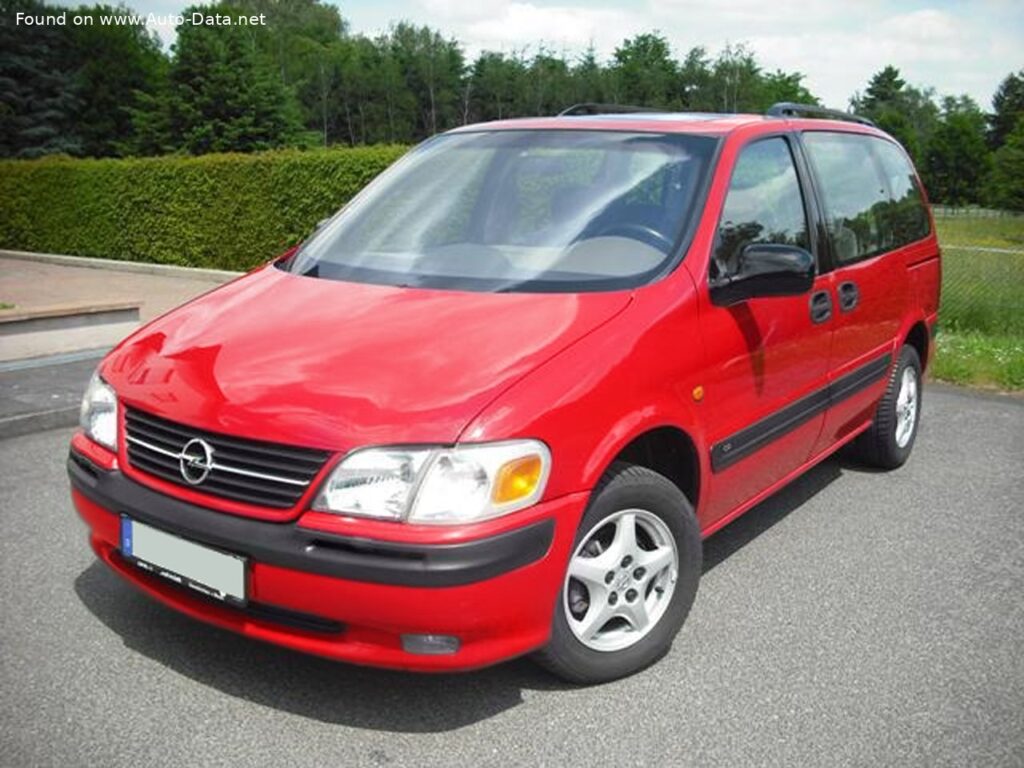
The Opel Sintra 2.2i 16V: A European Interpretation of the American Minivan
The Opel Sintra 2.2i 16V represents a notable, albeit short-lived, chapter in the European automotive landscape during the late 1990s. Introduced in March 1997 and discontinued by June 1999, the Sintra was Opel’s ambitious attempt to capture a segment of the burgeoning large minivan market in Europe. Unlike many of its European competitors, the Sintra was not an indigenous design but rather a rebadged version of General Motors’ second-generation U-body platform minivans, which were popular in North America as the Chevrolet Venture, Pontiac Trans Sport/Montana, and Oldsmobile Silhouette. This shared lineage meant the Sintra brought American-style spaciousness and practicality to European buyers, packaged with Opel’s design language and powertrain options tailored for the continent. The 2.2i 16V variant, with its 141 horsepower engine, was positioned as a capable and family-friendly option, emphasizing comfort and utility in a competitive market segment.
Engine and Performance of the Opel Sintra
Under the hood, the Opel Sintra 2.2i 16V featured a naturally aspirated, transverse-mounted 2.2-liter (2198 cm³ or 134.13 cu. in.) inline-four engine, designated by the code X22XE. This robust powerplant was designed to deliver a balance of power and efficiency suitable for family transport. It produced a respectable 141 horsepower at 5400 rpm, providing adequate motivation for the minivan’s substantial kerb weight of 3648.65 lbs. Torque output was equally impressive for its class, peaking at 148.99 lb.-ft. (202 Nm) at a relatively low 2600 rpm, ensuring good low-end grunt for city driving and highway cruising, especially when loaded with passengers and cargo.
Power was sent to the front wheels via a standard 5-speed manual transmission, a common setup for European vehicles prioritizing driver engagement and fuel economy. Performance figures for the Opel Sintra 2.2i 16V included an acceleration time from 0 to 60 mph in a calculated 12.1 seconds, with a top speed reaching 113.71 mph (183 km/h). While not a performance leader, these figures were competitive within the minivan segment, where utility and comfort typically took precedence over outright speed.
Fuel economy for the 2.2i 16V variant was rated at a combined 24.5 US mpg (9.6 l/100 km), with urban consumption at 18.1 US mpg (13 l/100 km) and extra-urban at 29 US mpg (8.1 l/100 km). These figures, while not groundbreaking, were acceptable for a vehicle of its size and power output in the late 1990s, especially considering its multi-port manifold fuel injection system and 10.5:1 compression ratio, which aimed for optimized combustion. The engine’s design, with four valves per cylinder, underscored Opel’s commitment to modern engine technology for its time.
Design and Features of the Opel Sintra
The Opel Sintra was designed as a full-size minivan, emphasizing interior space and versatility. Its body type featured five doors and a seven-seat configuration, making it an ideal choice for larger families or those requiring significant cargo capacity. With a length of 183.86 inches (4670 mm), a width of 72.05 inches (1830 mm), and a height of 70.08 inches (1780 mm), the Sintra was a sizable vehicle by European standards, reflecting its American origins. The generous 112.2-inch (2850 mm) wheelbase contributed significantly to its comfortable ride and expansive interior.
One of the Sintra’s key selling points was its highly flexible interior. The minimum trunk space of 16.24 cu. ft. (460 liters) could be expanded dramatically to a cavernous 132.96 cu. ft. (3765 liters) with the rear seats removed or folded, rivaling many larger utility vehicles. This adaptability made it exceptionally practical for hauling everything from groceries to furniture, a crucial feature for a family-oriented vehicle.
In terms of chassis and safety, the Sintra was equipped with a front-wheel-drive architecture, a common and efficient setup for minivans. It featured coil spring suspension at both the front and rear, designed to provide a smooth and compliant ride characteristic of family vehicles. Braking was handled by ventilated discs at the front and solid discs at the rear, augmented by an Anti-lock Braking System (ABS), which was becoming standard for improved safety in this era. Hydraulic power steering, utilizing a rack and pinion system, ensured ease of maneuverability despite the vehicle’s size. The Sintra rode on 205/65 HR 15 tires mounted on 6J x 15 wheel rims, providing a good balance of grip and ride comfort.
Technical Specifications
| Category | Specification |
|---|---|
| Brand | Opel |
| Model | Sintra |
| Generation | Sintra |
| Type (Engine) | 2.2i 16V (141 Hp) |
| Start of Production | March, 1997 |
| End of Production | June, 1999 |
| Powertrain Architecture | Internal Combustion engine |
| Body Type | Minivan |
| Seats | 7 |
| Doors | 5 |
| Performance Specs | |
| Fuel Consumption (Urban) | 18.1 US mpg (13 l/100 km) |
| Fuel Consumption (Extra Urban) | 29 US mpg (8.1 l/100 km) |
| Fuel Consumption (Combined) | 24.5 US mpg (9.6 l/100 km) |
| Fuel Type | Petrol (Gasoline) |
| Acceleration 0-60 mph | 12.1 sec |
| Maximum Speed | 113.71 mph (183 km/h) |
| Weight-to-Power Ratio | 11.7 kg/Hp, 85.2 Hp/tonne |
| Weight-to-Torque Ratio | 8.2 kg/Nm, 122.1 Nm/tonne |
| Engine Specs | |
| Power | 141 Hp @ 5400 rpm |
| Power per Liter | 64.1 Hp/l |
| Torque | 148.99 lb.-ft. (202 Nm) @ 2600 rpm |
| Engine Layout | Front, Transverse |
| Engine Model/Code | X22XE |
| Engine Displacement | 2.2 liters (2198 cm³ / 134.13 cu. in.) |
| Number of Cylinders | 4 |
| Engine Configuration | Inline |
| Cylinder Bore | 3.39 in. (86 mm) |
| Piston Stroke | 3.72 in. (94.6 mm) |
| Compression Ratio | 10.5:1 |
| Valves per Cylinder | 4 |
| Fuel Injection System | Multi-port manifold injection |
| Engine Aspiration | Naturally aspirated engine |
| Engine Oil Capacity | 4.49 US qt (4.25 l) |
| Coolant Capacity | 6.23 US qt (5.9 l) |
| Space, Volume and Weights | |
| Kerb Weight | 3648.65 lbs. (1655 kg) |
| Max. Weight (Gross) | 5169.84 lbs. (2345 kg) |
| Max Load | 1521.19 lbs. (690 kg) |
| Trunk (Boot) Space – Minimum | 16.24 cu. ft. (460 l) |
| Trunk (Boot) Space – Maximum | 132.96 cu. ft. (3765 l) |
| Fuel Tank Capacity | 18.49 US gal (70 l) |
| Dimensions | |
| Length | 183.86 in. (4670 mm) |
| Width | 72.05 in. (1830 mm) |
| Height | 70.08 in. (1780 mm) |
| Wheelbase | 112.2 in. (2850 mm) |
| Front Track | 61.42 in. (1560 mm) |
| Rear (Back) Track | 63.39 in. (1610 mm) |
| Drivetrain, Brakes and Suspension Specs | |
| Drivetrain Architecture | Front wheel drive (Internal Combustion engine drives front wheels) |
| Drive Wheel | Front wheel drive |
| Number of Gears and Type of Gearbox | 5 gears, manual transmission |
| Front Suspension | Coil spring |
| Rear Suspension | Coil spring |
| Front Brakes | Ventilated discs |
| Rear Brakes | Disc |
| Assisting Systems | ABS (Anti-lock braking system) |
| Steering Type | Steering rack and pinion |
| Power Steering | Hydraulic Steering |
| Tires Size | 205/65 HR 15 |
| Wheel Rims Size | 6J x 15 |
Legacy and Market Impact of the Opel Sintra
The Opel Sintra’s tenure in the European market was remarkably brief, lasting just over two years. Its reception was mixed, and it struggled to gain significant traction against established European rivals. The primary challenge for the Sintra stemmed from its American origins. While its spaciousness was a definite advantage, critics in Europe often pointed to its driving dynamics, which were perceived as less refined than those of its European competitors, such as the Renault Espace, Volkswagen Sharan, Ford Galaxy, and SEAT Alhambra. These European-designed minivans were often praised for their more agile handling and perceived higher build quality, traits highly valued by European consumers.
Furthermore, the Sintra faced significant scrutiny regarding its safety performance. Its initial Euro NCAP crash test results were notably poor for the time, which severely impacted consumer confidence and its market viability. This negative publicity, combined with a perception of lower material quality compared to its price point, made it difficult for the Sintra to compete effectively. Opel had aimed for the Sintra to fill a gap in its lineup, offering a larger, more versatile family vehicle than its smaller Zafira MPV, but the execution of adapting a North American platform for European tastes proved more challenging than anticipated.
Despite its shortcomings and short production run, the Opel Sintra holds a place in automotive history as an interesting case study of globalization and market adaptation. It represented General Motors’ attempt to leverage its global platforms to cater to diverse regional markets. For Opel, it was an ambitious, though ultimately unsuccessful, venture into the large MPV segment, paving the way for future, more successful European-developed models. Today, the Sintra is remembered less for its sales success and more for its distinctive origins and the lessons it offered about the nuances of cross-continental automotive design and consumer expectations. Its 2.2i 16V variant, in particular, showcases the type of practical, if not groundbreaking, powertrain choices made to serve its intended family demographic.
