
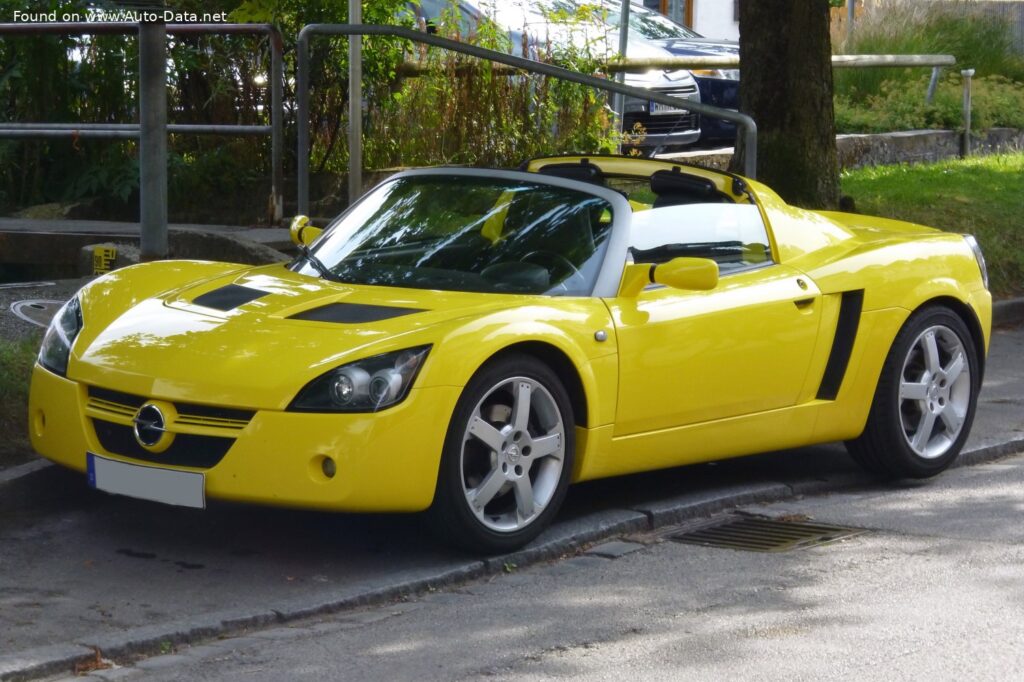
The Opel Speedster 2.0i 16V Turbo (200 Hp): A Purebred European Roadster
The Opel Speedster 2.0i 16V Turbo, produced between February 2003 and February 2004, represents a unique and highly focused chapter in the history of the German automotive manufacturer, Opel. Known as the Vauxhall VX220 in the United Kingdom, this two-seat roadster was a radical departure from Opel’s more mainstream offerings. Conceived as a halo car to inject excitement and a performance image into the brand, the Speedster was not developed entirely in-house by Opel. Instead, it was built by Lotus Cars at their Hethel plant in Norfolk, England, sharing a significant portion of its aluminum chassis and minimalist philosophy with the second-generation Lotus Elise. This collaboration resulted in a lightweight, driver-centric machine that prioritized raw driving enjoyment over creature comforts, positioning it as a direct competitor to other European lightweight sports cars.
The Speedster’s generation, simply known as “Speedster,” had a brief but impactful run. The 2.0i 16V Turbo variant, with its potent turbocharged engine, was the more powerful and performance-oriented option, building upon the naturally aspirated 2.2-liter model. It carved out a niche for enthusiasts seeking an unadulterated sports car experience, offering blistering acceleration and razor-sharp handling in a package that was distinctly European and, notably, never officially sold in the United States. Its role was to showcase Opel’s engineering prowess and commitment to performance, acting as a brand image booster in its primary European markets.
Engine & Performance: The Heart of the Opel Speedster 2.0i 16V Turbo
At the core of the Opel Speedster 2.0i 16V Turbo‘s exhilarating performance lies its sophisticated Z20LET engine. This 2.0-liter (1998 cm3 or 121.93 cu. in.) inline four-cylinder powerplant is a prime example of early 2000s turbocharged engineering. Featuring a double overhead camshaft (DOHC) valvetrain with 4 valves per cylinder, the engine is fed by a multi-port manifold injection system and significantly boosted by a turbocharger with an intercooler. This setup allowed the relatively small displacement engine to punch well above its weight class.
The Z20LET engine produces a robust 200 horsepower (Hp) at 5400 rpm, translating to an impressive power-per-liter output of 100.1 Hp/l. More critically for real-world performance in a lightweight vehicle, it delivers a substantial 262 Newton meters (Nm) of torque, equivalent to 193.24 lb.-ft., peaking at a usable 4200 rpm. This broad torque band, characteristic of turbocharged engines, ensures strong acceleration across the rev range. The engine is positioned transversely in the rear, contributing to the car’s balanced weight distribution and agile handling characteristics.
Mated to a precise 5-speed manual transmission, this powertrain enables the Speedster 2.0i 16V Turbo to achieve remarkable acceleration figures. It sprints from 0 to 60 mph in a mere 4.7 seconds, and from 0 to 100 km/h in 4.9 seconds. The top speed is an impressive 150.99 mph (243 km/h). With a curb weight of just 2050.3 lbs (930 kg), the car boasts an exceptional weight-to-power ratio of 4.7 kg/Hp (215.1 Hp/tonne) and a weight-to-torque ratio of 3.5 kg/Nm (281.7 Nm/tonne). These figures underscore the Speedster’s philosophy: minimal mass combined with potent power for maximum performance. Fuel economy, while not its primary focus, was respectable for a performance car of its era, with a combined rating of 27.7 US mpg (8.5 l/100 km) and CO2 emissions of 202 g/km.
Design & Features: Form Follows Function
The Opel Speedster’s design is a testament to the principle of form following function, heavily influenced by its Lotus origins. It features a classic two-door, two-seat roadster body type, characterized by its low slung profile, wide stance, and aggressive, angular lines. The composite body panels contribute significantly to its featherlight curb weight, which is a cornerstone of its performance credentials. Unlike many contemporary sports cars that were growing larger and heavier, the Speedster embraced minimalism.
The exterior design is sharp and purposeful, with a distinct front fascia that, while sharing some Opel styling cues, maintained an independent identity. The exposed headlights and aggressive air intakes hint at its performance capabilities. The interior is equally spartan, reflecting its track-focused intentions. Drivers are presented with a straightforward dashboard, essential instrumentation, and supportive bucket seats designed to hold occupants firmly during spirited driving. There’s no excessive luxury or complex infotainment; the focus is entirely on the driving experience.
In terms of features, the Speedster prioritized mechanical integrity and driving dynamics. Its drivetrain architecture features an internal combustion engine driving the rear wheels, a layout revered by driving purists. The suspension system consists of coil springs at both the front and rear, tuned for precise handling and minimal body roll. Stopping power is provided by disc brakes on all four wheels, augmented by an Anti-lock Braking System (ABS) for enhanced safety during hard braking. The steering is a rack and pinion type, offering direct and communicative feedback to the driver. The staggered tire sizes (175/55 R17 front, 225/45 R17 rear) mounted on 7.5J x 17-inch wheel rims further enhance grip and handling balance.
Practicality, while secondary, was not entirely overlooked. The Speedster offers a modest trunk space of 7.27 cu. ft. (206 liters), enough for a weekend bag or two. The fuel tank capacity is 9.51 US gallons (36 liters), which, combined with its fuel efficiency, provides a reasonable range for a sports car.
Technical Specifications: Opel Speedster 2.0i 16V Turbo (200 Hp)
| Category | Specification |
|---|---|
| Brand | Opel |
| Model | Speedster |
| Generation | Speedster |
| Variant | 2.0i 16V Turbo (200 Hp) |
| Production Start | February, 2003 |
| Production End | February, 2004 |
| Powertrain Architecture | Internal Combustion Engine |
| Body Type | Roadster |
| Seats | 2 |
| Doors | 2 |
Performance Specifications |
|
| Fuel Consumption (Urban) | 11.9 l/100 km (19.8 US mpg) |
| Fuel Consumption (Extra Urban) | 6.5 l/100 km (36.2 US mpg) |
| Fuel Consumption (Combined) | 8.5 l/100 km (27.7 US mpg) |
| CO2 Emissions | 202 g/km |
| Fuel Type | Petrol (Gasoline) |
| Acceleration 0 – 60 mph | 4.7 seconds |
| Acceleration 0 – 62 mph (0 – 100 km/h) | 4.9 seconds |
| Maximum Speed | 150.99 mph (243 km/h) |
| Weight-to-Power Ratio | 4.7 kg/Hp (215.1 Hp/tonne) |
| Weight-to-Torque Ratio | 3.5 kg/Nm (281.7 Nm/tonne) |
Engine Specifications |
|
| Power | 200 Hp @ 5400 rpm |
| Power per Liter | 100.1 Hp/l |
| Torque | 262 Nm (193.24 lb.-ft.) @ 4200 rpm |
| Engine Layout | Rear, Transverse |
| Engine Model/Code | Z20LET |
| Engine Displacement | 1998 cm3 (2.0 Liters / 121.93 cu. in.) |
| Number of Cylinders | 4 |
| Engine Configuration | Inline |
| Cylinder Bore | 86 mm (3.39 in.) |
| Piston Stroke | 86 mm (3.39 in.) |
| Compression Ratio | 8.8:1 |
| Valves per Cylinder | 4 |
| Fuel Injection System | Multi-port manifold injection |
| Engine Aspiration | Turbocharger, Intercooler |
| Valvetrain | DOHC |
| Engine Oil Capacity | 4.5 l (4.76 US qt) |
| Coolant Capacity | 13.2 l (13.95 US qt) |
Dimensions & Weights |
|
| Curb Weight | 930 kg (2050.3 lbs) |
| Maximum Weight | 1150 kg (2535.32 lbs) |
| Maximum Load | 220 kg (485.02 lbs) |
| Trunk Space (Minimum) | 206 l (7.27 cu. ft.) |
| Fuel Tank Capacity | 36 l (9.51 US gal) |
| Length | 3786 mm (149.06 in.) |
| Width | 1710 mm (67.32 in.) |
| Width (including mirrors) | 1884 mm (74.17 in.) |
| Height | 1117 mm (43.98 in.) |
| Wheelbase | 2330 mm (91.73 in.) |
| Front Track | 1450 mm (57.09 in.) |
| Rear Track | 1468 mm (57.8 in.) |
Drivetrain, Brakes & Suspension |
|
| Drivetrain Architecture | Rear-wheel drive, Internal Combustion Engine |
| Drive Wheel | Rear wheel drive |
| Gearbox | 5 gears, manual transmission |
| Front Suspension | Coil spring |
| Rear Suspension | Coil spring |
| Front Brakes | Disc |
| Rear Brakes | Disc |
| Assisting Systems | ABS (Anti-lock braking system) |
| Steering Type | Steering rack and pinion |
| Tires Size | Front: 175/55 R17; Rear: 225/45 R17 |
| Wheel Rims Size | 7.5J x 17 |
Legacy & Market Impact of the Opel Speedster
The Opel Speedster 2.0i 16V Turbo, along with its naturally aspirated sibling and its Vauxhall VX220 counterpart, carved out a distinct and memorable legacy in the European sports car market. Its reputation was built on pure, unadulterated driving engagement. Unlike many performance cars of its era that were becoming increasingly complex and comfort-oriented, the Speedster remained true to the lightweight, minimalist ethos championed by Lotus. This focus made it a darling of automotive journalists and track-day enthusiasts who appreciated its direct steering, superb chassis balance, and visceral connection to the road.
In its primary European markets, the Speedster faced competition from a varied field. Its most direct rival was undoubtedly the Lotus Elise and Exige, with which it shared its fundamental architecture. Other competitors included the more traditional Mazda MX-5 (Miata in the US), which offered a similar roadster experience but with a more conventional design and less extreme performance, and potentially the Porsche Boxster, though the Boxster occupied a higher price point and offered a more refined, luxurious experience. The Speedster differentiated itself by offering Lotus-like performance and handling at a more accessible price point than an actual Lotus, especially the turbocharged variant.
Despite its critical acclaim, the Opel Speedster was a niche product with a relatively short production run, particularly for the 2.0i 16V Turbo variant which only saw a year of production. This limited availability has contributed to its cult status among enthusiasts. It wasn’t a mass-market success, nor was it intended to be. Its purpose was to serve as a halo car, demonstrating Opel’s capability to produce a truly exciting and dynamically brilliant vehicle. It succeeded in this regard, enhancing the brand’s image and proving that Opel could, indeed, build a serious sports car.
Today, the Opel Speedster is regarded as a modern classic, sought after by collectors and driving enthusiasts who value its raw, unfiltered driving experience. Its lightweight construction, potent turbocharged engine, and direct connection to Lotus engineering make it a unique proposition in the used car market. It stands as a testament to a period when manufacturers were willing to take risks and produce specialized vehicles purely for the love of driving, leaving behind a legacy of performance and passion that continues to resonate with automotive aficionados.
