
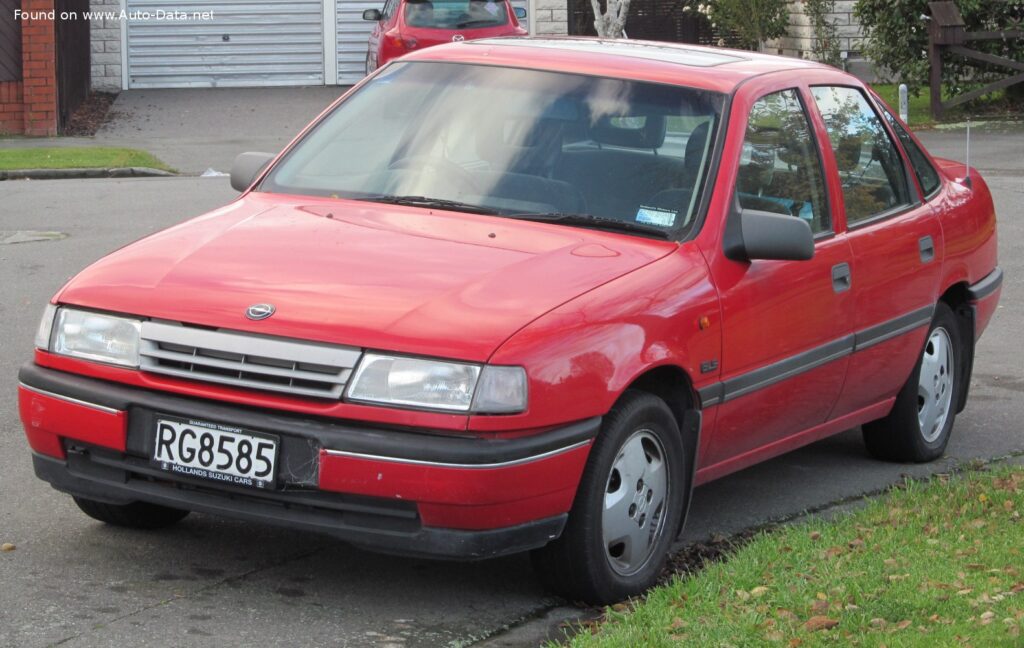
The Opel Vectra A 1.7 TD: A European Workhorse of the Early 1990s
The Opel Vectra A, introduced in 1988, marked a significant era for General Motors’ European subsidiary, Opel. Replacing the long-running Ascona, the Vectra A was designed as a modern, aerodynamically efficient, and spacious family car, primarily targeting the competitive European mid-size segment. The model under scrutiny, the Opel Vectra A 1.7 TD (82 Hp), represents a diesel-powered variant from the early production run, specifically manufactured between September 1991 and July 1992. While the Opel brand was not directly sold in the United States, its engineering and market philosophy often mirrored that of its GM stablemates globally, albeit tailored for European tastes and regulations. This particular 1.7-liter turbocharged diesel sedan was a practical and economical choice, embodying the shift towards more fuel-efficient powertrains in Europe during that period. It was a common sight on European roads, serving as a reliable workhorse for families and business fleets alike, showcasing Opel’s commitment to offering diverse and practical vehicle options.
Engine and Performance of the Opel Vectra A
Under the hood, the Opel Vectra A 1.7 TD featured an inline four-cylinder, 1.7-liter (1686 cm³ or 102.89 cu. in.) diesel engine, designated with the code 17DT. This powerplant was transversely mounted at the front, driving the front wheels through a five-speed manual transmission. While not a performance-oriented vehicle, its turbocharged nature provided a respectable output for its class and era. The engine produced 82 horsepower at 4400 rpm, which was a decent figure for a diesel of its size in the early 1990s. More importantly for a diesel, it delivered a robust 123.91 lb.-ft. (168 Nm) of torque at a relatively low 2400 rpm. This low-end torque was crucial for everyday drivability, offering good pulling power and making the car feel more responsive in urban traffic and on highways.
Performance figures for the 1.7 TD were pragmatic rather than exhilarating. It could accelerate from 0 to 60 mph in an estimated 13.8 seconds (0-100 km/h in 14.5 seconds), and its top speed reached 109.36 mph (176 km/h). These numbers positioned it squarely as a competent family sedan, capable of comfortable cruising without being a speed demon. The true strength of this powertrain lay in its fuel efficiency. With a combined fuel consumption rating of 35.6 US mpg (6.6 l/100 km), it offered excellent economy for long-distance travel, a significant factor for European buyers who faced higher fuel prices. The precombustion chamber injection system, combined with an overhead camshaft (OHC) valvetrain, contributed to its reliability and relatively smooth operation for a diesel of its time.
Design and Features
The Opel Vectra A, available in various body styles, is presented here in its four-door sedan configuration, offering seating for five occupants. Its design language was a clear departure from the more angular styling of its predecessor, the Ascona. The Vectra A embraced a more rounded, aerodynamic aesthetic, evidenced by its commendably low drag coefficient (Cd) of 0.29. This sleek profile not only contributed to its modern appearance but also aided in fuel efficiency and reduced wind noise at higher speeds.
In terms of dimensions, the Vectra A sedan measured 174.49 inches (4432 mm) in length, 67.17 inches (1706 mm) in width, and 55.12 inches (1400 mm) in height, with a wheelbase of 102.36 inches (2600 mm). These dimensions provided a spacious cabin and a particularly generous trunk capacity, ranging from 18.72 cu. ft. (530 liters) to a maximum of 29.66 cu. ft. (840 liters) with the rear seats folded down, making it highly practical for families and their luggage.
While the 1991-1992 Vectra A wasn’t laden with the digital features of modern cars, it offered essential amenities and engineering for its era. Standard features included hydraulic power steering, providing a conventional and direct steering feel. Safety was addressed with ventilated disc brakes at the front and drum brakes at the rear, complemented by an Anti-lock Braking System (ABS), which was an important safety feature for the time, enhancing control during emergency braking. The suspension system utilized a wishbone setup at the front and coil springs at the rear, aiming for a balance between ride comfort and stable handling. The car rode on 175/70 R14 tires, fitted on 14-inch wheel rims, providing a comfortable and compliant ride suitable for varied road conditions.
Technical Specifications: Opel Vectra A 1.7 TD (82 Hp)
| Category | Specification | US Equivalent (where applicable) |
|---|---|---|
| General Information | ||
| Brand | Opel | |
| Model | Vectra A | |
| Type (Engine) | 1.7 TD (82 Hp) | |
| Start of Production | September, 1991 | |
| End of Production | July, 1992 | |
| Powertrain Architecture | Internal Combustion engine | |
| Body type | Sedan | |
| Seats | 5 | |
| Doors | 4 | |
| Performance Specs | ||
| Fuel consumption (combined) | 6.6 l/100 km | 35.6 US mpg |
| Fuel Type | Diesel | |
| Acceleration 0 – 60 mph | 13.8 sec | |
| Maximum speed | 176 km/h | 109.36 mph |
| Weight-to-power ratio | 14.3 kg/Hp | |
| Weight-to-torque ratio | 7 kg/Nm | |
| Engine Specs | ||
| Power | 82 Hp @ 4400 rpm | |
| Torque | 168 Nm @ 2400 rpm | 123.91 lb.-ft. @ 2400 rpm |
| Engine layout | Front, Transverse | |
| Engine Model/Code | 17DT | |
| Engine displacement | 1686 cm³ | 102.89 cu. in. |
| Number of cylinders | 4 | |
| Engine configuration | Inline | |
| Cylinder Bore | 79 mm | 3.11 in. |
| Piston Stroke | 86 mm | 3.39 in. |
| Compression ratio | 22:1 | |
| Number of valves per cylinder | 2 | |
| Fuel injection system | Precombustion chamber injection | |
| Engine aspiration | Turbocharger | |
| Valvetrain | OHC | |
| Engine oil capacity | 4.5 l | 4.76 US qt |
| Coolant capacity | 7.4 l | 7.82 US qt |
| Space, Volume and Weights | ||
| Kerb Weight | 1169 kg | 2577.2 lbs. |
| Max. weight | 1690 kg | 3725.81 lbs. |
| Max load | 521 kg | 1148.61 lbs. |
| Trunk (boot) space – minimum | 530 l | 18.72 cu. ft. |
| Trunk (boot) space – maximum | 840 l | 29.66 cu. ft. |
| Fuel tank capacity | 61 l | 16.11 US gal |
| Dimensions | ||
| Length | 4432 mm | 174.49 in. |
| Width | 1706 mm | 67.17 in. |
| Height | 1400 mm | 55.12 in. |
| Wheelbase | 2600 mm | 102.36 in. |
| Front track | 1426 mm | 56.14 in. |
| Rear (Back) track | 1423 mm | 56.02 in. |
| Drag coefficient (Cd) | 0.29 | |
| Drivetrain, Brakes and Suspension Specs | ||
| Drivetrain Architecture | The Internal combustion engine (ICE) drives the front wheels of the vehicle. | |
| Drive wheel | Front wheel drive | |
| Number of gears and type of gearbox | 5 gears, manual transmission | |
| Front suspension | Wishbone | |
| Rear suspension | Coil spring | |
| Front brakes | Ventilated discs | |
| Rear brakes | Drum | |
| Assisting systems | ABS (Anti-lock braking system) | |
| Power steering | Hydraulic Steering | |
| Tires size | 175/70 R14 | |
| Wheel rims size | 14 inches | |
Legacy and Market Impact of the Opel Vectra A
The Opel Vectra A, particularly its diesel variants like the 1.7 TD, carved out a significant niche in the European automotive landscape during its production run from 1988 to 1995. It was a direct competitor to other popular mid-size family cars such as the Ford Sierra (and later the Mondeo), Volkswagen Passat, Renault 21 (and later the Laguna), and Peugeot 405. In this highly competitive segment, the Vectra A distinguished itself through its blend of modern styling, practical interior space, and a reputation for solid build quality.
The 1.7 TD model played a crucial role in the Vectra A’s success, particularly for fleet buyers and individuals seeking economical long-distance transport. Diesel engines were gaining immense popularity in Europe due to their superior fuel economy and robust torque characteristics, making them ideal for highway cruising and heavy daily use. The Vectra A 1.7 TD offered a compelling package of low running costs, decent performance for its class, and the practicality of a spacious sedan. Its reliability and ease of maintenance further cemented its position as a sensible choice for budget-conscious consumers and company car schemes.
While the Vectra A did not achieve the same iconic status as some of its more luxurious or performance-oriented contemporaries, its impact was profound in its segment. It was a car that reliably served millions of European families and businesses, becoming a ubiquitous sight on roads across the continent. Its legacy is one of dependable, no-frills motoring that offered excellent value for money. The Vectra A’s success also laid the groundwork for future generations of Opel’s mid-size offerings, demonstrating Opel’s capability to deliver a competitive and well-rounded product in a demanding market. Even today, it is remembered as a sturdy and practical vehicle that exemplified the pragmatic approach of European automotive engineering in the early 1990s.
