
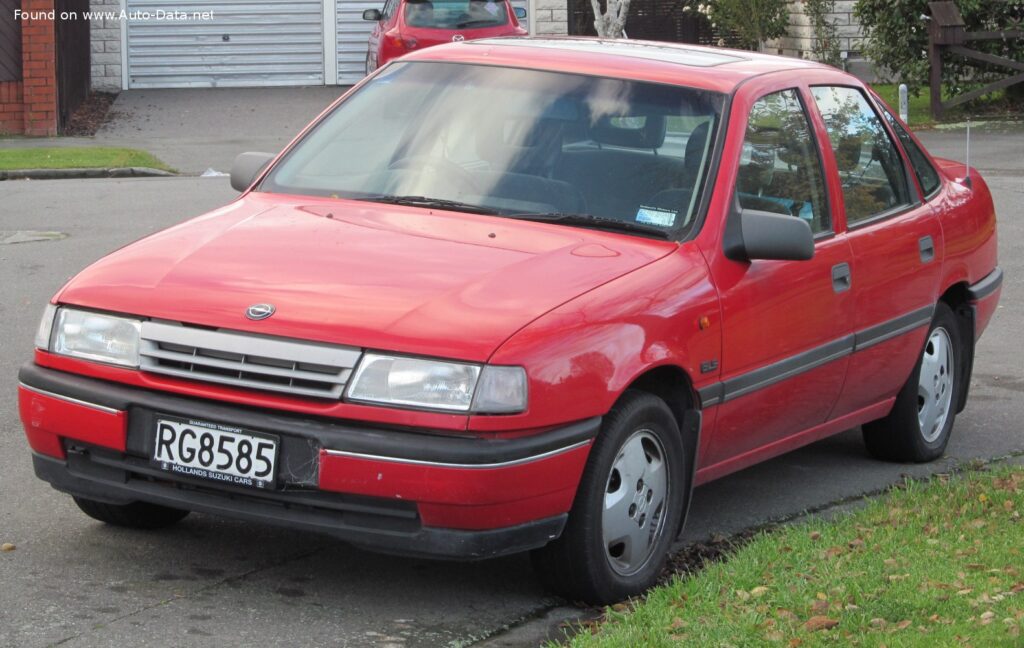
The Opel Vectra A: A European Mainstay (1988-1989)
The Opel Vectra A 1.8 S (88 Hp) represents a significant chapter in Opel’s history, marking the debut of a new nameplate that would become synonymous with the mainstream family car segment in Europe. Launched in October 1988, the Vectra A succeeded the long-running Ascona and quickly established itself as a formidable competitor in the highly contested D-segment. This particular variant, the 1.8 S, was an early offering in the Vectra A lineup, produced for a relatively short period until June 1989. It was designed as a practical, front-wheel-drive sedan, catering to European consumers seeking a reliable, fuel-efficient, and spacious vehicle for daily commuting and family travel. While Opel models were not sold under the Opel brand in the United States, the Vectra A’s design and engineering principles mirrored global trends in automotive development during the late 1980s, emphasizing aerodynamics, improved packaging, and enhanced driving dynamics.
The Vectra A’s introduction came at a time when European automakers were intensely focused on refining their mid-size offerings to meet evolving consumer demands for comfort, safety, and performance. Opel, a subsidiary of General Motors, leveraged its extensive engineering capabilities to create a car that was modern in appearance and robust in its mechanical underpinnings. The 1.8 S variant, with its carbureted engine, was positioned as an accessible entry point into the Vectra range, balancing adequate performance with sensible running costs, a crucial factor for its target demographic across the continent. Its role was to provide a dependable and unassuming option for a wide array of buyers, from private individuals to fleet operators, cementing Opel’s reputation as a purveyor of sturdy and sensible family transport.
Engine and Performance of the Opel Vectra A 1.8 S
Powering the Opel Vectra A 1.8 S (88 Hp) was Opel’s E18NVR engine, a naturally aspirated, inline four-cylinder unit with a displacement of 1796 cm3 (109.6 cubic inches). This engine was characteristic of the era, featuring a single overhead camshaft (OHC) valvetrain with two valves per cylinder, a configuration known for its simplicity and reliability. Unlike later, more advanced fuel-injected engines, the 1.8 S utilized a carburetor for its fuel delivery system, a common technology at the time, which contributed to its straightforward maintenance and cost-effectiveness.
The engine produced a respectable 88 horsepower (Hp) at 5400 rpm, delivering 49 Hp per liter of displacement. Torque output was equally competitive for its class, peaking at 143 Newton-meters (105.47 lb.-ft.) at a relatively low 2800 rpm. This low-end torque delivery made the Vectra A 1.8 S particularly tractable in city driving and provided sufficient pulling power for highway cruising, even when fully loaded. The powertrain architecture was front, transverse, with the engine driving the front wheels through a 5-speed manual transmission. This front-wheel-drive setup was a standard for mainstream European sedans, offering predictable handling characteristics, efficient packaging, and improved traction in varied conditions.
In terms of performance, the Vectra A 1.8 S was capable of a maximum speed of 182 km/h (113.09 mph), a respectable figure for a family sedan of its time. Fuel economy was also a strong suit, with a combined consumption rating of 7.1 liters per 100 kilometers, which translates to approximately 33.1 US miles per gallon or 39.8 UK miles per gallon. These figures underscored the vehicle’s design philosophy: to offer a practical and economical solution without sacrificing entirely on performance. The carbureted engine, while perhaps less refined than later fuel-injected units, was a proven workhorse that provided dependable service to countless European motorists.
Design and Features
The Opel Vectra A debuted with a clean, contemporary design that epitomized late 1980s automotive aesthetics, characterized by smooth lines and an emphasis on aerodynamics. The car’s body type was a classic 4-door sedan, providing seating for five occupants. Its overall length measured 4432 mm (174.49 inches), with a width of 1706 mm (67.17 inches) and a height of 1400 mm (55.12 inches). The wheelbase stretched to 2600 mm (102.36 inches), contributing to a stable ride and generous interior space for its class.
One of the standout features of the Vectra A’s design was its remarkably low drag coefficient (Cd) of 0.29. This was a significant achievement for a production sedan in 1988 and was a testament to Opel’s commitment to aerodynamic efficiency. A low Cd not only contributed to better fuel economy but also reduced wind noise at higher speeds, enhancing passenger comfort. The design was purposeful and understated, avoiding overly aggressive styling in favor of broad appeal and timelessness.
Inside, the Vectra A focused on practicality and ergonomics. The cabin was designed to be spacious and functional, with controls logically arranged for ease of use. While specific luxury features varied by trim level, the 1.8 S offered standard amenities expected in a mid-range family car of the period. A notable highlight was the ample trunk space, ranging from 530 liters (18.72 cubic feet) with the rear seats up, expandable to 840 liters (29.66 cubic feet) when the rear seats were folded down. This generous cargo capacity made the Vectra A a highly practical choice for families and those needing to transport luggage or goods. Safety features, while rudimentary by modern standards, included items like three-point seatbelts and a robust body shell designed to absorb impact forces, reflecting the prevailing safety regulations and expectations of the late 1980s. The overall package presented a compelling blend of utility, efficiency, and contemporary design for its target market.
Technical Specifications
| Category | Specification | US/Metric Equivalent |
|---|---|---|
| General Information | ||
| Brand | Opel | |
| Model | Vectra | |
| Generation | Vectra A | |
| Type (Engine) | 1.8 S (88 Hp) | |
| Start of Production | October, 1988 | |
| End of Production | June, 1989 | |
| Powertrain Architecture | Internal Combustion engine | |
| Body type | Sedan | |
| Seats | 5 | |
| Doors | 4 | |
| Performance Specs | ||
| Fuel Consumption (Combined) | 7.1 l/100 km | 33.1 US mpg / 39.8 UK mpg |
| Fuel Type | Petrol (Gasoline) | |
| Maximum Speed | 182 km/h | 113.09 mph |
| Engine Specs | ||
| Power | 88 Hp @ 5400 rpm | |
| Power per liter | 49 Hp/l | |
| Torque | 143 Nm @ 2800 rpm | 105.47 lb.-ft. @ 2800 rpm |
| Engine Layout | Front, Transverse | |
| Engine Model/Code | E18NVR | |
| Engine Displacement | 1796 cm3 | 109.6 cu. in. |
| Number of Cylinders | 4 | |
| Engine Configuration | Inline | |
| Cylinder Bore | 84.8 mm | 3.34 in. |
| Piston Stroke | 79.5 mm | 3.13 in. |
| Compression Ratio | 9.2:1 | |
| Number of Valves per Cylinder | 2 | |
| Fuel Injection System | Carburettor | |
| Engine Aspiration | Naturally aspirated engine | |
| Valvetrain | OHC | |
| Engine Oil Capacity | 4 l | 4.23 US qt | 3.52 UK qt |
| Coolant Capacity | 6.5 l | 6.87 US qt | 5.72 UK qt |
| Space, Volume and Weights | ||
| Trunk (boot) Space – Minimum | 530 l | 18.72 cu. ft. |
| Trunk (boot) Space – Maximum | 840 l | 29.66 cu. ft. |
| Dimensions | ||
| Length | 4432 mm | 174.49 in. |
| Width | 1706 mm | 67.17 in. |
| Height | 1400 mm | 55.12 in. |
| Wheelbase | 2600 mm | 102.36 in. |
| Front Track | 1420 mm | 55.91 in. |
| Rear (Back) Track | 1423 mm | 56.02 in. |
| Drag Coefficient (Cd) | 0.29 | |
| Drivetrain, Brakes and Suspension Specs | ||
| Drivetrain Architecture | The Internal combustion engine (ICE) drives the front wheels of the vehicle. | |
| Drive Wheel | Front wheel drive | |
| Number of Gears and Type of Gearbox | 5 gears, manual transmission |
Legacy and Market Impact of the Opel Vectra A
The Opel Vectra A, and particularly its early 1.8 S variant, played a pivotal role in solidifying Opel’s position in the highly competitive European D-segment. Upon its launch, it faced stiff competition from established rivals such as the Ford Sierra, Volkswagen Passat, and Renault 21. The Vectra A distinguished itself with its modern styling, excellent aerodynamics, and reputation for robust engineering and reliability, traits that were highly valued by European consumers. Its relatively short production run for the 1.8 S (88 Hp) model, from October 1988 to June 1989, reflects the rapid evolution of engine technology during that period, with Opel quickly transitioning to more advanced fuel-injected powertrains across the range.
The Vectra A inherited the mantle from the Opel Ascona, a car that had been a staple of European roads for decades. The transition to the Vectra nameplate symbolized a shift towards a more contemporary and globally aligned product strategy for General Motors’ European operations. While not sold in the United States as an Opel, the Vectra A was marketed as the Vauxhall Cavalier in the United Kingdom, where it achieved immense popularity and became a common sight on British roads, much like its Opel counterpart on the continent. This dual-brand strategy allowed GM to maximize its market penetration across Europe.
The car’s impact was largely defined by its ability to offer a compelling blend of practicality, comfort, and affordability. Its spacious interior and large trunk made it an ideal family car, while its efficient engines and reliable mechanicals ensured low running costs. The 1.8 S, with its carbureted engine, represented a more traditional approach to powertrain design, appealing to those who valued simplicity and proven technology. Despite the rapid advancements in automotive technology, the Vectra A’s fundamental qualities – its solid build, comfortable ride, and dependable performance – ensured its lasting appeal.
Over its production life, the Opel Vectra A became one of the best-selling cars in several European markets, proving to be a highly successful model for Opel. It laid the groundwork for subsequent Vectra generations, which continued to evolve with more sophisticated technology, enhanced safety features, and refined driving dynamics. The legacy of the Opel Vectra A is one of a pragmatic, well-engineered vehicle that competently met the needs of millions of European families, earning its place as a true automotive workhorse of its era. Even today, it is remembered as a sturdy and straightforward car, a testament to Opel’s engineering ethos of the late 20th century.
