
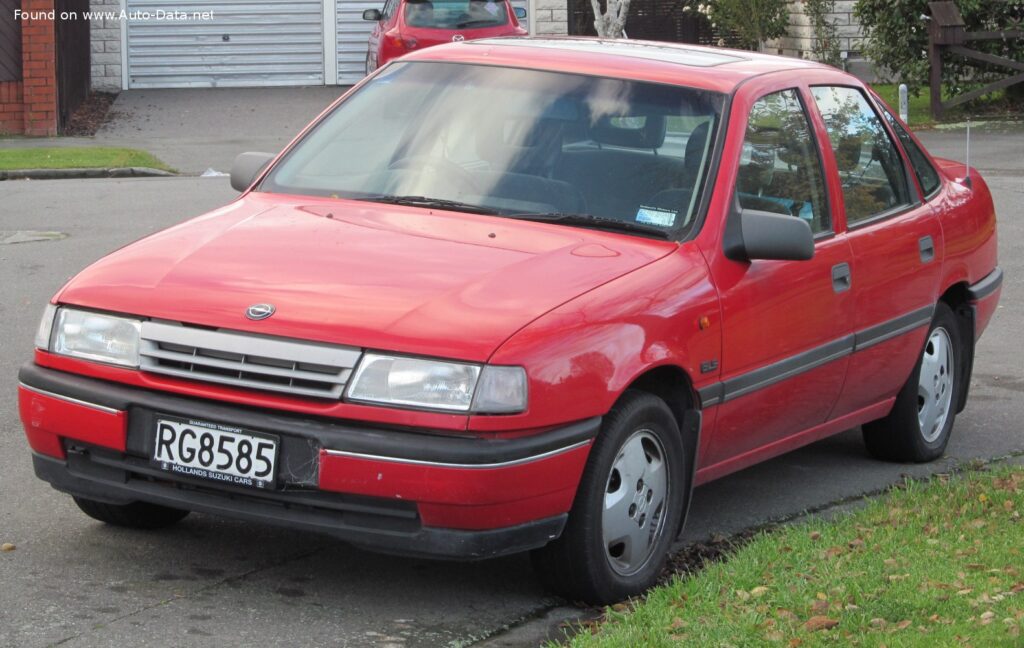
The Opel Vectra A 1.8 S (88 Hp) 4×4: A European Mainstay with All-Wheel Drive Ambition
The Opel Vectra A, introduced in October 1988, marked a significant chapter in the German automaker’s history, succeeding the popular Ascona. Positioned firmly in the European mid-size family car segment, the Vectra A was designed to compete fiercely against established rivals like the Ford Sierra and Volkswagen Passat. This particular variant, the Opel Vectra A 1.8 S (88 Hp) 4×4, represents an intriguing, albeit brief, foray into offering enhanced traction and stability in a mainstream sedan. Produced for less than a year, from October 1988 to June 1989, this all-wheel-drive model showcased Opel’s engineering efforts to provide a more versatile option for consumers, especially in regions prone to challenging weather conditions. While not sold in the United States, the Vectra A, under various guises, became a ubiquitous sight on European roads, embodying the practical, reliable, and increasingly sophisticated family car of the late 1980s.
Engine & Performance: The 1.8 S Powertrain with All-Wheel Drive
At the heart of the Opel Vectra A 1.8 S (88 Hp) 4×4 was Opel’s E18NVR engine, a naturally aspirated 1.8-liter (1796 cm³ or 109.6 cu. in.) inline four-cylinder unit. This powerplant, characteristic of its era, featured a single overhead camshaft (OHC) valvetrain and relied on a carburettor for its fuel injection system, a technology that was beginning to give way to more precise electronic fuel injection systems in the late 1980s but still prevalent in many entry-to-mid-level models.
The engine delivered a modest but respectable 88 horsepower at 5400 rpm, translating to a power-per-liter output of 49 horsepower. Torque figures stood at 143 Nm, or approximately 105.47 lb-ft, achieved at a relatively low 2800 rpm, indicating a powerplant designed for accessible low-end and mid-range grunt rather than high-revving performance. This characteristic made it well-suited for everyday driving and urban commutes.
Power was sent to all four wheels via a 5-speed manual transmission, a setup that was a notable differentiator for this Vectra variant. While all-wheel drive was becoming more common in higher-performance or specialized vehicles, its inclusion in a family sedan like the Vectra A 1.8 S was a significant engineering choice, aiming to provide superior grip and handling, particularly on slippery surfaces. The Vectra A 1.8 S (88 Hp) 4×4 could achieve a top speed of 173 km/h (107.5 mph). Its combined fuel consumption was rated at 8.2 liters per 100 km, which translates to an estimated 28.7 US miles per gallon, a reasonable figure for an all-wheel-drive sedan of its size and vintage. The engine oil capacity was 4 liters (4.23 US quarts), and the cooling system held 6.7 liters (7.08 US quarts) of coolant.
Design & Features: Practicality and Aerodynamics
The Opel Vectra A was offered primarily as a four-door sedan or a five-door hatchback (known as the Vectra A or Cavalier Mk3 in the UK). The Opel Vectra A 1.8 S (88 Hp) 4×4 specifically came in the popular sedan body style, designed for five occupants. Its exterior design was a departure from the more angular styling of its predecessor, the Ascona. The Vectra A adopted a sleeker, more aerodynamic profile, characterized by smooth lines and flush-fitting glass. This commitment to aerodynamics was evident in its remarkably low drag coefficient (Cd) of 0.29, which was highly competitive for its time and contributed to both fuel efficiency and reduced wind noise at speed.
Measuring 4432 mm (174.49 inches) in length, 1706 mm (67.17 inches) in width, and 1400 mm (55.12 inches) in height, the Vectra A provided ample interior space for a family sedan. The wheelbase of 2600 mm (102.36 inches) contributed to a stable ride and generous legroom for rear passengers. The trunk space was particularly impressive, offering a minimum of 530 liters (18.72 cubic feet), expandable to 840 liters (29.66 cubic feet) with the rear seats folded, making it a highly practical vehicle for family travel and cargo. The fuel tank capacity of 61 liters (16.11 US gallons) ensured a decent cruising range.
While specific interior features for the 1.8 S (88 Hp) 4×4 are not detailed, the Vectra A generally offered a well-appointed and ergonomically designed cabin for its class. Standard features would have included comfortable cloth seating, a functional dashboard layout with clear instrumentation, and basic amenities such as heating and ventilation systems. Safety features, by late 1980s standards, would have included three-point seatbelts for all outboard passengers and potentially an optional driver’s airbag in later models, though it’s less likely for this early 1988-1989 variant. The focus was primarily on passive safety through structural integrity rather than advanced electronic aids.
Technical Specifications: Opel Vectra A 1.8 S (88 Hp) 4×4
| Category | Specification | Metric / US Equivalent |
|---|---|---|
| General Information | ||
| Brand | Opel | |
| Model | Vectra | |
| Generation | Vectra A | |
| Type (Engine) | 1.8 S (88 Hp) 4×4 | |
| Start of Production | October, 1988 | |
| End of Production | June, 1989 | |
| Powertrain Architecture | Internal Combustion engine | |
| Body Type | Sedan | |
| Seats | 5 | |
| Doors | 4 | |
| Performance Specs | ||
| Fuel Consumption (combined) | 8.2 l/100 km | 28.7 US mpg |
| Fuel Type | Petrol (Gasoline) | |
| Maximum Speed | 173 km/h | 107.5 mph |
| Engine Specs | ||
| Power | 88 Hp @ 5400 rpm | |
| Power per liter | 49 Hp/l | |
| Torque | 143 Nm @ 2800 rpm | 105.47 lb-ft @ 2800 rpm |
| Engine Layout | Front, Transverse | |
| Engine Model/Code | E18NVR | |
| Engine Displacement | 1796 cm³ | 1.8 liters / 109.6 cu. in. |
| Number of Cylinders | 4 | |
| Engine Configuration | Inline | |
| Cylinder Bore | 84.8 mm | 3.34 in. |
| Piston Stroke | 79.5 mm | 3.13 in. |
| Compression Ratio | 9.2:1 | |
| Number of Valves per Cylinder | 2 | |
| Fuel Injection System | Carburettor | |
| Engine Aspiration | Naturally aspirated engine | |
| Valvetrain | OHC | |
| Engine Oil Capacity | 4 l | 4.23 US qt |
| Engine Oil Specification | Not specified | |
| Coolant Capacity | 6.7 l | 7.08 US qt |
| Space, Volume and Weights | ||
| Trunk (boot) Space – minimum | 530 l | 18.72 cu. ft. |
| Trunk (boot) Space – maximum | 840 l | 29.66 cu. ft. |
| Fuel Tank Capacity | 61 l | 16.11 US gal |
| Dimensions | ||
| Length | 4432 mm | 174.49 in. |
| Width | 1706 mm | 67.17 in. |
| Height | 1400 mm | 55.12 in. |
| Wheelbase | 2600 mm | 102.36 in. |
| Front Track | 1420 mm | 55.91 in. |
| Rear (Back) Track | 1423 mm | 56.02 in. |
| Drag Coefficient (Cd) | 0.29 | |
| Drivetrain, Brakes and Suspension Specs | ||
| Drive Wheel | All wheel drive (4×4) | |
| Number of Gears and Type of Gearbox | 5 gears, manual transmission |
Legacy & Market Impact: The Vectra A’s Role in Europe
The Opel Vectra A, and particularly the Opel Vectra A 1.8 S (88 Hp) 4×4 variant, played a specific role in the competitive European market of the late 1980s. While the standard front-wheel-drive Vectra A was a sales success, lauded for its reliability, practicality, and modern styling, the 4×4 variant aimed to carve out a niche for buyers seeking enhanced all-weather capability without stepping up to a dedicated SUV or a more expensive premium sedan from brands like Audi, which were also exploring all-wheel-drive technology at the time.
Opel faced stiff competition from domestic rivals such as the Volkswagen Passat B3 and the Ford Sierra, both of which also offered robust, family-oriented sedans and wagons. The Passat, with its transverse engine layout and available syncro (all-wheel-drive) system, was a direct competitor to the Vectra A 4×4. Ford’s Sierra, especially in its later iterations, also featured capable powertrains and a solid reputation. Other European contenders included models from Peugeot (like the 405) and Renault (like the 21), which emphasized comfort and distinctive styling.
The relatively short production run of the 1.8 S (88 Hp) 4×4 variant (less than a year) suggests that while technically innovative for Opel, it might not have achieved the widespread market penetration or sustained demand that the standard front-wheel-drive models did. This could be attributed to a combination of factors: the added cost and complexity of the all-wheel-drive system, the slightly reduced fuel economy compared to 2WD variants, and perhaps a market that wasn’t yet fully ready to embrace all-wheel drive in a mainstream family sedan as a necessity rather than a niche feature.
Despite its limited production, the Vectra A 1.8 S (88 Hp) 4×4 remains an interesting footnote in Opel’s engineering history. It demonstrated Opel’s willingness to experiment with advanced drivetrain technologies in its volume models, paving the way for future generations of all-wheel-drive vehicles from the brand. The Vectra A itself was a commercial triumph for Opel, selling millions of units across Europe and other international markets, including being rebadged as the Vauxhall Cavalier in the UK and Holden Apollo in Australia. Its legacy is one of a dependable, aerodynamic, and spacious family car that effectively moved Opel into a new era of design and engineering in the late 1980s. The 4×4 variant stands as a testament to the brand’s quiet ambition to offer more than just the conventional.
